The Ultimate Guide To Stealing Your Competitors’ Backlinks Using Curated Resource Lists
Oct 15, 2026
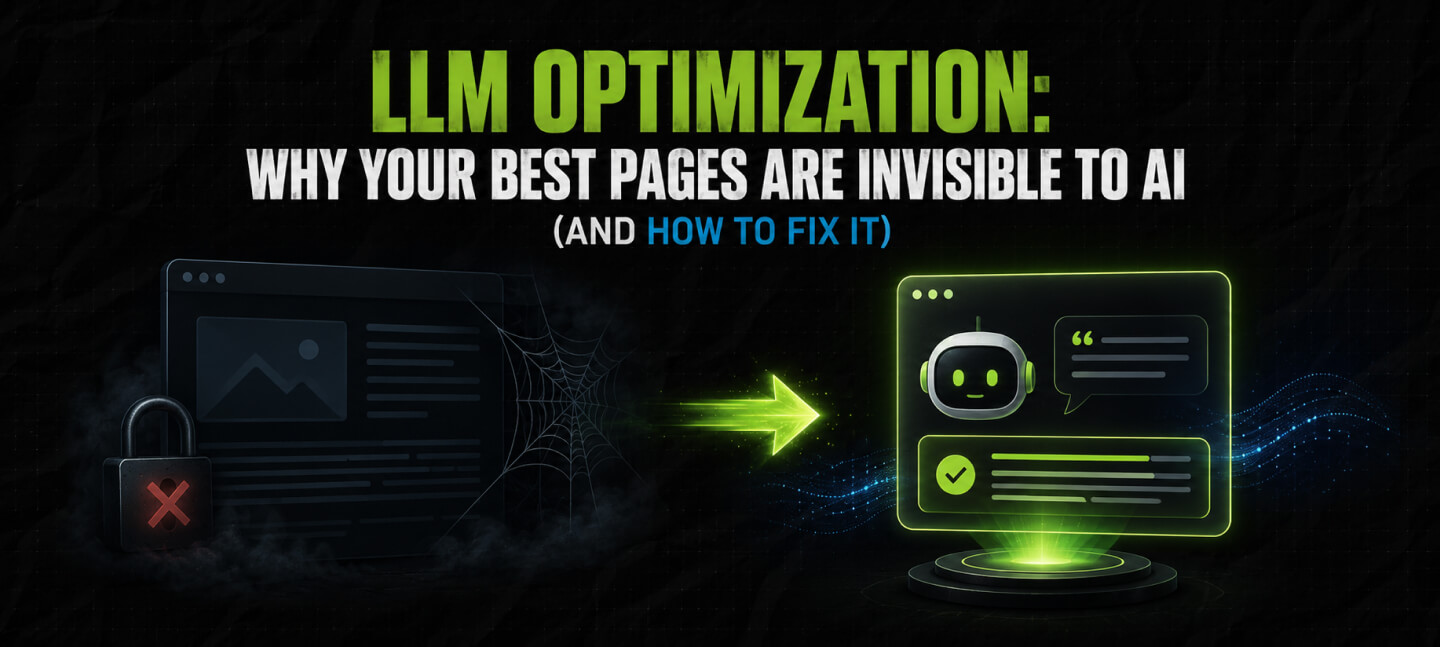

TBH, the uncomfortable truth that nobody wants to deal with is that a page can rank on Google’s first page and still be completely invisible to ChatGPT, Claude, and Perplexity.
And not just ranked low, but invisible. The bot fetched your URL, got a blank shell, and left.
Most articles on LLM optimization skip straight to writing advice: answer-first structure, cite your sources, add schema. That advice is fine.
But it treats the whole problem as an editorial one, and a large slice of the problem isn’t editorial at all. Rather, it’s mechanical.
Before an AI can decide whether your content is good enough to cite, it has to be able to read it – A surprising number of sites fail at that first step without ever knowing.
So this piece is built in the order the machine actually experiences your page: can it fetch you, can it read you, can it extract you, and only then does it trust you.
Get the order wrong, and you spend months polishing prose that no model will ever see. And that is precisely why I’m here to break down LLM optimization for you – that way you will understand why your best pages are invisible to AI, and how to fix it.
Stay tuned.
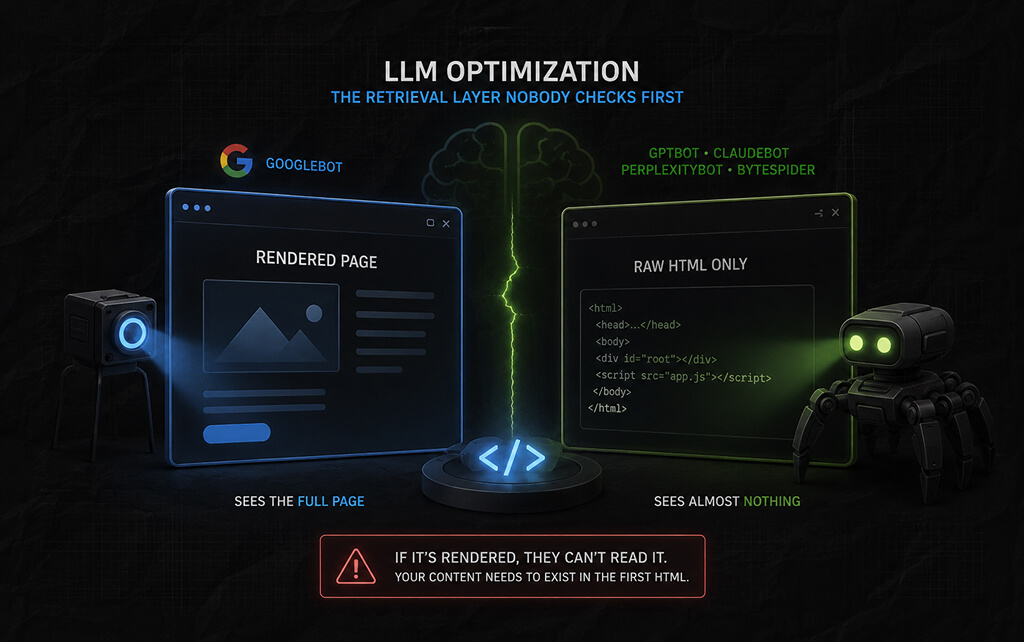
Googlebot runs a headless Chromium browser. It executes your JavaScript, waits for content to load, and indexes what the page becomes.
That capability took Google years to build, and it is genuinely good.
Also, note that it’s so good that in March 2026 Google quietly dropped its old warning about keeping pages functional without JavaScript – it trusts its own renderer that much.
AI crawlers are not Googlebot, and this is the trap. As of June 2026, none of the major AI crawlers render JavaScript.
Of course, this includes GPTBot, OAI-SearchBot, ChatGPT-User, ClaudeBot, Claude-SearchBot, PerplexityBot, Meta-ExternalAgent, and Bytespider.
So, when one of them fetches your page, it takes the raw HTML your server returns and nothing more – No script runs or ccontent loads in a second pass.
Whatever text sits in that first response is everything the model will ever get from you.
The evidence here is not a hunch.
Lantern’s analysis, working from a Vercel crawl-behavior study of more than 500 million GPTBot fetches, discovered no proof of JavaScript execution across the entire sample.
And the detail that makes it sting: GPTBot downloads JavaScript files roughly 11.5% of the time — it requests them, receives them, and then does nothing with what’s inside.
The file arrives. The content inside it may as well not exist.
Now, if your site is a React or Vue single-page app that builds its content in the browser, this is your problem whether you feel it or not.
A React SPA can rank well on Google while being entirely blank to every other AI crawler. Also, you are optimizing for a race half your competitors’ judges can’t watch.
There is a thirty-second test for this, and I’d run it before reading another word of GEO advice.
If the sentence is there, AI crawlers can read you.
However, if all you see is an empty div and a stack of script tags, your content is being assembled client-side, and to GPTBot and its siblings, your page is a loading spinner.
As a result, the fix is a server engineering decision, not a writing one: serve your critical content in the initial HTML through server-side rendering, static generation, or hydration.
Dynamic rendering – detecting the bot and serving it a special version – is a workaround Google itself has long discouraged.
So reach for real SSR instead.
| One nuance worth knowing, because it saves panic: content doesn’t have to be visible prose to count – data embedded in the initial HTML as inline JSON or structured-data markup is still in the raw response and readable by AI crawlers. What they miss is specifically the content your browser builds after load. |
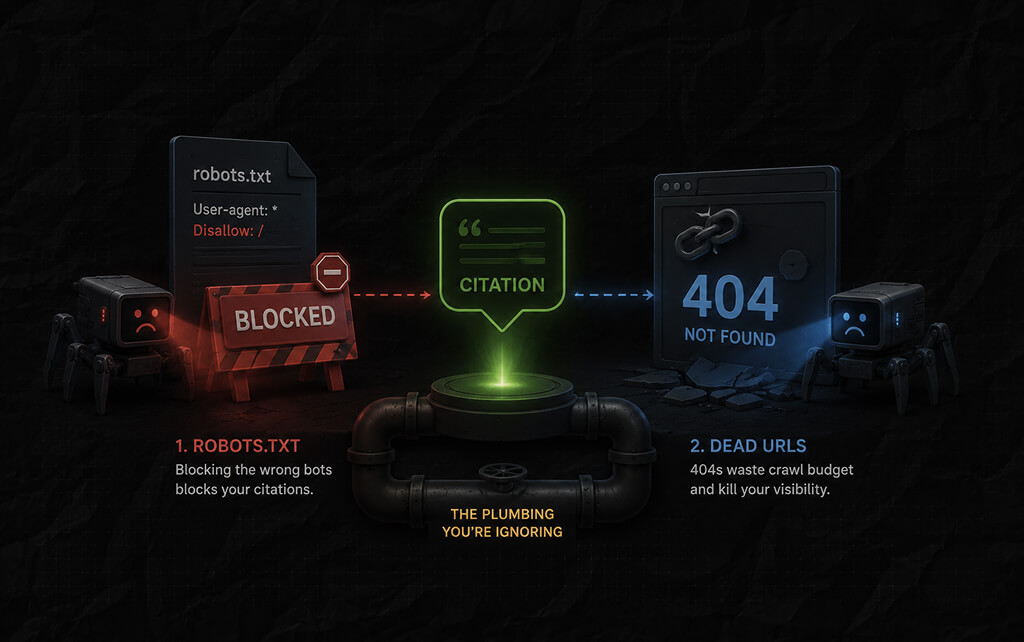
Two more mechanical failures quietly burn your citations, and neither has anything to do with how well you write.
The first is robots.txt.
Somewhere around 2023, a lot of teams added a block-every-AI-bot list to keep their content out of training runs.
While that was reasonable at the time, the problem is that the same list often sweeps in the retrieval crawlers, alongside the training ones.
Those are independently controllable, and most teams never made the distinction deliberately.
So, if you want to be cited but not trained on, that’s a specific, allowed configuration because blanket-blocking everything means you opted out of the answer economy by accident.
The second is dead URLs.
AI crawlers get a fixed, limited amount of attention on your site, and a meaningful share of their fetches end in 404s from stale sitemaps and broken internal links.
Every fetch spent on a URL that returns nothing is a crawl budget not spent on a page you actually want cited.
So, use the GREP command for your server logs in the context of GPTBot, ClaudeBot, OAI-SearchBot, and PerplexityBot.
Then, look at the status codes they’re getting, and clean up the ones ending in 404. I know it’s unglamorous, but it always works without fail.
None of this is exciting.
All of it is the difference between being readable and being a blank page to the fastest-growing discovery channel on the web.
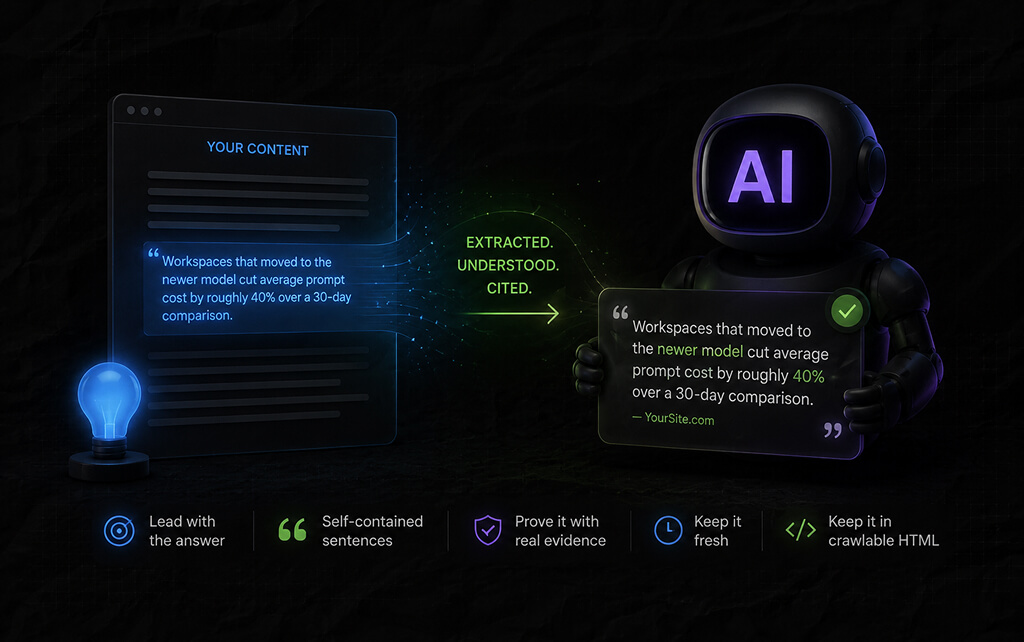
Once a model can fetch and read you, the editorial layer starts to matter, and here the advice converges across every credible source into a single principle: write content that survives extraction.
An AI answer is stitched together from fragments pulled out of many pages. So the question isn’t “is my article good?”
Instead, it’s “does a single sentence from my article still mean something when it’s lifted out and dropped into an answer with no surrounding context?”
That reframing changes how you write. Remember that self-contained sentences win.
A line like “this approach works well in production” is unciteable. So, pull it out, and it says nothing.
Similarly, a line like “workspaces that moved to the newer model cut average prompt cost by roughly 40% over a 30-day comparison” carries its own meaning anywhere it lands.
Why? Because it’s specific, quantified, and standalone. As a result, the model can extract it and trust it in one move.
The structural habits that follow from this are straightforward. So, you need to lead each section with the answer, then add the evidence.
Don’t bury the conclusion under three paragraphs of throat-clearing.
Also, use headings that match how people actually phrase questions, while keeping your important claims in crawlable HTML rather than locked inside a script.
And support factual claims with real proof, because AI systems increasingly cross-reference what you say against a wider consensus before repeating it.
Additionally, if your number disagrees with the number on a canonical source, the model tends to trust the canonical source and quietly drops you.
This is also where freshness earns its keep.
Retrieval systems favor pages they can tell are current, so broadcasting updates through sitemaps and clear timestamps genuinely affects whether you’re the source chosen for a given answer.
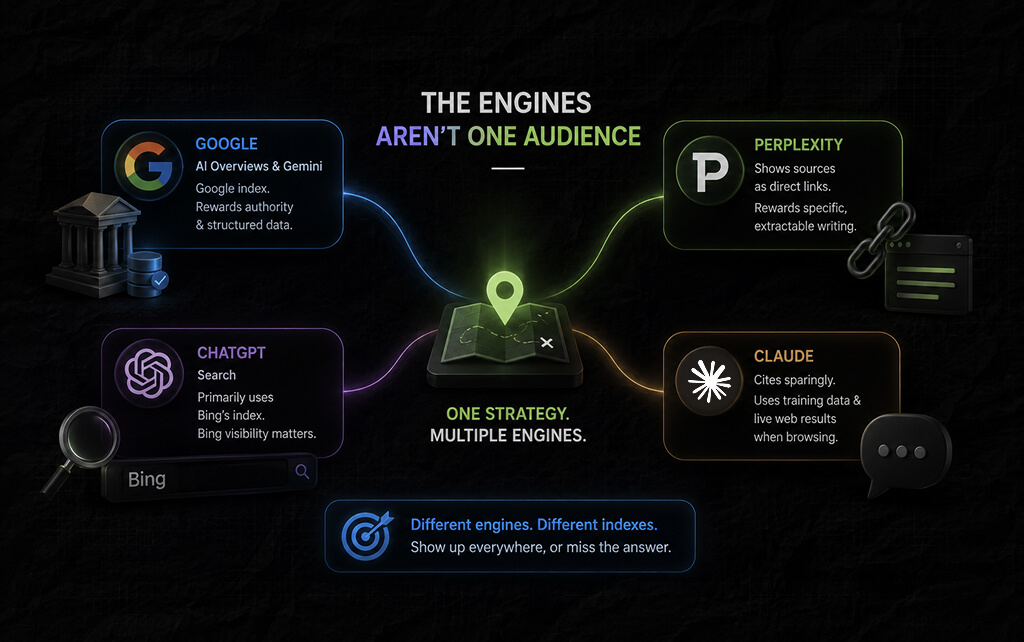
It’s tempting to treat ‘AI search’ as a single target, but the engines pull from different places, and knowing where changes what you prioritize.
Google’s AI Overviews and Gemini draw from Google’s own index and lean toward established publishers and structured data.
The good news here is that your existing SEO investment largely transfers – the same authority and markup that help you rank tend to help you get pulled into an Overview.
On top of that, ChatGPT’s search feature is a different animal: a large majority of its responses lean on Bing’s index rather than Google’s, which means Bing visibility, not just Google visibility, quietly becomes part of your LLM strategy.
Perplexity shows its sources as direct links and rewards specific, extractable, well-structured writing.
Claude in chat cites more sparingly by design, pulling from training data and, when browsing is enabled, live web results.
The practical read on all this: the common thread across every engine is structured, specific, citation-friendly writing, so that’s where your effort compounds.
The main thing that diverges is the index each engine trusts. You don’t need four separate content strategies.
So, you need one solid one, plus an awareness that ceding any single engine cuts your reach in a channel where source overlap between engines is already low.
Losing one isn’t losing a quarter of your visibility on a given answer. It can mean losing that answer entirely.
Also, in this context, understand that measurement is the last honest gap worth naming. There is no Search Console for AI citations yet.
The current state of the craft is prompt-based monitoring.
So, just run a fixed set of real buyer questions across ChatGPT, Perplexity, Gemini, and the rest every week or two, and record whether you show up.
Also, pair that with GA4 configured to surface referral traffic from AI platforms, and Search Console’s own reporting on visibility from Google’s generative features.
It’s coarser than the SEO dashboards you’re used to, and citation traffic rarely climbs in a straight line.
Instead, it spikes when an engine picks you up and dips when the answer rotates to someone else. So, track it anyway – you can’t improve what you refuse to look at.
The reflex objection is that this is a lot of effort for a channel that’s still small. Two things push back on that.
First, the traffic quality is not small. Lantern’s monitoring shows AI-referred visitors converting at 14.2% versus 2.8% for standard Google clicks.
Someone arriving from an AI answer has usually already had their question framed and their options narrowed; they land closer to a decision. Fewer visitors, but each one worth several of the old kind.
Second, and more sobering: almost nobody is showing up at all.
One August 2026 audit found that 94.8% of sites checked never appeared in AI assistant answers, drawn from testing 193 sites against nearly 6,000 answers across ChatGPT, Claude, Gemini, and Perplexity.
That’s not a crowded field you’re fighting to break into. It’s a wide-open one that most of your competitors haven’t figured out yet.
And, if the JavaScript problem is as common as the crawl data suggests, one many of them can’t enter until they fix their plumbing.
That’s the real shape of LLM optimization in 2026. The writing advice is real, and you should follow it.
But the leverage — the part your competitors are sleeping on — sits underneath the writing, in whether the machine can read the page at all.
As a result, you need to fix the retrieval layer first. Then make the words worth extracting. Ultimately, doing it in that order is the whole game.
Barsha is a seasoned digital marketing writer with a focus on SEO, content marketing, and conversion-driven copy. With 8+ years of experience in crafting high-performing content for startups, agencies, and established brands, Barsha brings strategic insight and storytelling together to drive online growth. When not writing, Barsha spends time obsessing over conspiracy theories, the latest Google algorithm changes, and content trends.
View all Posts

The Ultimate Guide To Stealing Your Competito...
Oct 15, 2026
Beyond The Basics: Master Guest Posting For H...
Oct 15, 2026
Best Generative Engine Optimization (GEO) Com...
Oct 14, 2026
Digital PR for Link Building: How To Earn Hig...
Oct 13, 2026
Cracking The Code Of The Social Media Saga Si...
Oct 13, 2026