
The Traffic-to-Revenue Gap: Why More Website Visitors Don’t Always Create More Customers
Sep 17, 2026
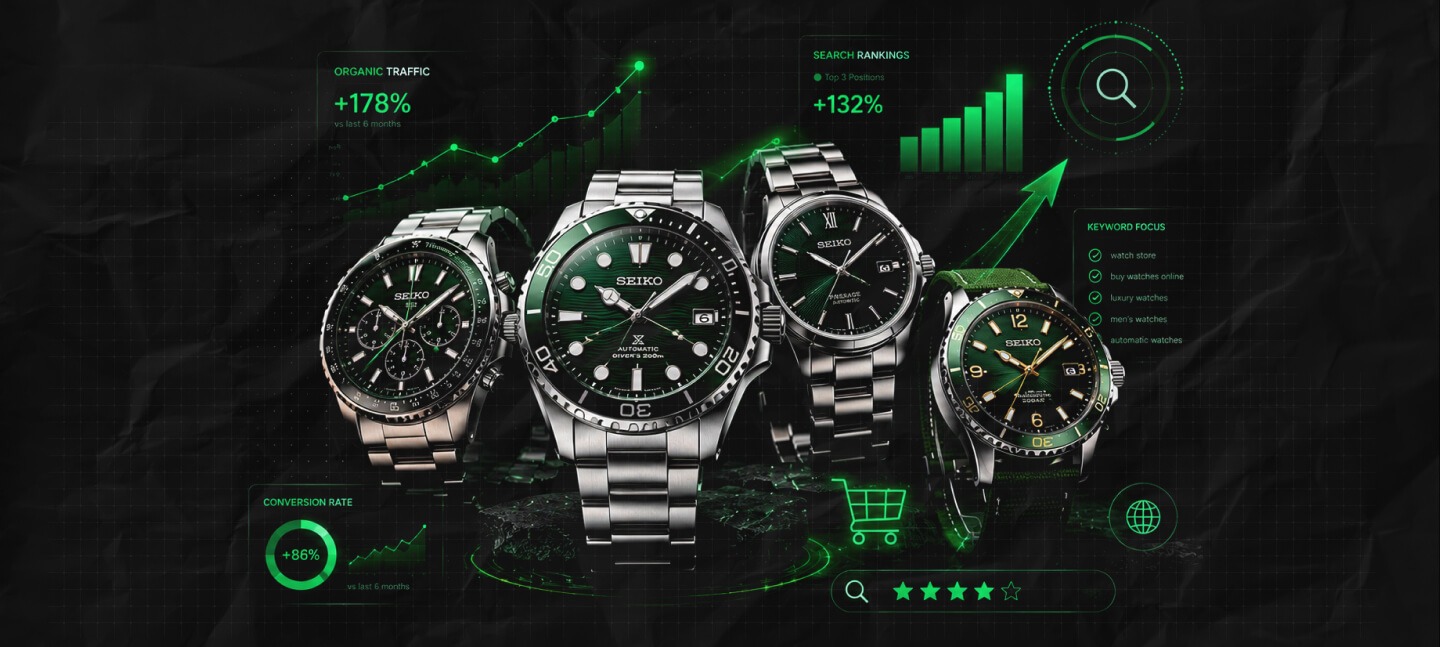

Anyone working in watch retail often encounters a specific SEO challenge – multiple product pages with hundreds of variants, thin text, and picky buyers who heavily research before any purchase.
And that is precisely why I’m here – with my in-depth guide on SEO for watch retailers – to highlight keyword mapping, product-schema, revenue tracking, and building content clusters.
Stay tuned.
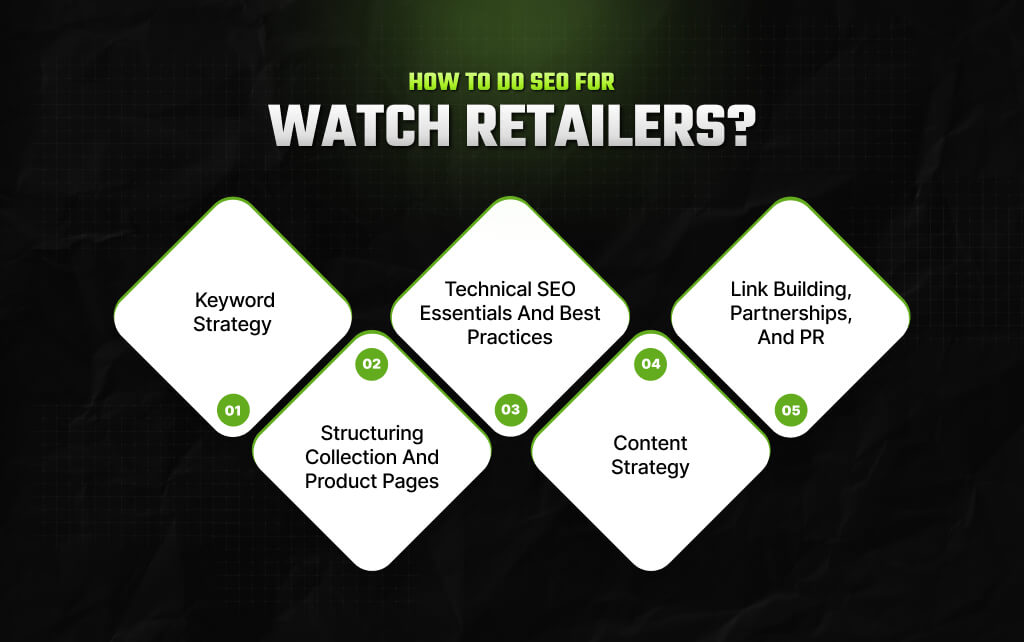
In this section, I’ve discussed how to do SEO for watch retailers in detail.
In my experience as an SEO and content professional for eight years, I can tell that seed keywords in the watch retail industry usually have three things:
In that case, typical seed keywords would be like “Rolex pilot watch,” “Omega dive watch,” or “Browse Seiko models in green.”
Take these seed keywords and then expand them with modifiers like material (titanium), price band (luxury, under $4oo), and size (50mm).
This is because commercial intent commonly shows a higher cost per click. As a result, it is only expected that brand + model numbers or ‘buy’ will have CPCs in the range of $1.50 and $5 – and this can vary as per markets.
Also, generic informational search queries like ‘how to fix a luxury watch without spending much’ will have a low cost per click but high value in terms of discovery.
Additionally, I’ve shown below how the keyword mapping will look:
| Page | Description |
|---|---|
| Product Pages | SKUs, “buy [brand] [model],” exact model numbers. |
| Category/Collection | style + attribute filters (e.g., “women’s pilot watches 50mm). |
| Content Pages | Comparisons, maintenance instructions, and buying guides. |
This is basic – your product pages have to be a balance of content that is crawlable and content that ensures conversions.
In that case, here’s how your content should ideally look:
Additionally, ensure that product schema fields include
| Template | Conversion Impact | Image Needs | SEO Value | Structured Data Complexity |
|---|---|---|---|---|
| Hybrid (tabs) | Balanced discovery and conversion | 4 to 6 images + thumbnails | Medium-high | Medium with schema in the visible areas |
| SEO + Long-form Sales | High for non-branded discovery | 6 to 10 high-resolution images | High with good keyword coverage | High with complete product and reviews |
| Minimalist | Simple buy flow + high speed | 2 to 3 optimized images | Organic discovery is low | Low with basic offers |
The top technical benchmarks and KPIs that watch retailers need to consider are as follows:
| Technical KPI | Target |
|---|---|
| TBT goal | Lowest feasible for smooth interactivity |
| CLS target | <0.1 |
| LCP target | <2.5s |
Moreover, you need to measure and track image payloads per page – and while doing so, use the lazy-loading feature for any below-the-fold media.
Also, take into consideration the different conversion trade-offs. So, you can deter loading your boost speed, but ensure you are testing to find out that image placeholders don’t end up hurting the confidence of buyers.
Pillar content with relevant clusters is good for both purchase intent and discovery. On that note, here’s an example of a content pillar with clusters:
Pillar Content: The Ultimate Guide To Buying Luxury Watches.
Cluster Content:
Naturally, each pillar content should be comprehensive, helpful, and conversion-focused. Moreover, ensure it has between 2000 and 2500 words.
Plus, cluster posts should be between 900 and 1400 words. Also, these should ideally link to the pillar and answer specific search queries.
My research shows that authoritative, long-form content always increases the potential for backlinks and featured snippets. Also, for the academic context and backing decision-making for online purchases, you can check out relevant studies from Harvard Business School.
Scalable and sustainable content types for most watch sellers:
High-quality backlinks remain one of the strongest ranking signals in search. For watch retailers, however, the goal shouldn’t be acquiring as many links as possible.
The focus should be on earning links from relevant websites that potential customers actually trust.
The most successful link-building strategies in the watch industry focus on expertise, credibility, and genuine relationships. A handful of relevant, high-authority links from trusted industry sources will typically deliver more SEO value than dozens of low-quality backlinks.
Barsha is a seasoned digital marketing writer with a focus on SEO, content marketing, and conversion-driven copy. With 8+ years of experience in crafting high-performing content for startups, agencies, and established brands, Barsha brings strategic insight and storytelling together to drive online growth. When not writing, Barsha spends time obsessing over conspiracy theories, the latest Google algorithm changes, and content trends.
View all Posts

The Traffic-to-Revenue Gap: Why More Website ...
Sep 17, 2026
The Volatility Trap: What Crypto Position Siz...
Sep 17, 2026
Schema Markup: How To Use It Without Turning ...
Sep 17, 2026
Turn A Search Question Into A Watchable Expla...
Sep 16, 2026
Agency Guide To YouTube Growth: Wholesale Pri...
Sep 15, 2026