How To Track Brand Citations In ChatGPT And Perplexity?
Apr 30, 2026

Among all the search engines out there, Google’s search engine is the most potent in getting the most traffic.
This is because the intuitive Google algorithm helps rank your website by locating the keywords you used in your content. Ultimately, Google decides the ranking of a webpage based on several factors.
The algorithms of the Google search engine are not consistent. This is because Google keeps updating the algorithm quite often.
The updates may occur twice or thrice a year. Although the minor updates go unnoticed, whenever Google makes any significant change in the algorithm, they announce it.
For instance, page speed on desktops has been a ranking factor for any web page since 2010. The same started to apply to mobiles in 2018.
In addition, there are many other ranking factors that Google keeps updating each year.
So, what is a Google algorithm update? How often does Google change its algorithms? How do the Google algorithm updates affect the web pages?
If you want answers to questions like this, you can follow this article.
In this article, I have discussed the google algorithm updates and how the Google algorithm updates and how major Google algorithm updates can affect the websites’ ranking.
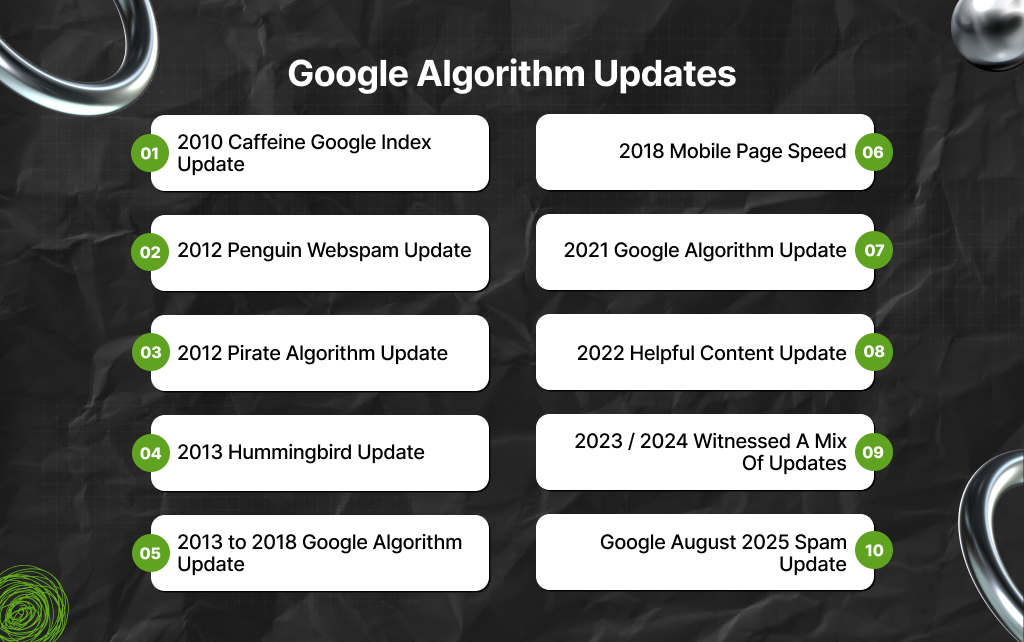
The Google algorithm is a complex system that retrieves data from the search engine’s search index and delivers instant results for a specific keyword-driven query.
Numerous ranking factors and the combination of the algorithms rank a web page in the SERPs. As mentioned earlier, Google keeps changing these ranking factors every year.
As a result, it is simple, really. Google algorithm updates mean a change in the Google search engine.
Google updates its algorithm for search quality improvement, the relevance of search results, and boosting the overall user experience of searchers.
Ranking factors such as the page speed are called Core Web Vitals. Google has passed several milestones in terms of updating the Google search engine.
Here, I have put down a brief history of the Google algorithm updates.
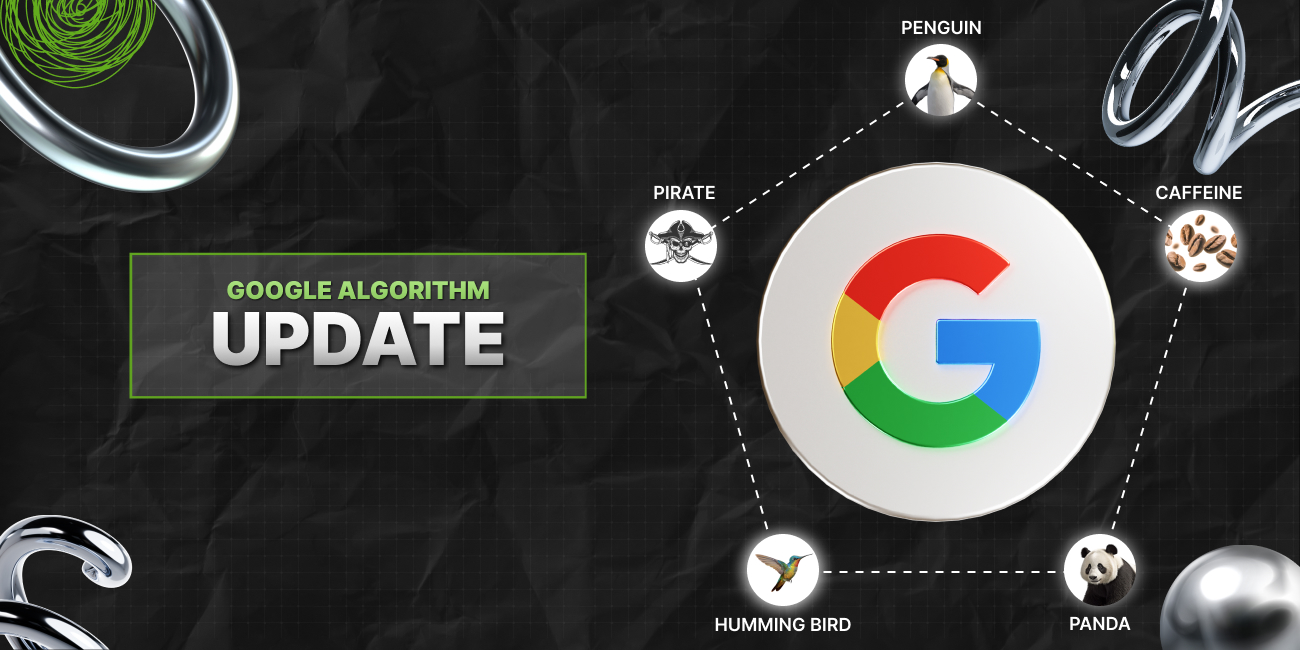
In June 2010, Google introduced the caffeine Google index update. The intent was to speed up the process of showing search results.
As a result, the users could get faster results for their web searches, and the content publishers could see their web pages.
The Google index update made it easier for Google to crawl and store data more efficiently.
According to statistics, the Caffeine update started to provide 50% faster web search results than before.
Google introduced this update to speed up the process of web searches to meet the increasing number of web searches in the world.
In addition, Google announced site speed as a ranking signal for ranking a site in the SERP.
The Penguin algorithm updates, or, as Google puts it, “webspam algorithm updates,” came in 2012. Google intended to target websites with webcams and websites that used manipulative link-building tactics.
In 2012, Google made it possible to identify the links to determine whether they are going back to a genuine or a spammy website.
The result decreased the organic traffic of those websites with high volume, but the low quality of poor links.
Also, in 2012, Google rolled out another Google algorithm update. The pirate algorithm update came out to prevent the infringement of copyrighted content available on some websites.
Many websites contain pirated files of copyrighted content, which is against the law.
Google realized that piracy was indeed a prohibited act. So they rolled out the Pirate Algorithm update to identify the sites reported for violating the Digital Millennium Copyright Act.
Once Google finds out such websites with pirated copyrighted content, they can severely decrease their organic ranking.
What is the Google algorithm update? Once you know the answer, you know how important the search intent is.
In 2013, Google introduced the Hummingbird update, impacting the user experience on the Google search engine.
The hummingbird update helped Google to understand the search intent of the users. The search intent of the web searchers is one of the critical factors for ranking a page in the SERP.
The update enabled Google to find relevance between the searched topic and the search result.
As a result, the users started to find more relevant content according to the keyword they used for searching.
In the 2013 Google algorithm update, Google focused on improving the local searches with the pigeon update.
In 2014, with the HTTPS/ SSL update, Google focused on the security aspect of the internet.
Since most of the online searches are done using a mobile phone, Google gave importance to the mobile-friendliness of a website through the 2015 Google algorithm update.
In 2015, Google used machine learning and artificial intelligence in its RankBrain algorithm update. The update puts a query through an interpretation to determine the most relevant search result for a specific search. As a result, SEO experts keep tracking RankBrain Google algorithm updates.
In 2016, Google introduced the Possum Google algorithm update to improve the local search results.
Another important Google algorithm update came out in 2018. The Mobile page speed update of 2108 set a new ranking signal.
The pages optimized for better speed on mobile devices are now qualified to rank higher in the SERP.
Google’s “Speed up the internet” and the “Mobile-first” initiatives profited greatly from this update.
In addition, as a result of this Google algorithm update, the user experience on mobile became better and faster.
Google released three core updates in 2021. In June, July, and November, Google released three core updates back to back. In addition, there were two product review updates as well.
In June of 2021, the Google core algorithm update brought the Page Experience Update for mobile devices. In late November of 2021, Google also announced a Local search update.
According to the page experience update, Google will prioritize Security, mobile-friendliness, safe browsing, and minimum page loading speed to rank a webpage on the SERP.
Google’s Helpful Content update in 2022 targeted unoriginal, low-quality content that was specifically designed to manipulate rankings on search engine result pages.
In contrast, the update rewarded sites that created people-first, helpful content consistently – this includes content pieces that genuinely answered search queries, offering an overall satisfying user experience.
As a result, websites featuring multiple pieces of shallow and unhelpful content witnessed a significant drop in ranking and traffic.
However, the sites that created user-centric, valuable content could benefit from the update.
Moreover, this update was able to reinforce the significance of creating content with a site’s target audience in mind and not for manipulating search engines.
From 2023 to 2024, the search engine giant rolled out several updates – a mix of spam and core algorithm updates with the sole purpose of improving search quality.
Moreover, this was also Google’s attempt to combat manipulative methods and black hat SEO.
As a result, while core updated prioritized content evaluation methods and rewarded pages featuring credible and high-quality information, spam updates targeted black hat tactics such as spammy backlinks, low-quality content written with AI, and keyword stuffing.
These sorts of changes ensured Google’s priorities are reinforced: surfacing user-focused, helpful content while penalizing different manipulative tactics that were fooling search results.
With this update, Google went after anything that was abusing the reputation of a website – this includes all types of black hat SEO, including Parasite tendencies.
FYI, parasite SEO involves the use of trusted website domains for hosting unrelated third-party pieces of content, such as casino reviews or payday loans, for manipulating search rankings.
Any website that was caught violating this Google policy risked manual penalties, which, in turn, required noindexing or removing bad content for recovery.
However, any legitimate usage of third-party content pieces – like user-generated material or syndicated news – is still allowed when managed properly.
The August Spm update actually touched down very fast. As a result, websites that came under attack from this update witnessed results immediately within 24 hours.
Yep, it literally hit very fast and very hard. Then, in September, the update made a comeback, with many websites that had been previously hit witnessing significant recoveries.
And my website was one of those sites – what a confusing period of time for us in this industry.
When someone hits the browser’s “back” button, they’re trying to do something simple: to go back to where they just were.
Back button hijacking disrupts that basic expectation. It happens when a website interferes with normal browser behavior and blocks users from returning to the previous page.
Instead, they might get redirected to pages they never opened, shown unwanted recommendations or ads, or simply prevented from navigating the web the way they intended.
Google prioritizes user experience above all else. Back button hijacking disrupts how browsers are meant to work, breaks the natural flow of navigation, and leaves users feeling frustrated.
Many people say it makes them feel misled, and over time, less likely to trust or revisit unfamiliar websites.
Google has previously made clear that adding deceptive or manipulative entries into a user’s browsing history goes against Google Search Essentials.
Also, Google has noticed this behavior becoming more common. That’s why it’s now being formally classified as a violation under our malicious practices policy.
FYI, this defines such behavior as anything that creates a gap between what a user expects and what actually happens, often resulting in a misleading experience or putting user privacy and security at risk.
Websites that engage in back button hijacking may face manual penalties or automated ranking drops, both of which can negatively affect their visibility in search results.
To give site owners time to adjust, this policy is being announced two months ahead of enforcement, which begins on June 15, 2026.
Barsha is a seasoned digital marketing writer with a focus on SEO, content marketing, and conversion-driven copy. With 8+ years of experience in crafting high-performing content for startups, agencies, and established brands, Barsha brings strategic insight and storytelling together to drive online growth. When not writing, Barsha spends time obsessing over conspiracy theories, the latest Google algorithm changes, and content trends.
View all Posts
How To Track Brand Citations In ChatGPT And P...
Apr 30, 2026
Step By Step Plan To Reach 10K Followers With...
Apr 30, 2026
MIXX.com 2026 Review Explaining Why It’s St...
Apr 30, 2026
The Surprising Correlation Between Follower C...
Apr 30, 2026
Imagen AI Profile Building Vs VSCO Film Packs...
Apr 30, 2026