The Keyword With 10 Searches That Sent Ahrefs Thousands Of Visitors
Sep 24, 2026
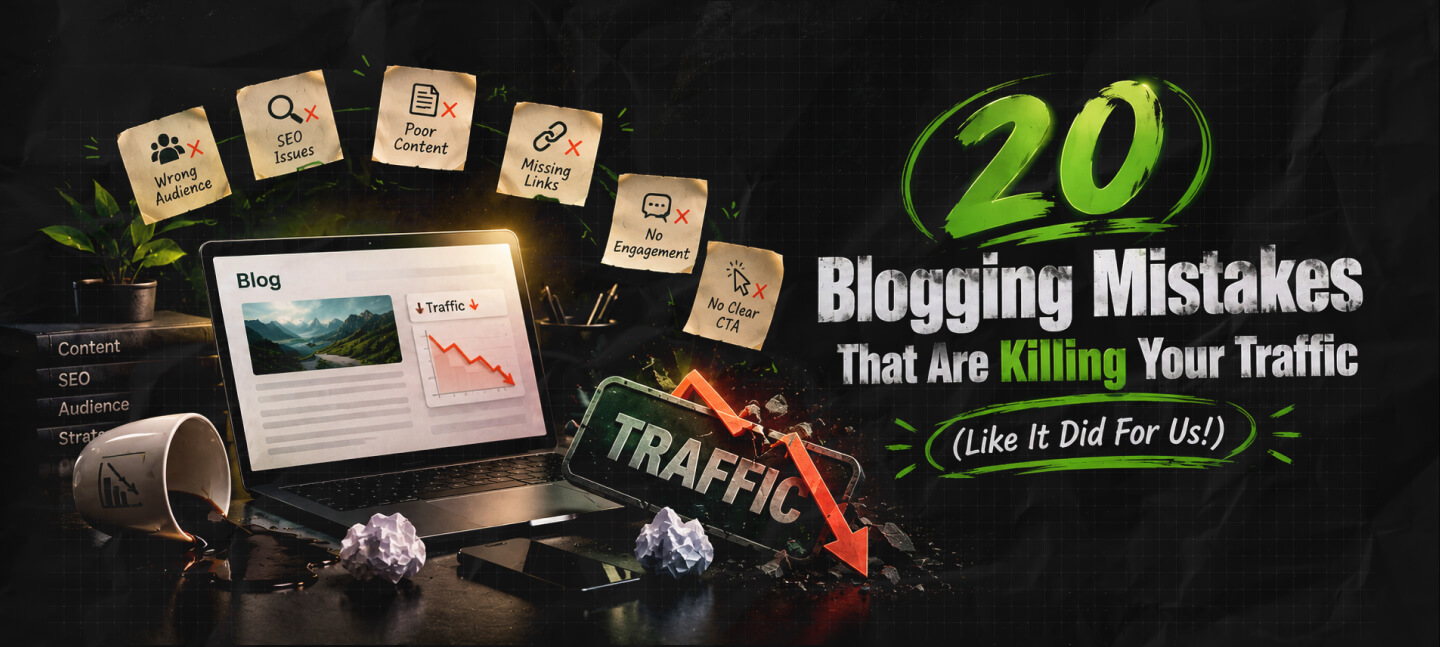

To be honest, I’ve made absolutely all possible blogging mistakes over my decade-long experience – I have been blogging for 10 years now.
And that’s truly long enough to make every possible fatal mistake that can kill your traffic.
In the past decade, I learned what works, what doesn’t work, and more importantly, which mistakes end up killing your traffic silently.
It is super easy to overlook small things when you are in charge of just too many things. But these small errors usually end up becoming a big deal. For instance, this blog did really well till we got hit by the 2024 March Update.
After the update, I worked on Search Engine Magazine for nine months before I witnessed any traction on that site. And then the site did really well for almost two years before getting hit by the recent Spam Update – the one Google rolled out on 18th August.
Standing proudly at 1.5K organic traffic, I am here to take back my site to 30K like it was only two weeks back.
Based on my experience with recovering websites hit by Google updates, I decided to break down all the fatal blogging mistakes that are silently killing your traffic.
Also, I’ve highlighted all possible solutions for each of your problems.
Stay tuned.
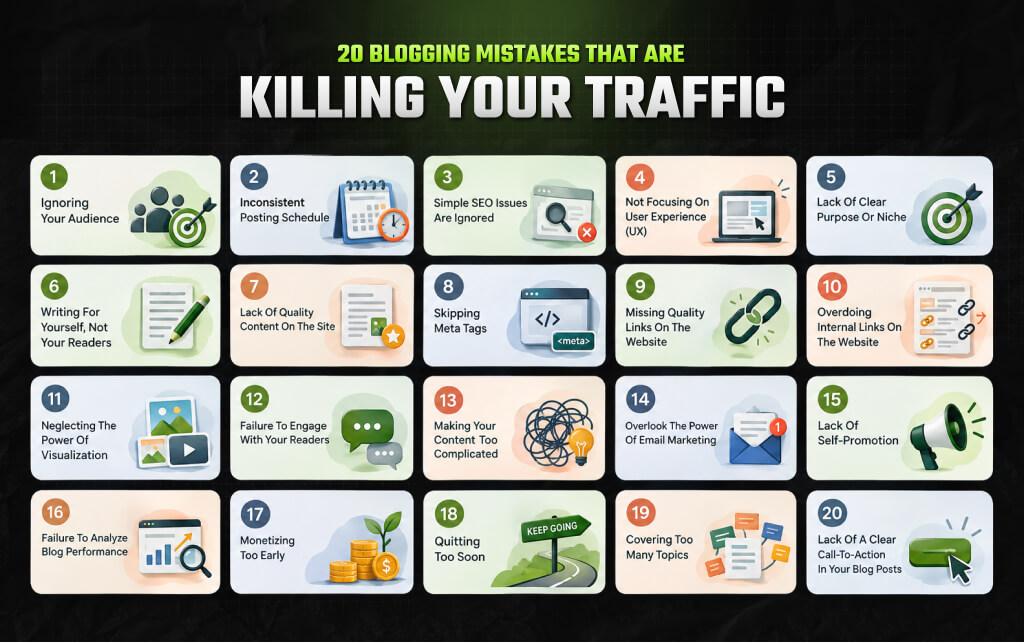
So, here I am with the 20 most fatal blogging mistakes that are killing your traffic slowly. And these are not mistakes I read about on the internet.
Instead, these are mistakes I’ve made on my blogs – these are the mistakes that impacted my sites, including Search Engine Magazine.
And based on my experience, here’s an honest breakdown of all possible blogging mistakes that you need to stop making ASAP!
One of the biggest mistakes bloggers make is needing to understand their audience. Blogging without knowing who you’re writing for can result in irrelevant or unengaging content.
Whether you’re blogging for personal branding or business growth, understanding your target audience is essential for creating content that resonates with them.
Define your audience before even beginning to write. Recall their age, gender, interests, pain points, and what solutions they are looking for. Use this information to channel your content strategy so that whatever you write will impact them meaningfully.
Consistency is the key to audience engagement. Posting erratically or abruptly abandoning your blog for weeks or even months will disillusion readers into no longer waiting around for your next post. This affects your Google rankings as well.
Create a content calendar and post consistently. Whether it’s weekly, biweekly, or monthly, set up when you’ll be posting new content, so your audience knows when to check back in. That also means that search engines know your site is active, which could improve your SEO.

One of the most important aspects of your blog: if you fail to optimize your posts, you are likely to have your content buried inside a search engine’s results pages; it becomes really hard for potential readers to find you.
Do your basic research and apply appropriate SEO techniques, such as optimizing your blog posts for the most relevant keywords, meta descriptions, and getting those SEO-friendly URLs.
This should also be top-notch, readable content with a decent structure through headers, bullet points, and proper usage of internal/external links.
Customers will only exit if your blog is unclear and unattractive. A bad user experience contributes to high bounce rates and ultimately harms your blog’s performance. A clear, easy-to-navigate layout and fast-loading pages are essential to keep users interested.
Invest in a clean, responsive design that makes it easy for readers to navigate your site from any device.
Ensure that your pages load quickly; your blog has to be mobile-friendly. Use simple, clear menus and organize content in such a way as to ensure that users find what they want.
Content without a niche is unlikely to attract or retain audiences. If you create too much content on too many niches, it becomes too broad, so no one group is appropriately attracted to your content.
This, therefore, focuses you on attracting the right audience and builds authority in your area of expertise.
Define a niche for yourself and stick to it. Your blog should always focus on specific topics that may fall under personal branding or business. Whether on the lines of digital marketing, parenting, travel, or cooking, align the content accordingly to your niche.

It may be easy to write content that interests or is enjoyable to you as a writer. However, if the content doesn’t fill the needs of your readers, it won’t resonate with them. Writing for yourself limits the reach of your blog and fails to deliver value to your target audience.
Writing always has to be a goal of the audience. Ask yourself: What questions or problems do they have? What kind of content are they seeking? Write for them-think about what they need answers, solutions, and value, rather than just giving them your thoughts.
The most important thing for an unhappy blogger is not producing quality content. Quality content is always needed to attract visitors to come to your website and increase frequency.
Without well-researched, engaging, or informative posts, readers will never consider coming back to your webpage. Your audience needs high-quality content that answers their questions, solves their problems, or entertains them.
So this is something I faced for years since I was working with a bunch of writers. Now, it wasn’t possible to scale content production for my sites on my own. I did need content writers. But I had to ensure the quality was good.
And for that, I made a checklist that always works. Also, I made it mandatory for my team to leave screenshots from Copyscape, Grammarly, Copyleaks, and Yoast at the end of every blog.
These small pieces of information, such as meta descriptions, title tags, and alt text for images, give search engines context about your content. Skipping meta tags can really hurt your blog’s visibility in SERPs. Without proper meta descriptions and title tags, your blog may not rank well or even attract clicks from potential readers.
The fix here is really simple. Now that you know, skipping meta tags can impact the organic traffic on your website, so you need to make this a mandatory part of your content and publishing guidelines.
For me, checklists work wonders. And you can try it out as well.
Internal links help readers find their way around your site, keeping them engaged in other posts. External links to reliable sources give credibility to your blog and build the domain authority of your site.
Without enough good internal or external links, your blog will have very limited SEO opportunities. External links to respected, relevant sources show that you’re connecting with the broader internet community, while internal links keep users on your site longer.
Personally, I’m not a fan of outbound links. But that doesn’t mean I will write a blog and not cite my sources. So, I avoid using too many outbound links randomly – because irrelevant linking can also turn out to be harmful for your site.
Instead, I prefer using outbound links for citing my sources – it adds more depth to my content. As for internal links, I will always recommend doing it because it is the most effective way of ensuring organic traffic is spread across your cluster – and not focused on a few articles.
While internal links are important in making navigation better and improving search engine optimization, over-linking is as bad as under-linking. The former is overwhelming to a reader and makes your content look spammy, negatively affecting the user experience.
As I was just saying, you can’t go overboard with your links – I mean, nobody wants to be distracted by links every few lines. It makes the overall reading experience really poor.
So, the best way to go about this is to have an internal linking strategy in place from the beginning – and when you are linking your content, ensure you follow the strategy already set in place, instead of randomly placing links.
In today’s fast-paced world, most people process images faster than text. Omission of visuals in your blog posts makes your content feel stale and boring. Adding visuals like images, infographics, or video can increase engagement and improve the user experience.
Incorporate quality images, graphics, and videos to break up the textual portion of your content so it is more attractive to your readers. Use visuals to present information and to corroborate the explanation of concepts, statistics, and stories in an interesting way.
Blogging is about posting and forgetting. Building a community means engaging with your audience for long-term relationships. And when bloggers ignore comments, emails, or social media messages, they miss opportunities to connect with readers and build trust.
Respond to comments on your blog posts, answer questions, or engage in some conversation with your readers. This is a way to create a community.
You’re showing them that you care about their input and that it has value. And of course, it might make them return to your blog repeatedly.

Technical words or heavy use of jargon will easily disconnect you from the audience, especially those readers who do not know about your topic.
You would still want to indicate that you are an expert in the given field of discourse, but always strive for clarity and accessibility.
Use plain, simple, and conversational words. Make use of words and avoid jargon. You be technical, explain what the jargon means along with examples if possible.
Most bloggers will overlook email marketing in preference to social media or SEO marketing. But email is one of the best ways to nurture relationships with your audience and drive traffic to a blog.
Build an email list starting day one. A lead magnet, free e-book or checklist is a great incentive to get people to sign up for your emails. Keep them engaged by sending updates, exclusive content, or promotions through your email list.
Some bloggers hesitate to promote their content because they don’t want to appear “salesy” or overly self-promotional. However, promoting your blog is essential to attracting traffic and growing your audience.
Engaging visuals not only enhance the user experience but also increase the chances of your content being shared on social media. Furthermore, visual content can separate huge blocks of text and make your posts look much more reader-friendly.
Share your blog posts on social media, guest post on other blogs, participate in online communities, and collaborate with influencers. Don’t be afraid to promote your content strategically and highlight its value to your audience.

You will know what works and what doesn’t if you measure the performance of your blog. Creating and publishing content just in hopes of getting somewhere is going to get you nowhere.
Use Google Analytics and other analytics tools to monitor site traffic, bounce rate, and other conversions. Track your blogs’ performance through constant adjustments within a content strategy based on collected data.
Many bloggers are eager to monetize their blogs immediately, but doing so too early can damage your credibility. If your blog doesn’t have a solid foundation or a loyal following, aggressively pushing products or services can turn readers off.
Focus on creating rich content and engaging with your audience first. You will be able to add affiliate links, sponsored posts, or digital products only after you have managed to get them to return again and again without disturbing them.

Blogging success does not happen overnight. Many bloggers quit too soon without seeing immediate results. Sometimes the best thing is to become patient and persistent while working to develop your blog.
Blogging is a long-term commitment. Stay consistent, produce quality content, and be patient with time passing by as your audience grows. Relish small victories along the way and push forward.
When you start blogging about everything out there, you don’t get authority on anything. FYI, Google and other search engines only reward helpful content – the blogs that have depth and add value.
As a result, a blogging site with 40 posts within a single niche will always have more potential to outrank a blogging site with 100 posts across multiple unrelated topics.
It’s best to opt for a niche first and then go deep within it. Moreover, if you are already working within a crowded niche, then you can narrow it down. For example, ‘fitness’ is very broad. However, ‘strength training for men over 30’ will give you an actual shot at ranking on SERPs.
Each of your blogs should be able to help a reader take the next step. Without a proper CTA button, people will read your content and leave your page.
Moreover, your call-to-action does not have to be something commercial like ‘shop now.’ Instead, it could be something related to your content.
Make it a part of your content formats – ensure you are adding CTAs related to your blog and website – something like ‘join my maillist now,’ or ‘leave a commnent.’ Also, you can ask people to go to another page that covers a subtopic in detail.
Understand that the key here is to give your readers the next place to go – any strong blog ending with an effective CTA can transform the most casual readers into long-term subscribers or even customers.
Barsha is a seasoned digital marketing writer with a focus on SEO, content marketing, and conversion-driven copy. With 8+ years of experience in crafting high-performing content for startups, agencies, and established brands, Barsha brings strategic insight and storytelling together to drive online growth. When not writing, Barsha spends time obsessing over conspiracy theories, the latest Google algorithm changes, and content trends.
View all Posts

The Keyword With 10 Searches That Sent Ahrefs...
Sep 24, 2026
Paying Freelance Writers In Ten Countries: An...
Sep 24, 2026
GroomPanel Vs Other SMM Panels: What Makes It...
Sep 24, 2026
The Traffic-to-Revenue Gap: Why More Website ...
Sep 17, 2026
The Volatility Trap: What Crypto Position Siz...
Sep 17, 2026