
SEO Dashboard: What To Track, What To Ignore, And How To Make It Useful
Sep 25, 2026


FAQ schema sounds like one of the easiest SEO wins. Add questions and answers to a page. Mark them up. Let search engines understand the content.
That approach made sense when FAQ rich results were widely visible in Google Search. But frankly, the landscape has changed.
Interestingly, I was pretty surprised to find out that Google has started restricting FAQ rich results. And this is especially true for most non-government and commercial websites.
That basically means incorporating FAQ schema to each piece of content on your site just because some SEO professional recommends it isn’t going to really work anymore.
TBH, it’s not really a valuable strategy. But that does not make FAQ schema irrelevant. However, it does mean you have to understand the purpose behind using a markup.
On that note, today, I’ll break down FAQ schema, highlighting its purpose, where it belongs, and more importantly, whether the page even qualifies for the search features you are trying to support.
Stay tuned.
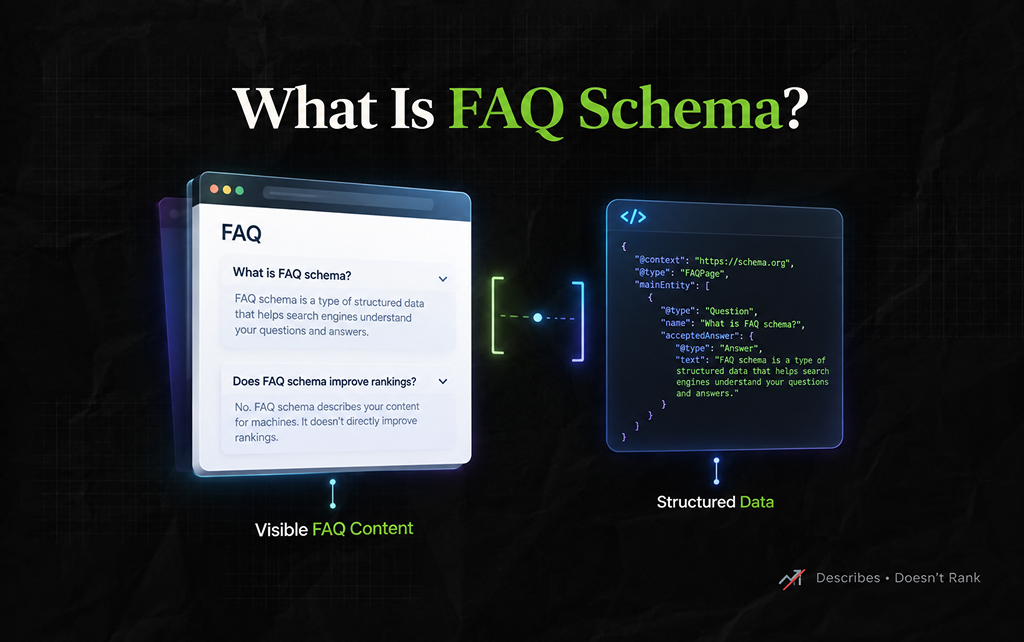
FAQ schema is structured data that is able to identify a set of Frequently Asked Questions as well as their answers on a webpage. It uses the FAQPage type from Schema.org.
The markup tells machines: this is the part of the page that has questions followed by answers. And that’s about it – remember that it doesn’t tell Google or other search engines that the pages should rank on tops of SERPs.
In my experience, this distinction is super-important. Always remember that FAQ schema is structured data. It is not a ranking shortcut.
Frankly, any page can have a section for ‘FAQ’ without really using any FAQ schema.
Also, you can technically add FAQ schema without even having an FAQ section as part of your content.
So, the content comes first. And the markup describes that content for machines. For example, suppose an article about technical SEO ends with:
“Can good site health improve your ranking?
Yes, good site health can improve your site’s rankings – and that too, both directly as well as indirectly. Google and other search engines prioritize sites that offer a fast, secure, and smooth experience.”
That is useful FAQ content.
As a result, if you use FAQ schema, the markup describes the question and answer that already exist on the web page.
The structured data should reflect the visible content. It should not be treated as a hidden collection of keywords for search engines.

FAQ schema became popular because Google could use properly marked-up questions and answers to create expanded search results.
That gave websites additional visibility within the search results.
But Google later limited FAQ rich results primarily to popular, authoritative health and government websites.
For most other websites, using FAQ schema no longer means you should expect those expanded FAQ results to appear.
This changed the economics of the tactic.
So, if your entire reason for using FAQ schema was “I want more real estate on SERPs,” you need to reconsider the strategy.
Also, if the questions genuinely improve the page and the structured data accurately describes them, there can still be reasons to implement it.
The markup simply should not be sold internally as a guaranteed rich-result opportunity.
This misconception refuses to disappear.
FAQ schema does not work like: Add schema → receive ranking boost. Instead, structured data helps Google and other search engines understand content and other elements on a particular page.
Also, a page can have perfect FAQ markup and still:
The quality of the underlying page remains much more important. Schema supports understanding. It does not replace useful content.

TBH, the strongest use case in this context is fairly simple.
So, you can add FAQ schema when a page has a useful FAQ section in the content that aligns with the relevant eligibility requirements of structured data.
I know it doesn’t sound exciting like some SEO hack. Plus, it’s much more sustainable than some hack, especially where results are concerned.
FAQ schema can make sense when the:
For example, a software product page may answer questions about integrations, pricing, setup, or compatibility.
A service page may answer practical questions about the process. A detailed guide may answer common questions that naturally arise after the main explanation.
In these cases, the FAQ section has value even before you think about schema.
The best FAQ questions often come from places outside keyword tools. So, you need to look at:
These sources reveal what people actually struggle with. Also, keyword tools can help too. But search volume should not be the only criterion.
For instance, a question with 20 monthly searches can be extremely valuable if it resolves a major objection from a potential customer.

Structured data creates an additional maintenance responsibility.
So, suppose your FAQ says: Does your software integrate with Salesforce?
And the answer says: Yes, our software supports Salesforce integration.
Six months later, the integration is discontinued. The visible FAQ needs to change. The structured data needs to change too.
Otherwise, your markup is describing information that is no longer accurate.
This is one reason automated schema systems can create problems.
Moreover, if your CMS generates FAQ markup automatically, make sure it updates when the underlying content changes.
Search engines should not have to reconcile two different versions of your content.
As a result, if the visible page says “We currently support integrations with Salesforce and HubSpot,” but the structured data says “We support Salesforce, HubSpot, Zoho, and Pipedrive,” then you have created an inconsistency.
The schema is not a place to add information that you forgot to publish. It should represent the page accurately.
Also, the same principle applies when an FAQ is removed, rewritten, or moved to another section. Update the structured data accordingly.
Another common implementation problem is choosing FAQPage simply because a page contains questions.
Schema types describe specific concepts.
FAQPage is intended for pages containing FAQs and answers. It is not a generic “this page has questions” label.
For example, an article containing one rhetorical question in the introduction does not suddenly become an FAQ page.
Likewise, a forum where users ask questions and other users provide answers is not necessarily a standard FAQPage implementation.
Also, Schema.org has different types for different situations. And choosing the correct type matters.
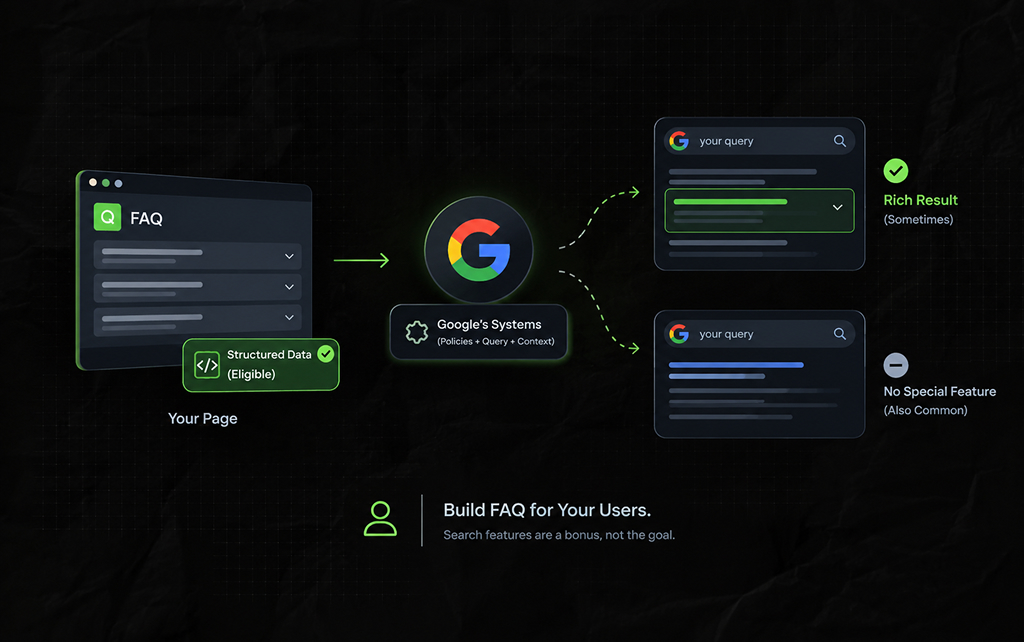
Even correctly implemented structured data does not guarantee that Google will display a special search result.
This is an important distinction between ‘Eligibility’ and ‘Appearance.’
Your page may meet the technical requirements for structured data without receiving a particular search enhancement.
Search engines decide what to display based on their systems, policies, and the query.
So the business case for FAQ content should not depend entirely on a rich result appearing.
Moreover, you should build the FAQ because it helps the user. Treat any additional search presentation as a potential benefit rather than the core reason for creating the content.

A useful FAQ section can fill gaps in an otherwise strong page. Now, imagine an article explaining competitor backlink analysis.
The main content explains the process. But readers may still wonder:
Those questions add practical value.
Also, the FAQ becomes an extension of the article. It should not become a second summary of the article.
Large websites can accumulate hundreds or thousands of FAQ blocks. That creates a maintenance problem.
As a result, if your website has automated FAQ schema across thousands of pages, outdated markup can become difficult to identify.
Before implementing it at scale, establish:
Also, understand that the more structured data you add, the more important governance becomes.
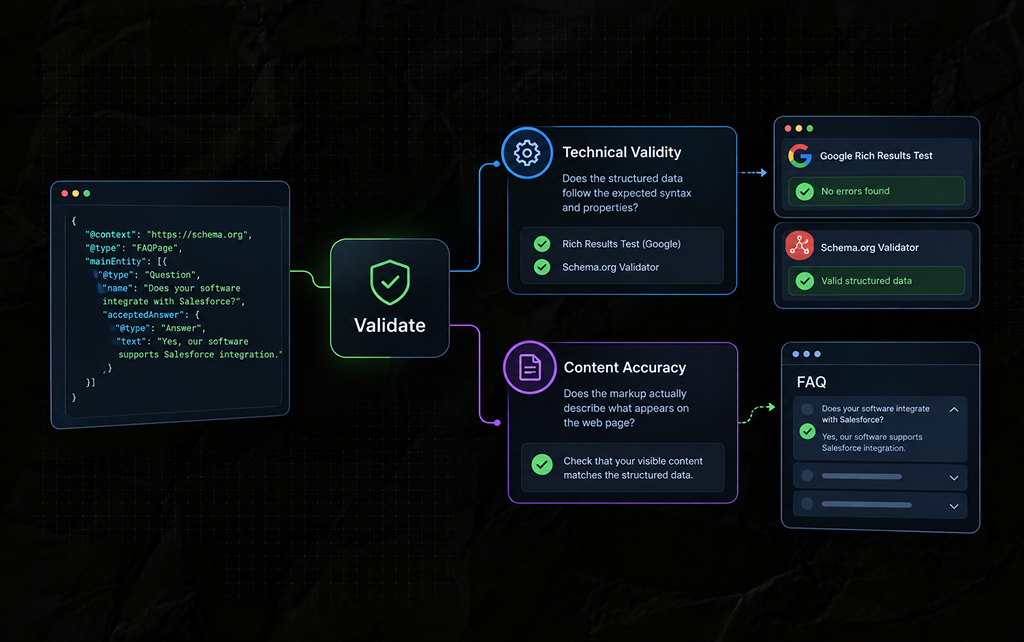
In this context, there are two different things to check.
Does the structured data follow the expected syntax and properties?
Google’s Rich Results Test can help determine whether supported structured-data features are detected.
Schema.org’s validator can also help check whether the markup follows the broader Schema.org vocabulary.
Does the markup actually describe what appears on the web page?
A technically valid implementation can still be strategically poor.
For example, your JSON-LD may parse perfectly while describing an FAQ that users cannot find on the web page.
Also, passing a validator does not automatically mean the implementation is good.

It is tempting to assume that FAQ schema is especially important because AI search systems need structured information.
That conclusion is too simple.
AI systems can use many types of information, and structured data is only one way of describing content.
Clear writing, consistent entities, useful answers, reputable sources, strong site architecture, and accessible content all contribute to how information can be understood and retrieved.
So don’t create FAQ sections solely because you believe an AI system will prefer them.
Instead, make important information easy for both people and machines to understand. That means:
The underlying information matters more than the schema label.
Before implementing FAQ schema, ask five questions.
1. Is there a genuine FAQ section on the web page? If not, don’t manufacture one.
2. Does the FAQ answer useful questions? If the answers add nothing beyond the article, reconsider the section.
3. Is the content visible to readers? The markup should accurately describe accessible page content.
4. Is the information likely to remain accurate? If the content changes frequently, plan for maintenance.
As a result, if your answer to these questions is yes, FAQ schema can be a sensible implementation.
However, if the only answer is “our SEO plugin says we should add it,” that is not a strong reason.

FAQ schema works best when it is considered alongside the rest of your structured data.
Moreover, depending on the website, useful schema may include:
The right combination depends on what the website actually represents. Do not add every available schema type.
Also, think about the entities and relationships that matter on each page. The question is not “Which schema can we add?”
Instead, it is “What does this page represent, and what information would help machines understand it?”
And that is a much better starting point.
FAQ schema is not dead. But the old idea of adding FAQ markup to every page for extra Google real estate is outdated.
For most sites, the value now starts with the FAQ content itself, not the expectation of a prominent FAQ rich result.
So, create questions because users genuinely have them. Write answers because those answers make the page more useful. Then use structured data when it accurately describes that content and fits the page.
That approach makes FAQ schema a small part of a broader SEO strategy rather than another markup tactic added for the sake of having more markup.
And that is probably the right way to think about structured data in general: describe what is genuinely there. Don’t manufacture information just because a search engine can read it.
Barsha is a seasoned digital marketing writer with a focus on SEO, content marketing, and conversion-driven copy. With 8+ years of experience in crafting high-performing content for startups, agencies, and established brands, Barsha brings strategic insight and storytelling together to drive online growth. When not writing, Barsha spends time obsessing over conspiracy theories, the latest Google algorithm changes, and content trends.
View all Posts

SEO Dashboard: What To Track, What To Ignore,...
Sep 25, 2026
Analytics SEO: How To Turn Search Data Into B...
Sep 25, 2026
AI Search Tools: What They Actually Measure A...
Sep 25, 2026
The Keyword With 10 Searches That Sent Ahrefs...
Sep 24, 2026
Paying Freelance Writers In Ten Countries: An...
Sep 24, 2026