The Ultimate Guide To Competitor Backlink Analysis: An Actionable SEO Blueprint To Steal Your Rivals’ Traffic
Oct 23, 2026


In case you have been living under a rock, affiliate marketing involves promoting a company’s product or service and earning a commission for every sale you make.
FYI, every time someone clicks your link to buy a service or product that you are promoting, you earn a commission. This is super legitimate and definitely not a scam.
As someone who has been running successful affiliate marketing campaigns on two of my websites, I can tell you that if done right, you can earn a sustainable income over time.
Moreover, it is absolutely legal but only if you comply with all relevant laws, policies, and regulations in your country.
For instance, here are the official guidelines of the FTC on affiliate marketing.
Also, this is an ethical way of earning a living – just ensure you are open about being an affiliate for the product while creating promotional content for the same.
Plus, it is best to promote products and services that you actually believe in – I mean, how can you promote something you know won’t do people any good? It’s not ethical, and with time, your credibility will go down.
So many websites are currently making money via affiliate marketing, including major names like NerdWallet, The Verge, New York Times, and more.
But the real question that I am going to break down for an insightful analysis is something entirely different – is affiliate marketing legit?
Considering so many people have successfully used affiliate marketing to earn a living, the shortest answer is obviously YES!
TBH, there are several instances of people making good money from affiliate marketing as well.
And on that note, here’s a list of people and their earnings from affiliate marketing (data published on Ahrefs in March, 2024).
| Name | Identity | Financial Insights |
|---|---|---|
| Pat Flynn | Entrepreneur | Made 6 figures in nearly a month in 2017. |
| Living Cozy | Independent affiliate website | Made over $12 million in revenue. |
| Grilling Dad | Independent affiliate website | Made more than $25,000 every month. |
| MoneySmart | Asia’s NerdWallet | Made $29 million in 2o22. |
| DogFoodAdvisor | Affiliate website for dog food | Got acquired for $9 million. |
| Wirecutter | Currently a part of the NY Times | Got acquired for $30 million. |
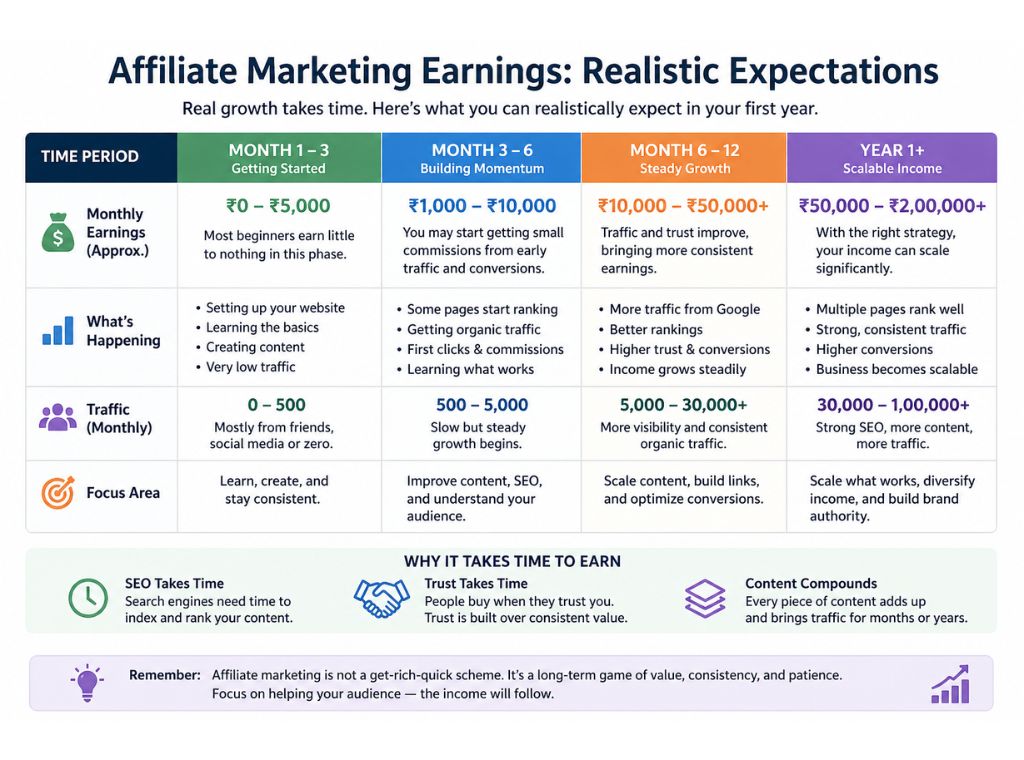
Having shared this data, let me make one thing very clear – affiliate marketing is not your get-rich-quickly method!
While the process is very simple, it is not easy and can get challenging. Moreover, it takes lots of time and investment even before you earn your first dollar.
Also, you need to understand that whatever you are doing in detail, with special focus on your SEO strategy.
As a result, if you are ready to invest your energy, time, and money into running successful affiliate campaigns, then it is worth every penny you invest.
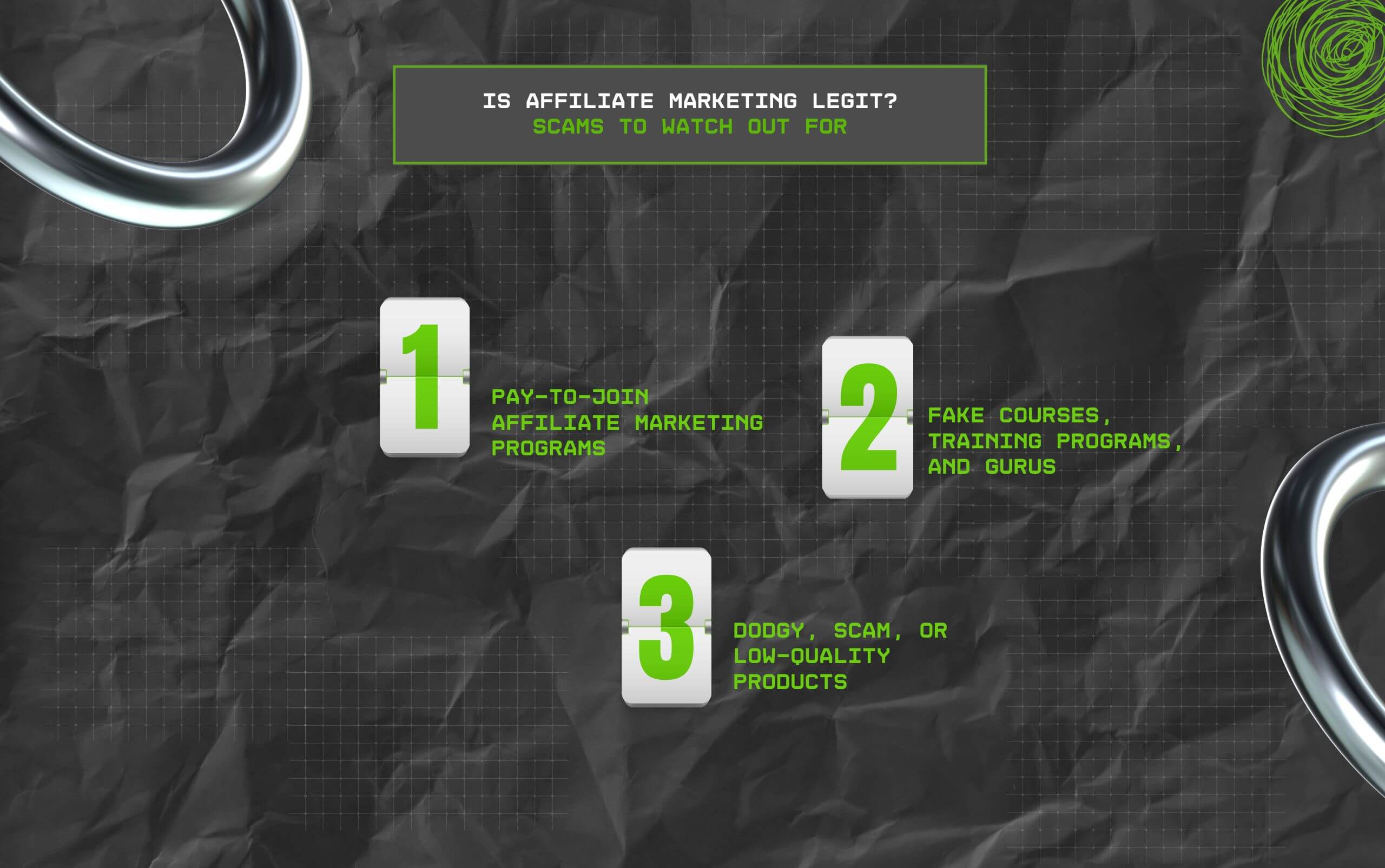
While affiliate marketing isn’t a scam, like any other industry, it has its own share of scams and fraudulent activities.
On that note, I have been able to identify three major scams that you need to watch out for:
As the name suggests, some affiliate programs charge a fee for making people join. In that case, don’t pay to join.
This is because legitimate affiliate programs like Amazon’s affiliate program are always free for anyone to join, since there’s no downside for merchants, considering you get paid only when the sale goes through.
The affiliate marketing landscape is crowded with fake coaches (and gurus) who sell courses on how to earn from affiliate programs.
But the problem is, these people have no actual experience. In fact, they don’t earn from these programs but instead from selling courses to people like you.
As a result, such training programs or courses are usually generic and underwhelming, failing to deliver any actual results.
Based on my eight years of experience in the digital marketing industry, including affiliate marketing, I have done my best to highlight some of the top red flags that you need to watch out for in this context.
| Issue | Explanation |
|---|---|
| Unrealistic Promises | Does it sound too good to be real? Then it probably could be so. |
| Questionable Success Stories | They might come with social evidence, but there is something so shady and suspicious about them. From AI-generated testimonials and images to generic names and no photo IDs. |
| Pressure Tactics | Are they spamming you with scarcity and urgency? And this is true especially if the program is a scam. |
| No Proof of Success | They don’t have any websites or case studies to show their work. Also, if they show charts, then ask for the actual website because usually these charts are either stolen or fake. |
| Image Over Actual Value | Instead of sharing content for free, their positioning and marketing are about their luxury lifestyles and how much they earn. |
Of course, you can learn it for free, but if you are bent on doing a course, then avoid all the red flags I mentioned above.
Also, here’s my checklist to find the right instructor and training program for learning how to do affiliate marketing.
Of course, it is super tempting to promote a service or product simply because it gives high commissions.
Having said that, it is important to understand that you will damage your credibility if you promote a low-quality product. Moreover, things can get worse if the product is a scam and doesn’t even exist.
For instance, MTTB (My Top Tier Business) was a product that multiple affiliate marketing professionals promoted to earn a high commission.
In 2018, the parent company of MTTB, MOBE, was charged with fraud, halting the business.
In this context, prominent faces associated with the affiliate marketing program were also charged, with MOBE eventually opting for a settlement.
As a result, it is best to avoid promoting any bad product or service.
So, here’s my quick checklist to help you out while you are selecting products and services for affiliate marketing.
Based on what I have discussed so far, here’s a table highlighting the differences between legit affiliate programs and scams at a glance.
| Legit Affiliate Programs | Scam Affiliate Programs |
|---|---|
| Promotes real services and products | No actual product value. |
| Comes with transparent disclosures. | Comes with offers like ‘Earn ₹1 lakh in 7 days.’ |
| Time-consuming to build organic traffic. | No actual product or service value. |
| Income grows gradually over time. | Comes with fake testimonials. |
Remember that real growth takes a lot of time in the affiliate marketing industry. On that note, here’s what you can expect realistically in the first year.

Is affiliate marketing legit? Yep! So, now, let’s get the basics sorted!
The niche becomes your primary focus area. For instance, while it is not really fun, you can make a website that is all about dishwashers or washing machines.
Now, any ideal affiliate niche comes with four distinctive qualities:
While anyone can do affiliate marketing via any platform – TikTok or YouTube – I would suggest developing a website with your focus on SEO.
Why? This is because the organic search traffic is consistent and passive – as a result, it is important for consistent organic traffic to translate to consistent clicks on the affiliate links.
As I was telling you, the easiest programs for affiliate marketing are Amazon Associates and Target’s big-box retailers.
Also, you can find popular networks for affiliate marketing online, such as ShareASale, Commission Junction, and AvantLink.
Moreover, if you use any product that you believe in, then check whether it has any affiliate program.
However, if it doesn’t, then reach out and find out whether the brand would be interested in exploring possibilities for affiliate marketing.
So, you are always aware of what content will work for your affiliate promotions, thanks to your comprehensive niche research.
For instance, if you are building a website for washing machines, then you need content around “best washing machines,” “croma washing machine review,” and more.
Just ensure that you are actually testing the product and not just duplicating content that already exists online.
Also, in Google’s Helpful Content Guidelines, the search engine giant has explicitly stated that they are looking for helpful, people-first content.
So ensure your content is transparent, helpful, and keeps your audience at the forefront.
Barsha is a seasoned digital marketing writer with a focus on SEO, content marketing, and conversion-driven copy. With 8+ years of experience in crafting high-performing content for startups, agencies, and established brands, Barsha brings strategic insight and storytelling together to drive online growth. When not writing, Barsha spends time obsessing over conspiracy theories, the latest Google algorithm changes, and content trends.
View all Posts

The Ultimate Guide To Competitor Backlink Ana...
Oct 23, 2026
How To Land High-Authority Editorial Backlink...
Oct 23, 2026
Why Your Website Traffic Dropped Suddenly And...
Oct 23, 2026
How Do The Physical Google Review Tools Redef...
Oct 23, 2026
How To Get Your Brand Cited In AI Search Resu...
Oct 22, 2026