Is Serpstat Worth It? A Deep Dive Into Pricing, Data Accuracy, And Features
Oct 09, 2026

SEO has always involved language.
I mean, don’t you choose the words that people look for, use them to create content, and try to respond to the queries? You do, right?
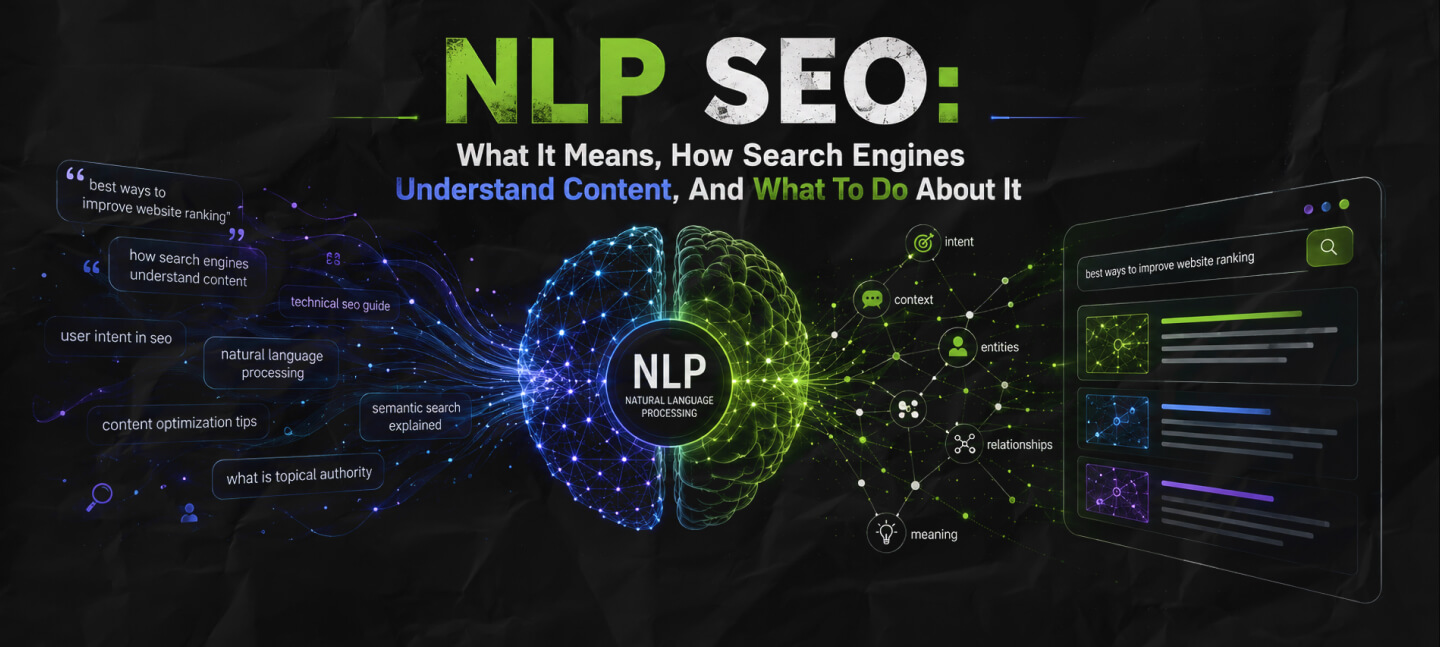
But the truth is, Google and other search engines aren’t really looking for those words anymore. Now, search engines can easily understand the exact relationship between two words and identify different entities, interpret context, and ultimately find out what a page is discussing.
And this is where NLP SEO enters the conversation.
FYI, NLP is Natural Language Processing – and today, I am here to discuss what NLP SEO means and, more importantly, how search engines understand context in 2026.
Of course, the internet is brimming with advisory blogs discussing how to optimize your content for NLP using related keywords and search queries.
While some of that advice is sort of helpful, most of it seems to me oversimplified and completely useless.
Frankly, there’s no magic list that lists different NLP terms for making a page rank on Google.
Rather, it is more about understanding how search engines process language in 2026 – and how you can improve your content more useful in the same context.
And that is the sort of distinction which matters.
Stick around while I do a deep dive on NLP SEO and help you understand how search engines look at content – and what you can do about it.
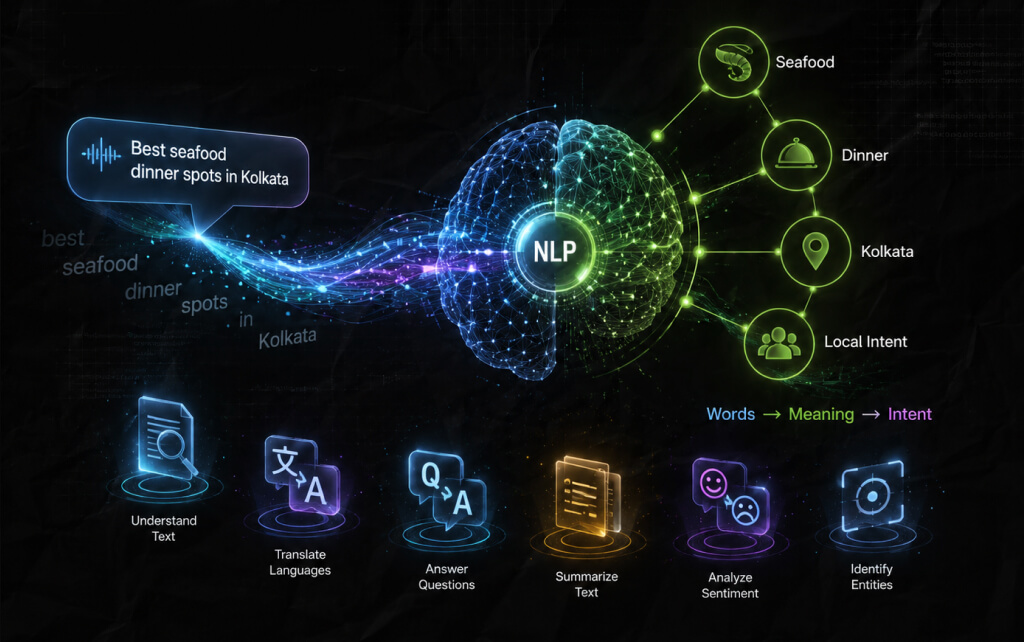
NLP, that is, Natural Language Processing, falls under AI – the sort of AI that helps computers process and understand human language.
For more clarity, I can tell you that NLP sits at the intersection of three things:
Now, to further simplify this for you, let’s look at everything that computer systems can do with the help of NLP:
Google and other search engines use high-end language understanding systems to process and actually ‘understand’ queries.
So when someone searches, “best seafood dinner spots in Kolkata,” Google doesn’t look at the query as a series of six unrelated words.
Instead, it can interpret concepts such as: dinner spots + seafood + Kolkata + local intent. That understanding helps it find relevant results.
NLP SEO is not an official Google optimization category. It is an industry term used to describe SEO practices informed by how search engines process natural language.
So, the basic concept is to create content that clearly communicates the topic, the different entities, the relationships, and most importantly, the intent behind the information.
That means moving beyond, “How many times did I use my target keyword?” and asking, “Does the content clearly explain what this topic means and how its different concepts relate?”
That is a much more useful approach.
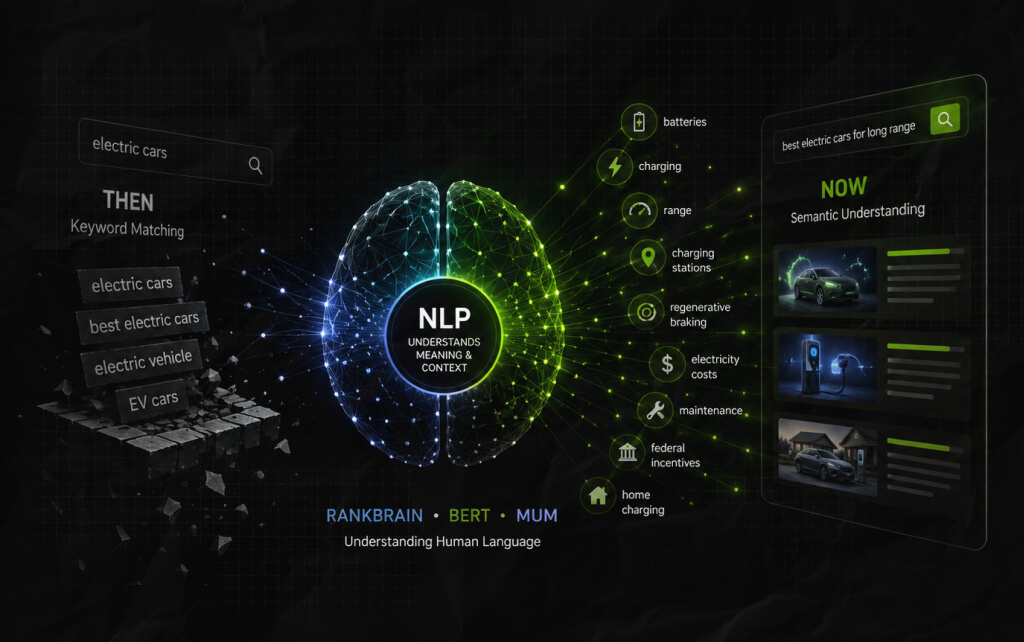
Search has moved far beyond simple keyword matching.
Earlier search systems had to rely more heavily on signals such as exact words appearing on a page.
Modern search systems can understand language in more sophisticated ways.
Google has introduced several major language and machine-learning systems over the years, including:
Now, I need to highlight something important in this context. These systems don’t perform the same function, and they aren’t interchangeable.
However, they do reflect something broader from an evolving perspective – Google and other search engines are using machine learning increasingly for understanding human language.
That basically means SEO can’t depend on exact-match keywords – atleast not entirely.
As a content marketing professional for nearly a decade, I can tell you that NLP is not just about what keywords you are using – and understanding this is super important.
So, let’s assume you are creating content on ‘electric cars.’ A basic keyword-focused approach might repeatedly use:
However, a stronger article might naturally discuss:
Now, these are sections and phrases you are adding to your content. Why? Because you know they will make your content helpful.
Afterall, these keywords represent concepts that are related to your primary topic – you are adding them because they help explain the subject better. Not because your SEO intern asked you to.
That is the difference between semantic relevance and keyword stuffing.
Of course, the same word can mean different things – it entirely depends on the context in which you are using the word.
So, take the word ‘apple,’ for instance. It could refer to:
The surrounding language helps determine the meaning.
As a result, it could be something like, ‘Apple launched a new MacBook.’ The context makes the company meaning obvious.
But for ‘I packed an apple for lunch,’ the meaning is completely different. This is why simply inserting related words into an article is not enough.
Remember, context creates meaning.
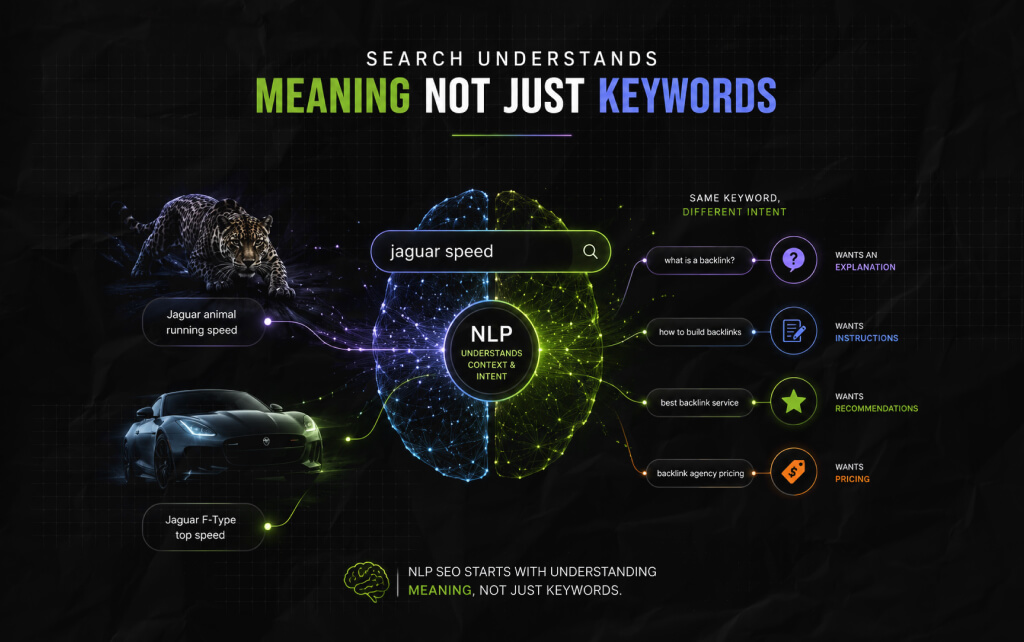
Suppose you search ‘jaguar speed.’
Now, you could be asking about the animal or the car. The search engine needs to interpret the likely meaning. Other words in the query can provide clues.
So, while ‘Jaguar F-Type top speed,’ clearly points toward the automobile, ‘Jaguar animal running speed’ clearly points toward the animal.
Good content does something similar – it establishes context around its subject.
NLP and search intent are closely connected.
Consider these searches:
They all contain the word: backlink.
But the users want different things.
A page that tries to answer all four poorly may be less useful than separate pages with clear purposes.
So NLP SEO starts with understanding the meaning behind the query, not simply identifying its keywords.
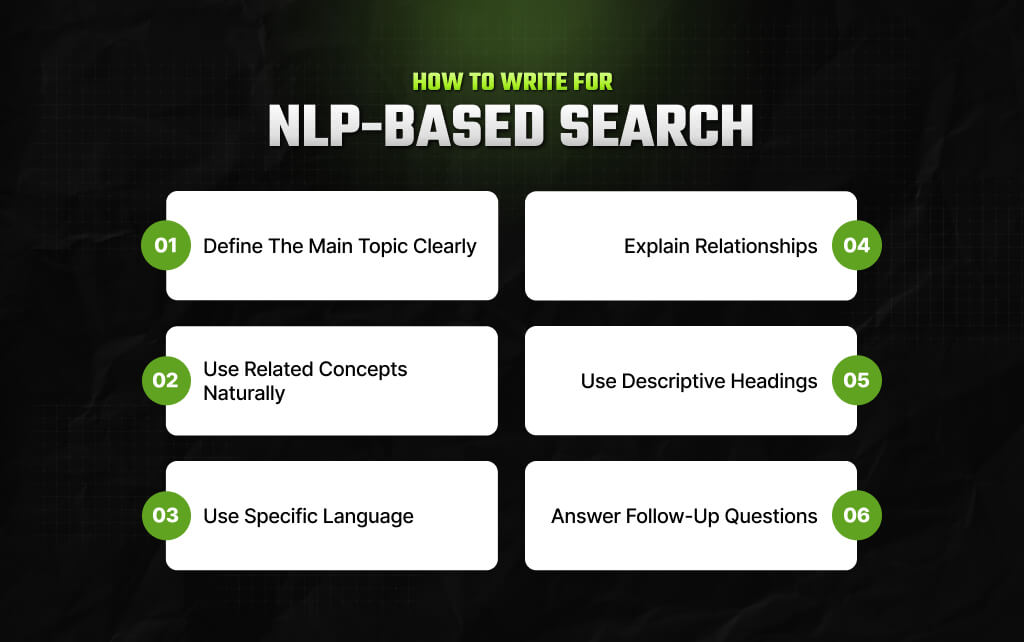
I have seen so many people starting out in the content industry confusing NLP SEO with writing in a robotic way.
Now, to tell you the truth, it doesn’t work that way – you should do anything but write like a robot. Be as natural, as organic, as possible.
So, write naturally. But make your meaning obvious.
If your article is about ‘What is vector search?’, answer that question early. Don’t spend 600 words discussing the history of AI before explaining vector search.
Why? Because a clear definition gives the page a strong topical foundation.
If you’re writing about ‘email marketing,’ you may naturally discuss:
Also, note that these aren’t just LSI keywords. Rather, they are concepts that genuinely belong to the topic.
Compare these sentences:
Now, which sentence communicates with more clarity? Which sentence actually uses specifics to clearly communicate the point?
Of course, the second sentence makes things more specific by telling the reader:
Specific language gives search systems clearer information to interpret.
Don’t simply mention related entities. Instead, discuss how different topics connect within your content.
So, in this context, let’s look at this sentence:
“Google Search Console reports indexing problems, while Google Analytics focuses on website traffic and user behaviour.”
What can you see? The relationship between Google Search Console and Google Analytics is explicit thanks to the clarity offered by this sentence
And that is so much more valuable than just mentioning the two tools randomly for the sake of adding LSI keywords.
A heading like, ‘Things to Consider,’ doesn’t tell anyone much. But a heading like ‘How Search Engines Understand NLP SEO?’ does communicate the point.
The second heading communicates the subject immediately. Moreover, clear headings improve usability. Also, they create a clearer information structure.
Good content anticipates what the reader will ask next. As a result, if your article answers, ‘What is NLP SEO?’ the next questions might be:
Remember, when you answer any relevant follow-up queries in your blog, it makes the content complete and helpful for readers – and that’s what matters to search engines.
However, while doing so, don’t add questions for increasing the length of your content. All sections should serve the reader.
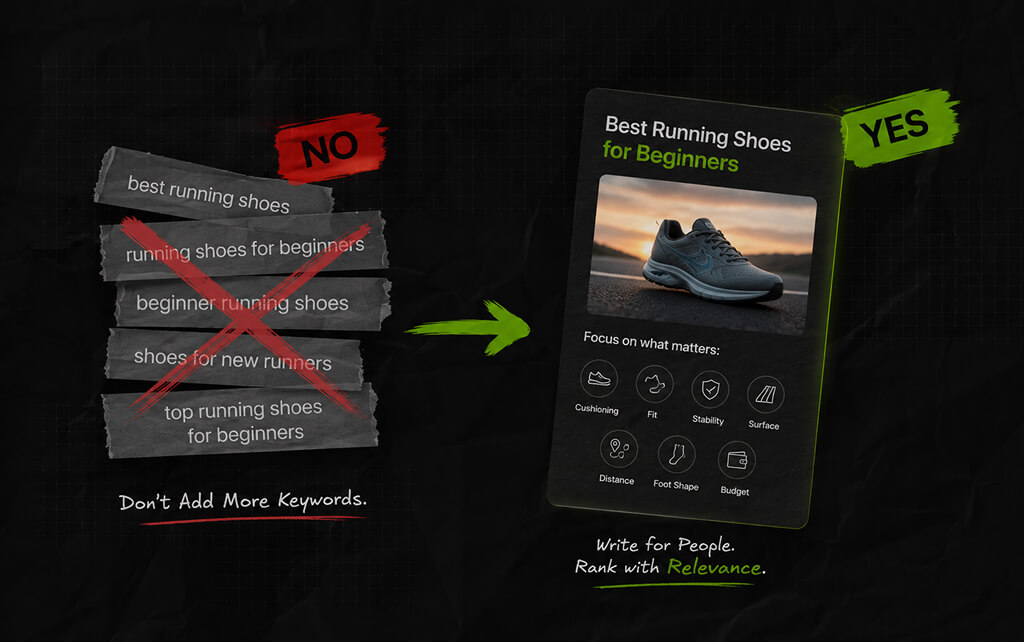
No.
In my experience, I’ve seen this as one of the biggest misconceptions most beginners are stuck with.
So, let’s assume you are writing about ‘the best running shoes for beginners.’ Do you really need to use these keywords in every paragraph?
I don’t think so!
Also, use natural language while writing about the best running shoes that beginners will actually benefit from.
Then discuss the actual factors a beginner needs to evaluate:
The article becomes more useful. And it naturally contains the vocabulary associated with the topic.
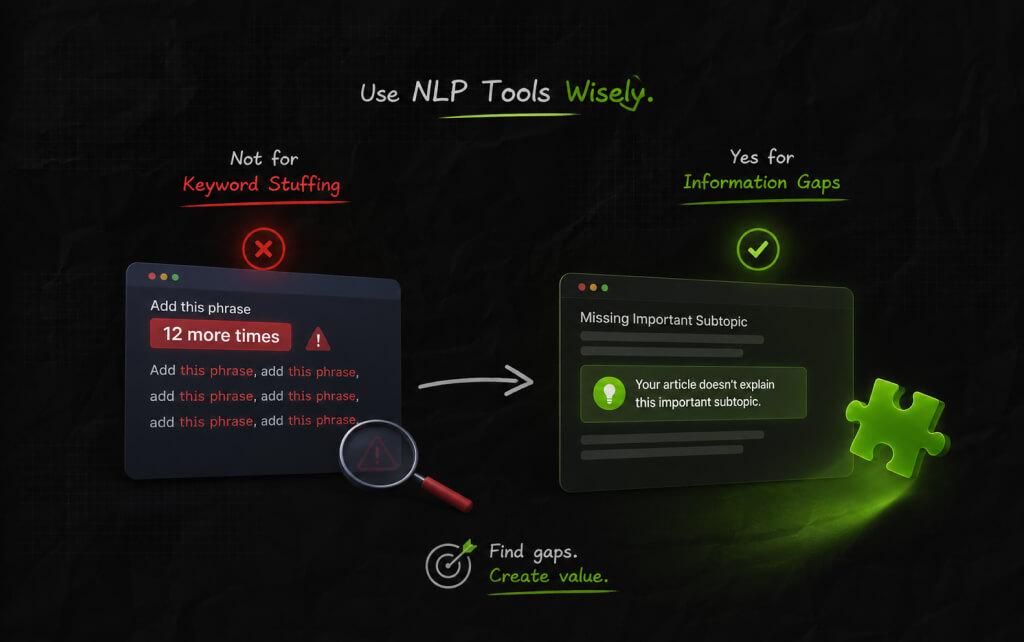
Several SEO tools analyse content using NLP-related concepts. And they may show:
These tools can be useful for research. But don’t treat their recommendations as Google’s secret ranking formula.
So, if a tool tells you, ‘Add this phrase 12 more times,’ then you should probably question the recommendation.
However, if it helps you discover, ‘Your article doesn’t explain this important subtopic,’ then isn’t that much more useful?
Use NLP tools to identify information gaps, not to manufacture keyword density.
Not directly.
Using an NLP content tool does not give you a ranking advantage simply because the tool uses machine learning.
The value comes from what you do with its insights.
For example, your competitor’s article explains how backlinks work, but your article only defines them.
An NLP or content analysis tool might highlight the gap.
Then, you can improve the article by explaining the process – and that’s useful. However, adding 15 related words without improving the explanation is not.
This is where SEO strategy becomes more interesting.
Search engines can process language. But your goal shouldn’t be to trick that processing. Instead, your goal should be to make your information easier to understand.
That means:
These practices improve content whether or not NLP is involved.
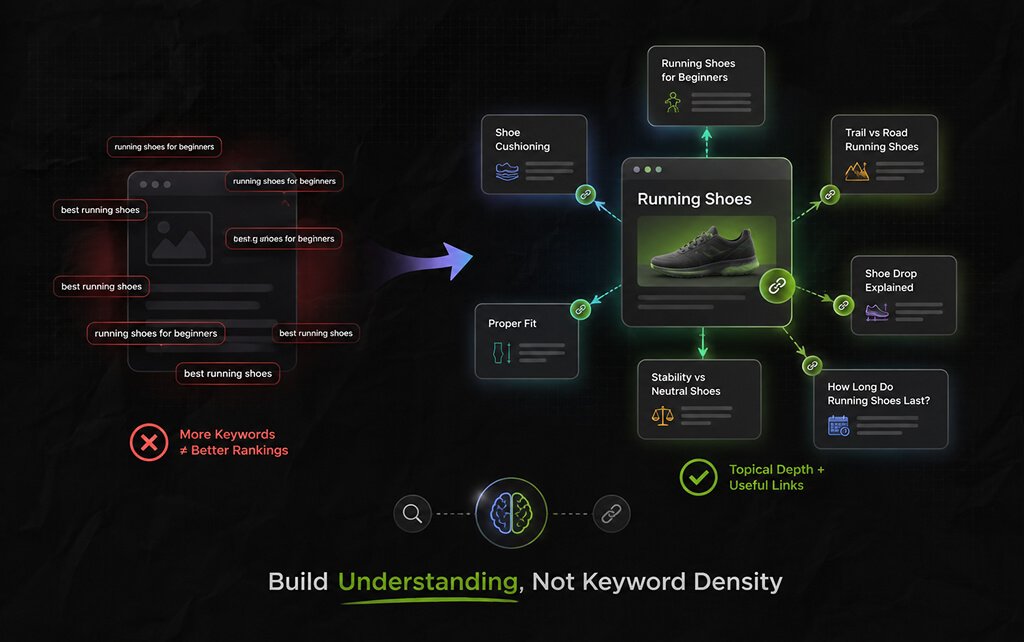
NLP also helps explain why topical depth matters. So, imagine two websites covering ‘Running shoes.’
Now, website A publishes: Best Running Shoes
But website B publishes:
Honestly, website B has created a much richer information environment around the topic.
Also, the pages have relationships:
This can create stronger topical coverage than repeatedly publishing generic articles targeting minor keyword variations.
Internal links can reinforce these relationships.
Suppose you have an article about ‘How to Choose Running Shoes?’ Then, you could naturally link to:
Also, the anchor text gives users context about what they will find. More importantly, the pages now form a connected information structure.
Don’t link randomly. Instead, link when the second page genuinely helps explain the first topic.
In this context, I’ve highlighted the differences between traditional keyword SEO and NLP SEO – check it out for a better understanding.
| Traditional Keyword Focus | NLP-Informed Approach |
|---|---|
| Match exact phrases | Understand the underlying topic |
| Repeat target keywords | Use natural terminology |
| Create pages for keyword variations | Consolidate closely related searches |
| Focus heavily on keyword density | Focus on useful information |
| Treat related words as keywords | Treat them as concepts and context |
| Optimize mainly for phrases | Optimize for intent and meaning |
The second approach doesn’t eliminate keywords. Rather, it puts them in context.
No.
You do not need to turn natural writing into something that sounds like a database. Instead, write for people first.
If a sentence sounds unnatural because you are trying to include a related phrase, remove the phrase.
However, if a paragraph needs another concept because the reader would otherwise miss an important part of the explanation, add it.
That is a much healthier approach to NLP SEO.
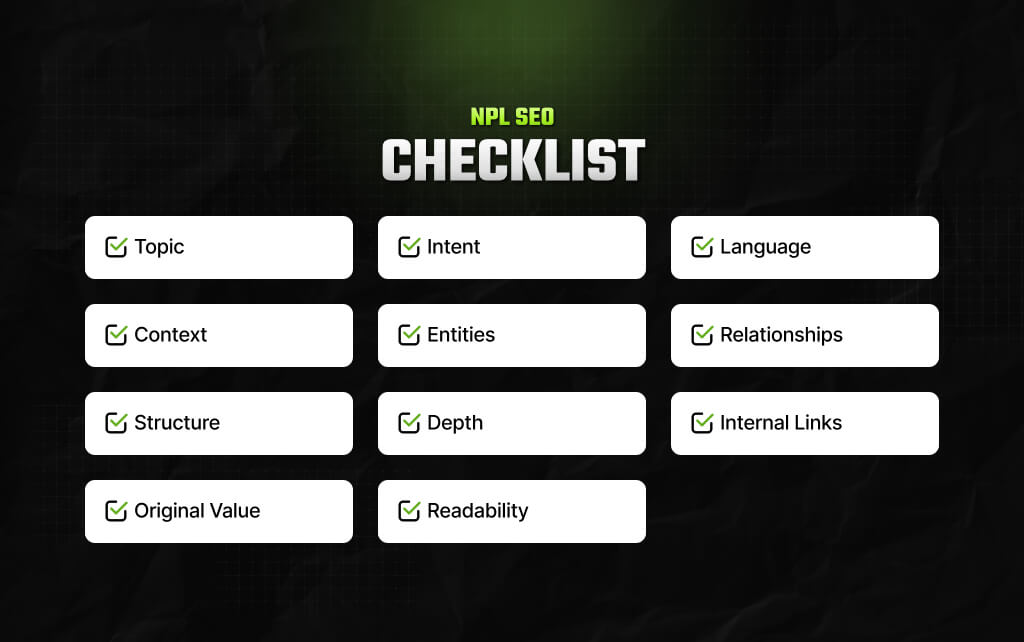
Before publishing an article, ask:
If the answer is yes, you are probably doing something much more valuable than simply optimizing for NLP.
Search will continue becoming better at processing language.
AI-powered search systems are already changing how people discover information. Users don’t always type short keyword queries anymore.
Instead, they ask complete questions, describe situations, provide context, and often ask follow-up questions.
That means content needs to work at the concept level, not just the keyword level.
As a result, a page should be able to answer:
The exact questions will vary by topic. But the principle remains the same.
Barsha is a seasoned digital marketing writer with a focus on SEO, content marketing, and conversion-driven copy. With 8+ years of experience in crafting high-performing content for startups, agencies, and established brands, Barsha brings strategic insight and storytelling together to drive online growth. When not writing, Barsha spends time obsessing over conspiracy theories, the latest Google algorithm changes, and content trends.
View all Posts

Is Serpstat Worth It? A Deep Dive Into Pricin...
Oct 09, 2026
How To Use Screaming Frog: The Definitive Tec...
Oct 09, 2026
Master The Rich Result Test: Fix Your Broken ...
Oct 08, 2026
Does vnROM Bypass Still Work? A Realistic 202...
Oct 08, 2026
Event Pages That Rank And Convert: A Practica...
Oct 06, 2026