
The Traffic-to-Revenue Gap: Why More Website Visitors Don’t Always Create More Customers
Sep 17, 2026

Every day, online store owners and digital marketing teams open their performance dashboards and run into a classic problem.
They see that thousands of people are visiting their websites, clicking on a couple of product pages, and then vanishing into thin air. It is a brutal reality of the modern web: the vast majority of your traffic leaves without spending a single dollar.
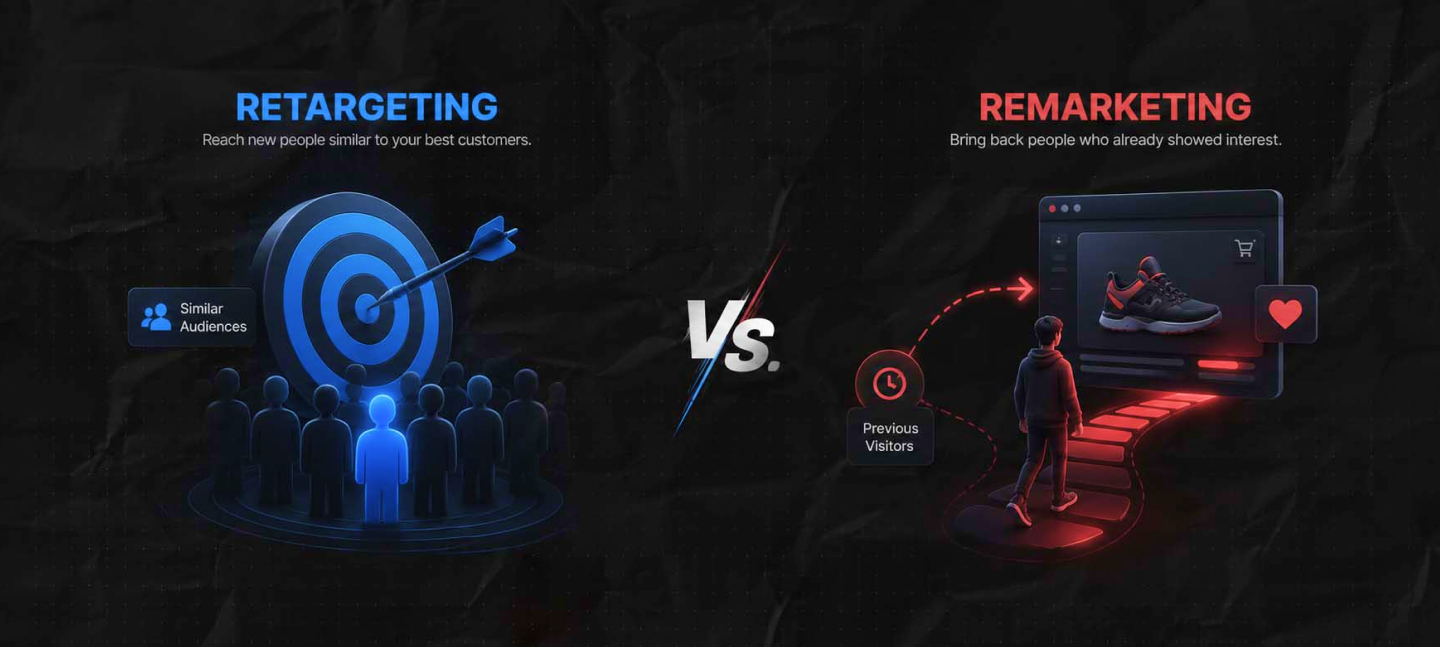
When you lose those visitors, your natural instinct is to try and pull them back to your site to figure out how to increase online sales. But when you start looking for solutions, you immediately hit a wall of confusing technical words. This brings us directly to the debate of retargeting vs remarketing.
To keep it as simple as humanly possible, the entire debate comes down to two things: the type of audience you are trying to reach and the communication channel you use to talk to them.
The massive uptick in conversations surrounding retargeting vs remarketing isn’t just random watercooler talk. It is a direct response to a massive seismic shift in how modern search engines and web browsers handle personal privacy.
For more than a decade, digital advertisers had it easy. They could drop a tracking cookie into a user’s browser, track every move they made across the web, and serve them hyper-specific ads for weeks. But those days are coming to a permanent end.
Global privacy regulations, Apple device privacy updates, and the systematic elimination of third-party tracking cookies by major web browsers have broken the traditional retargeting model.
Because tracking anonymous web surfers has become significantly more difficult and expensive, brands are being forced to rethink their entire user retention strategy.
They are asking hard questions about whether they should spend their capital renting audiences through paid ad networks or investing heavily in building out their own first-party email and text lists.
Because different marketing platforms use these definitions to sell their own software features, they become incredibly blurry. For example, Google Ads uses the word “remarketing” as an umbrella term for paid display ads, even though the rest of the industry calls that retargeting.
Let us break down the standard platform definitions using the latest industry documentation to clarify the confusion.
| Strategic Component | Retargeting Perspective | Remarketing Perspective | Original Source Insight |
|---|---|---|---|
| Primary Audience Type | Anonymous website visitors or app browsers. | Known leads, past buyers, or active subscribers. | Criteo Commerce Data Logs |
| Core Delivery Channel | Paid ad networks (Google Display, Meta Feeds, Reels). | Owned communication tools (Email, SMS, Push alerts). | Search Engine Journal Strategy Guides |
| Baseline Data Source | Browser tags, device tracking pixels, and cookies. | First-party CRM databases and customer list profiles. | RTB House Privacy Evaluation Reports |
| Typical Cost Model | Cost-Per-Click (CPC) or Cost-Per-Mille (CPM) ad spend. | Flat-rate software subscription fees for email/SMS engines. | Techiegigs Performance Analysis |
If you want to know how to run google ads successfully under modern standards, you have to understand how data verification impacts your visibility. Search engines and ad platforms are moving entirely toward a validation model called first-party data matching.
When you dive into the technical execution of retargeting vs. remarketing, the line between our two core terms starts to blur beautifully.
If you take a list of your existing email subscribers (which is a remarketing asset) and upload that encrypted text list directly into a platform like Google Ads or Meta, you can serve paid display ads directly to those specific people across the internet.
This is technically a remarketing strategy based on data origin, but it utilizes a retargeting execution style to display the message.
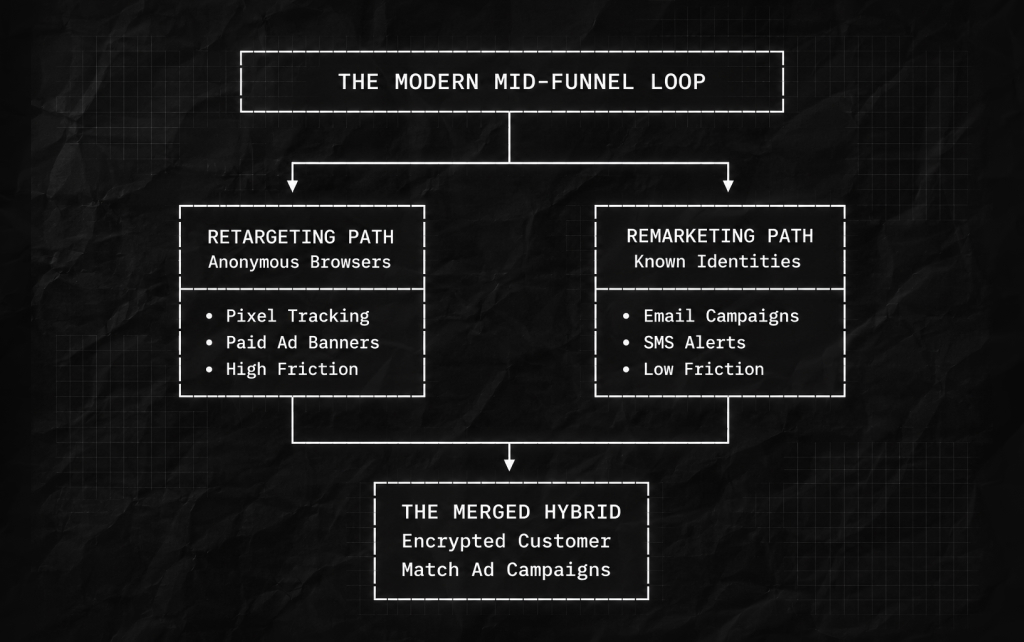
When you look at retargeting vs remarketing, it’s tempting to compare them like two competing strategies. That’s the wrong lens entirely.
They’re not rivals. Rather, I would call them teammates. Each one shows up at a different moment in the customer journey, doing very different kinds of work.
Think about someone landing on your blog for the first time. Maybe they clicked through from Google, skimmed an article, and left.
At this stage, they’re not just a cold lead. To clarify, they’re barely a lead. They don’t know your brand, they don’t trust you yet, and they’re definitely not ready to buy anything.
And here’s the catch: you don’t have their contact details. No email or phone number. Nothing!
This is exactly where retargeting earns its place.
With paid ads, you can quietly reappear in their world. Not aggressively, but just enough to stay familiar. A display ad showing the exact product they checked out. A reminder of the guide they almost finished reading.
It’s subtle, but powerful. You’re not selling yet; you’re just staying remembered.
Now fast forward a bit.
The same user signs up for your newsletter. Or downloads a free resource. Or leaves something sitting in their cart.
That’s a completely different relationship. You’re no longer guessing. In contrast, you’ve got a direct line to them.
At this point, spending money on another ad impression often makes less sense. Instead, remarketing takes over in a much more personal way.
For instance, a well-timed cart abandonment email, or a follow-up with useful recommendations.
It can also be a short, friendly nudge that feels like a conversation rather than a campaign.
Unlike ads, these messages don’t fight for attention in crowded feed. They show up in a space where people check deliberately: their inbox.
And the best part? It’s far more cost-efficient and often converts better.
Before you scale any campaign around retargeting vs remarketing, it’s worth pausing and tightening the basics. Small technical gaps can quietly drain your budget.
At its core, the debate around retargeting vs remarketing isn’t about choosing one over the other. It’s about knowing when and how to use each effectively.
Too many brands over-invest in retargeting ads without building a strong email base. Others focus heavily on newsletters but struggle to bring new people into the funnel.
Both approaches hit a ceiling. Therefore, the smarter play is balance.
Use retargeting to capture attention when it’s still anonymous and exploratory. Use remarketing to nurture that attention once it becomes identifiable and intentional.
Remember, one brings people back. Meanwhile, the other brings them closer. And when those two work together properly, you don’t just get conversions; you build consistency.
Barsha is a seasoned digital marketing writer with a focus on SEO, content marketing, and conversion-driven copy. With 8+ years of experience in crafting high-performing content for startups, agencies, and established brands, Barsha brings strategic insight and storytelling together to drive online growth. When not writing, Barsha spends time obsessing over conspiracy theories, the latest Google algorithm changes, and content trends.
View all Posts

The Traffic-to-Revenue Gap: Why More Website ...
Sep 17, 2026
The Volatility Trap: What Crypto Position Siz...
Sep 17, 2026
Schema Markup: How To Use It Without Turning ...
Sep 17, 2026
Turn A Search Question Into A Watchable Expla...
Sep 16, 2026
Agency Guide To YouTube Growth: Wholesale Pri...
Sep 15, 2026