The Ultimate Guide To Competitor Backlink Analysis: An Actionable SEO Blueprint To Steal Your Rivals’ Traffic
Oct 23, 2026

I still remember the late-night panic attack of 2022. I had just launched my very first blog. I spent three weeks tweaking font colors and installing dozens of shiny plugins.
I thought it looked spectacular. Then, I asked my friend Sarah to open it on her old iPhone while we were sitting in a basement coffee shop with terrible cell service.
Nothing loaded. For a full twelve seconds, her screen was completely blank. When the page finally sputtered to life, a giant email pop-up immediately blocked the text. She couldn’t find the close button. She got frustrated, locked her phone, and sighed.
That was the exact moment I realized my beautiful website was actually a usability nightmare.
If you are running a site like searchenginemagazine.com, or just trying to figure out how to get your own digital business off the ground, you are probably asking yourself a classic question: how much does it cost to start a blog that actually works?
The honest answer is very little. You don’t need a $5,000 budget or a custom developer to build something beautiful and lightning-fast. You just need to avoid the classic traps that kill amateur websites before they even get a chance to rank on Google.
When people start searching for WordPress Design Tips, they usually find bad advice. Amateur blogs will tell you to install heavy animations, parallax scrolling backgrounds, and complex multi-layered menus. They make it sound like your site needs to look like a high-budget video game.
Let me tell you about a massive mistake I made on my second website. I bought a premium, bloated theme because the demo looked like a Hollywood movie trailer. It had video headers and elements that flew across the screen when you scrolled.
Here is what happened in real life:
I had to scrap the entire thing. I went back to a completely free, lightweight theme and used simple, clean spacing instead. My traffic doubled in a month. That experience taught me the golden rule of web creation: good layout isn’t about what you can add. It is about what you have the courage to strip away.
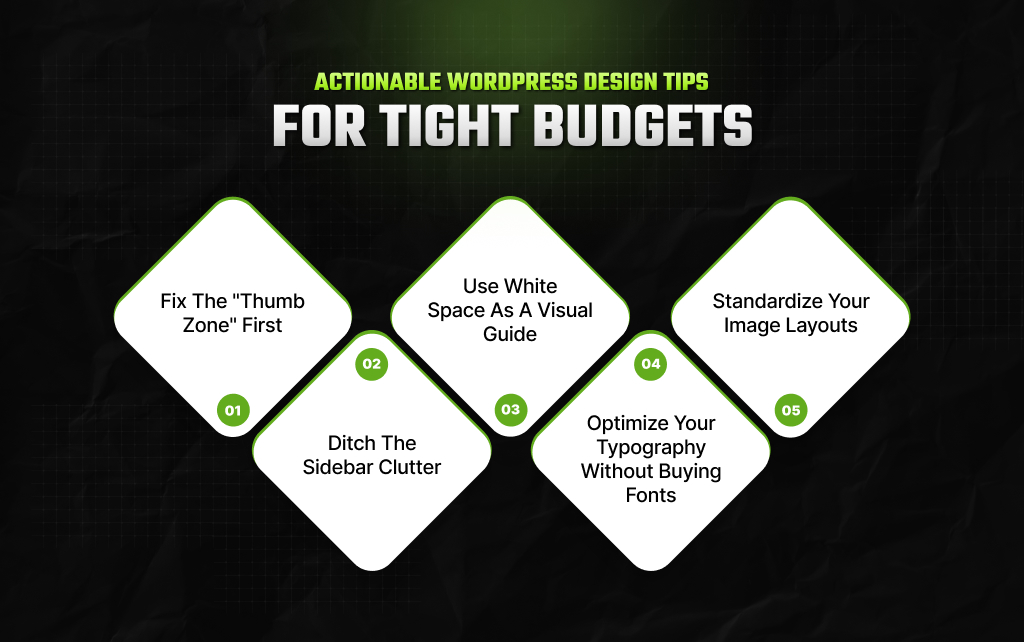
You do not need fancy premium software. You just need to focus on how a real human being interacts with your page. Here are five practical, budget-friendly strategies you can implement by tonight.
Most people read content on their phones while holding it with one hand. If your primary navigation menu or search bar is tucked away in the very top-left corner, you are forcing your readers to stretch their thumbs awkwardly. Move your most important buttons down where they are easy to hit.
Look at your current layout. Do you have a sidebar filled with a calendar, a tag cloud, a generic stock photo of yourself, and links to archives from three years ago?
Nobody clicks those. They distract from your actual writing and slow down your load times. Remove the sidebar entirely on your blog posts. Give your text breathing room.
Amateur writers fear empty space. They try to fill every square inch of the screen with ads, images, or colorful backgrounds. Don’t do that.
White space tells the reader’s eyes exactly where to look next. It makes your site feel expensive, even if you spent zero dollars on it.
You do not need to purchase custom typography licenses. Stick to system fonts that load instantly on any device, like Arial, Helvetica, or system-serif.
Make your body text at least 16px or 18px. Line height should be spacious. If your text looks like a dense wall of bricks, people will close the tab.
Stop uploading raw photos straight from your phone. They are massive file sizes that crush your site speed.
Use free online tools to resize your images to the exact dimensions of your content block, compress them to WebP, and apply a uniform border or shadow style using native WordPress blocks.
Implementing these foundational WordPress Design Tips costs absolutely nothing but a few minutes of your time, yet they instantly elevate your brand.
Once you fix your layout, you will naturally start worrying about traffic. This is where new bloggers fall into the second major trap. They ask a question that shows they are focusing on the wrong things: how many seo keywords should i use per page?
They think if they write a 1,000-word article and jam their specific phrase into the text exactly twenty times, Google will magically reward them.
[ Traditional Stuffer Mentality ] ──> Stuff keywords 20x ──> High bounce rate / Unreadable text
[ Modern Human-First Mentality ] ──> Solve real user pain ──> Long dwell time / Organic keyword variants
Let’s look at a practical scenario. Imagine someone lands on your site looking for advice. They read a sentence that says: “If you want the best WordPress Design Tips, read our guide on WordPress Design Tips because these WordPress Design Tips are great.”
They are going to leave immediately. They realize you are writing for a robot, not a human.
Google’s modern ranking systems are incredibly smart. They don’t count keywords like a simple calculator anymore. Instead, they look at user signals.
Do people stay on your page? Do they scroll down? Do they click your links? If your layout is so ugly or your text so stuffed with keywords that people leave within five seconds, your rankings will tank, no matter what your SEO plugin tells you.
Use your main phrase naturally in the title, once near the beginning, and maybe a couple of times in the body text where it makes sense. That is it.
Let us be completely transparent about the money side of things. When you ask how much does it cost to start a blog, you will find web hosting companies trying to upsell you on premium security packages, managed database tools, and expensive email suites.
You do not need any of that when you are starting out. Here is a realistic, bare-bones budget breakdown based on real-world maintenance costs:
| Resource | True Annual Cost | The Beginner Strategy |
|---|---|---|
| Domain Name | $12 – $15 | Buy from a reputable registrar. Avoid hidden privacy fees. |
| Shared Web Hosting | $35 – $60 | Start small. You can always upgrade when your traffic hits 10,000 views a month. |
| Design Framework | $0 | Use native block builders. Avoid heavy theme builders that slow things down. |
| Total Startup Cost | Under $75 | Anything more than this is an unnecessary luxury for a beginner. |
By keeping your overhead low, you take the financial pressure off yourself. You can focus entirely on refining your content and mastering simple layout adjustments without stressing over a massive monthly bill.
I don’t think I’ve ever seen a “perfect” site at the beginning. Most of them are a bit chaotic. The main downsides are slow pages, inconsistent design, things you’d probably redo later.
And that’s fine.
The bigger mistake is getting stuck trying to optimize everything too early. I’ve done it myself. T clarify, I spent more time tweaking scores and tools than actually improving the experience. I didn’t have these WordPress Design Tips then.
What matters more is simple: Does your site feel easy to use? Can someone land on a page and actually get what they need without friction?
If you stay focused on that, and not just the metrics, your site tends to grow in a much more stable way over time.
Read Also:
Barsha is a seasoned digital marketing writer with a focus on SEO, content marketing, and conversion-driven copy. With 8+ years of experience in crafting high-performing content for startups, agencies, and established brands, Barsha brings strategic insight and storytelling together to drive online growth. When not writing, Barsha spends time obsessing over conspiracy theories, the latest Google algorithm changes, and content trends.
View all Posts

The Ultimate Guide To Competitor Backlink Ana...
Oct 23, 2026
How To Land High-Authority Editorial Backlink...
Oct 23, 2026
Why Your Website Traffic Dropped Suddenly And...
Oct 23, 2026
How Do The Physical Google Review Tools Redef...
Oct 23, 2026
How To Get Your Brand Cited In AI Search Resu...
Oct 22, 2026