SEO Content Audit: A Practical Framework For Creating Helpful Content That Google Wants To Rank
Jul 25, 2026

A new frontier has emerged in the never-ending evolutionary landscape of advancing search engine optimization (SEO): Answer Engine Optimization (AEO).
SEO focuses on improving rankings within search engine results pages (SERPs) based on keywords, backlinks, and on-page factors.
AEO seeks to answer a far more fundamental question. How can we make content more accessible and relevant for users who expect direct, precise answers?
AEO combines traditional SEO with strategies that provide the most useful, concise, and direct answers to users’ queries.
This is because search engines, particularly Google, have been changing towards focusing on answering the query in the form of a knowledge panel, featured snippets, and direct responses rather than just giving a list of relevant web pages.
In this article, we’ll dive deep into the concept of Answer Engine Optimization, exploring its importance and key strategies. And how businesses and content creators can adapt their digital marketing approach to leverage this new model.

Answer Engine Optimization – Optimizing the content to directly answer the search queries.
Increasing its chances of becoming a “featured snippet,” knowledge graph result, or other types of “instant answers” appearing directly within the results of search engines.
With a world of user behavior trending toward voice search and direct answers, AEO aims to meet that demand for instant, accurate, and accessible information.
Search engines, like Google, are trying to evolve from merely indexing and ranking web pages to “answer engines,” providing direct answers on the SERPs.
In a typical example, if you search for a question like “What is the capital of France?” on Google.
Then, the search results page would feature the answer “Paris” on the front page, usually in a box called “Knowledge Panel” or “Featured Snippet.”

The advancement of AI, machine learning, and natural language processing (NLP) skills has been instrumental in going from traditional SEO to AEO.
Search engines, like Google, have become more competent in understanding the meaning of a user’s query outside of the keyword alone.
For example, the BERT update on Google introduced more complex techniques for understanding the nuances of natural language.
With this development, search engines are moving to an intent-based understanding of queries. Results that can answer direct questions. Optimization for keywords is not enough; one needs to anticipate the kinds of answers that your readers seek.
Users expect seamless, immediate, and frictionless answers as the algorithms at their back improve.
The core importance of AEO lies in delivering that experience by focusing more on delivering answers rather than links pointing to pages where one might find the answer.
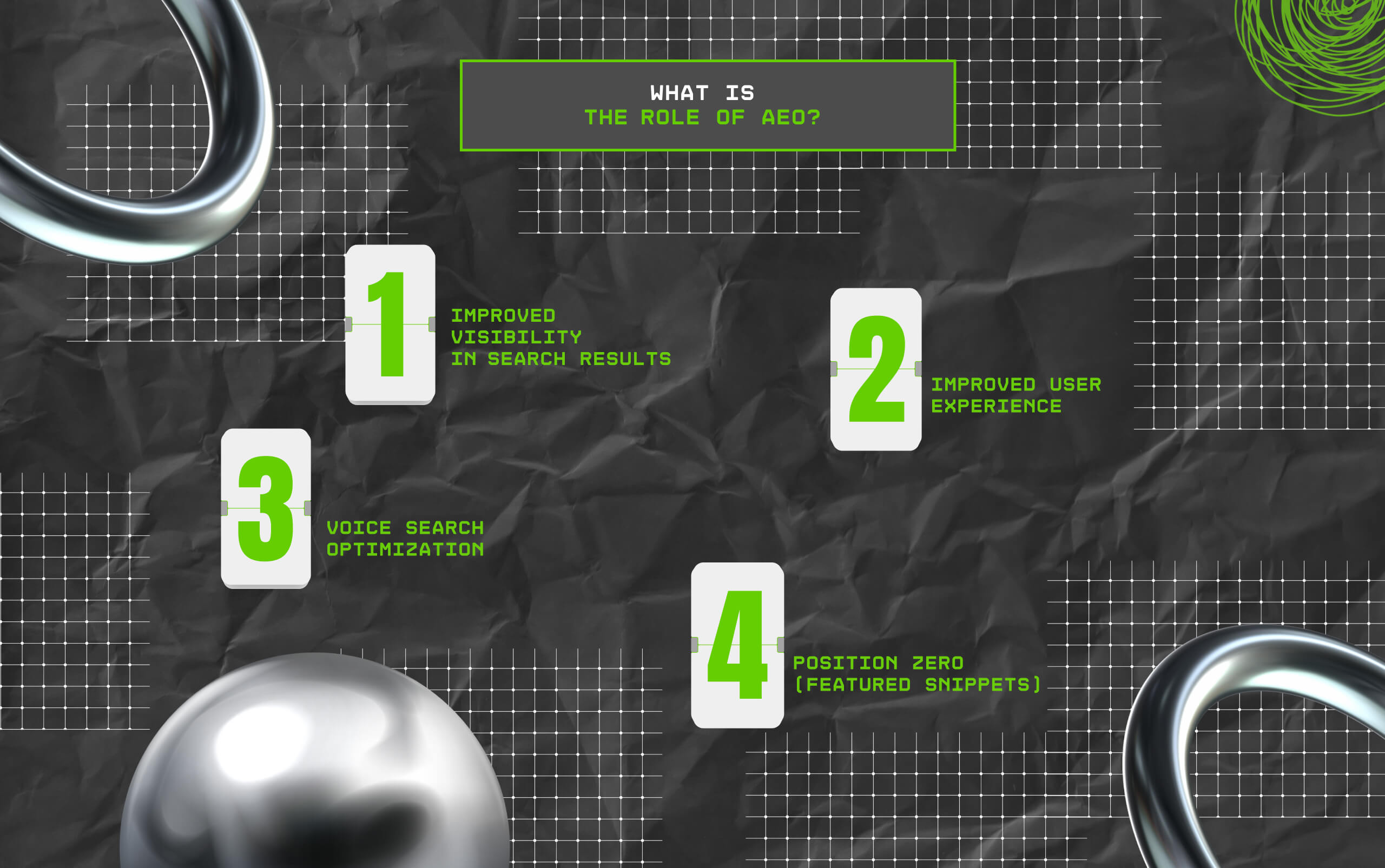
For these reasons alone, AEO is turning out to be critical to modern SEO:
The primary benefit AEO has is the increased visibility of the content. Chances are high that more users will spot your content when it’s a featured snippet or appears under the “People Also Ask” section.
This brings in substantial traffic since users are eager to click on results visible directly on SERPs rather than waiting to land on your website and then search for the same information.
Google’s primary goal is to quickly enhance the user experience by providing the most relevant information.
By answering questions directly AEO improves the efficiency of the search process. It allows users to find the information they need without having to navigate through multiple websites.
Given the increasing popularity of voice assistants such as Google Assistant, Siri, and Alexa, voice searches require direct, simple answers.
And since voice search is primarily a feature for mobiles, AEO is very mobile-friendly, making it easier for mobile optimization.
Voice queries are usually short, question-phrased, often like how a person might ask a question in a normal, conversational context.
Optimizing for AEO means your content is more likely to be eligible to appear as a direct answer in the voice search results.
Position Zero, or the featured snippet, is perhaps one of the most coveted positions in search results, even though it gives an instantaneous, brief answer at the top of the page with a link back to the source content.
Being in such a spot makes your content more noticeable and increases your site’s authority and relevance.
AEO can help content creators maximize their chances of being featured by optimizing for this coveted position.
Do not confuse AEO with SEO. AEO requires attention to those strategies that would best satisfy search engines but should simultaneously clearly deliver answers to users.
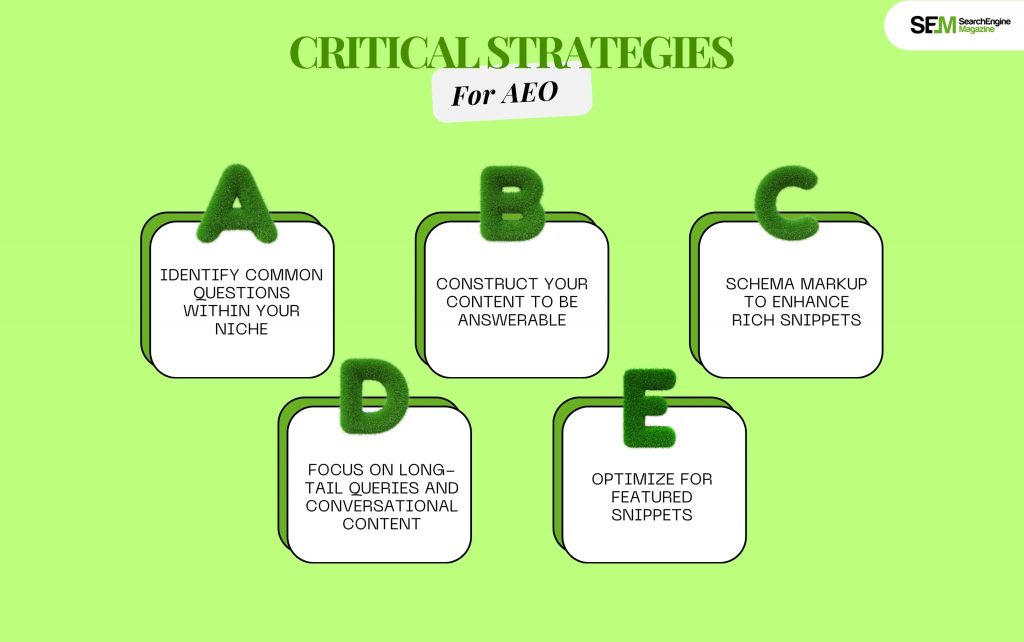
Below are some critical tactics that can help improve your AEO efforts.
One of the starting steps in AEO is figuring out the kinds of questions users in your niche are asking.
Conducting thorough keyword research and digging through “People Also Ask.” It may help identify common queries your target audience is searching for.
From this, you understand the most frequently asked questions, and you can determine how you can directly answer your content.
As the content is well-structured and easy to read, search engines look for it.
AEO optimization means structuring your content answerably so users and search engines can easily find and understand the answers to their questions.
Best Practices:
Schema markup is a form of microdata that can help search engines better understand the context of your content.
Adding structure to your web pages using schema markups increases the chances of your content showing up as a rich snippet or knowledge panel.
Schema can be used for most types of content, such as:
With conversational AI and voice search becoming increasingly prevalent, users will ask longer, more natural questions.
For example, instead of searching for “best camera,” a user might say, “What is the best camera for beginners in 2024?”
Create content that addresses long-tail keywords and questions to optimize for these queries. Create that content by—
Featured snippets are one of the most active direct ways to secure an answer in search results.
For better optimization, your content should be clear, concise, and formatted accordingly for featured snippet optimization.
Unlike traditional SEO, the technical aspect of the AEO content optimization focuses on improving the structure, speed, and crawlability.
That is, it prioritizes the overall structure of the page, its loading speed, and how the content is interpreted by the LLMs.
Some of the core technical SEO foundations for AEO include—
Firstly, the use of the proper tags in the header, footer, and article helps break down the content into distinguished blocks.
This way, the search bots can better crawl through the content and scan the sections for indexing.
Additionally, using the schema markup to structure the data of the entire content can help create a hierarchical order.
Moreover, this structured data makes it easier for AI to understand the webpage’s structure and align the content with user-intent searches.
Moreover, the speed of the page should be optimal. That is, it should not have any lagging or broken link issues.
Making the page fast-loading with good website performance.
Additionally, a clear structure of the webpage and its content can aid in updating sitemaps and creating a clean site structure.
This way, the AI models and search bots can navigate through the content to index the elements.
Finally, using descriptive texts for images and other multimedia on the webpage can help in providing contextual details to the multimodal AI models.
Making it easier for the models to decrypt the media through the texts and improve the content ranking on the webpages.
One of the simplest ways to build authority on the AI search engine pages is to create a topic cluster.
That is, users need to create content across diverse related topics under the pillar content.
This will help the AI model navigate through the interconnected pages, covering related content, to determine the site’s authority.
So, here are some of the ways clustering for a specific niche topic should be done—
Firstly, you need to create pillar content covering a broad topic from your niche industry.
Moreover, the keyword should be relevant, and the search volume should be high.
Additionally, you need to create a support system to manage the cluster topics under the pillar content.
Ensuring that the clusters cover most of the related content queries, search intent, and build a complete system.
Moreover, the relevant pages under the pillar content cluster should focus primarily on covering the major aspects of the pillar content.
So, you need to conduct thorough keyword research, map out the structure of the cluster, and plan the content strategy accordingly.
Finally, internal linking should be used to tie down the entire clusters together under the pillar content.
So, it becomes easier to navigate through the content clusters for both the readers and the AI search bots.

AEO is not a one-time deal. Instead, it is important to observe the results of this work and adjust as necessary.
Track your featured snippet rankings, your presence in the knowledge panel. And all other formats of direct answer formatting that you are targeting.
Use tools like Google Search Console and Google Analytics to monitor how your content is performing in search results.
Regularly review your keyword strategy and adjust your content to align with user intent and search engine requirements.
Additionally, a key metric to understand the AEO performance of the webpage is measuring the citations, mentions, and overall audience engagement.
That is, the clicks on the content, the views, and the ranking on the AI-driven search engine results page.
With the advancement of AI, NLP, and machine learning, the future of AEO will only integrate itself deeper into the DNA of SEO.
Personalized answers combined with relevant context, as toolchains like ChatGPT and Google’s capabilities in AI offer. It will grow more meaningful over time.
The secret to success in the future for AEO will lie in staying ahead of technological revolutions and constantly updating your content to meet what the user wants.
Search engines evolve from the earlier days of indexing and ranking to understanding intent and delivering answers immediately. Businesses embracing AEO have a head start on remaining competitive in the digital space.
Chandrima is a seasoned digital marketing professional who works with multiple brands and agencies to create compelling web content for boosting digital presence. With 3 years of experience in SEO, content marketing, and ROI-driven content, she brings effective strategies to life. Outside blogging, you can find her scrolling Instagram, obsessing over Google's algorithm changes, and keeping up with current content trends.
View all Posts

SEO Content Audit: A Practical Framework For ...
Jul 25, 2026
The Complete Guide To Free Rank Tracking
Jul 25, 2026
Maximizing B2B Reach: SEO for LED Power Suppl...
Jul 25, 2026
How Clinical And Reference Labs Should Choose...
Jul 24, 2026
Why MIB Browsers Are Valuable For Network Tro...
Jul 24, 2026