The Traffic-to-Revenue Gap: Why More Website Visitors Don’t Always Create More Customers
Sep 17, 2026
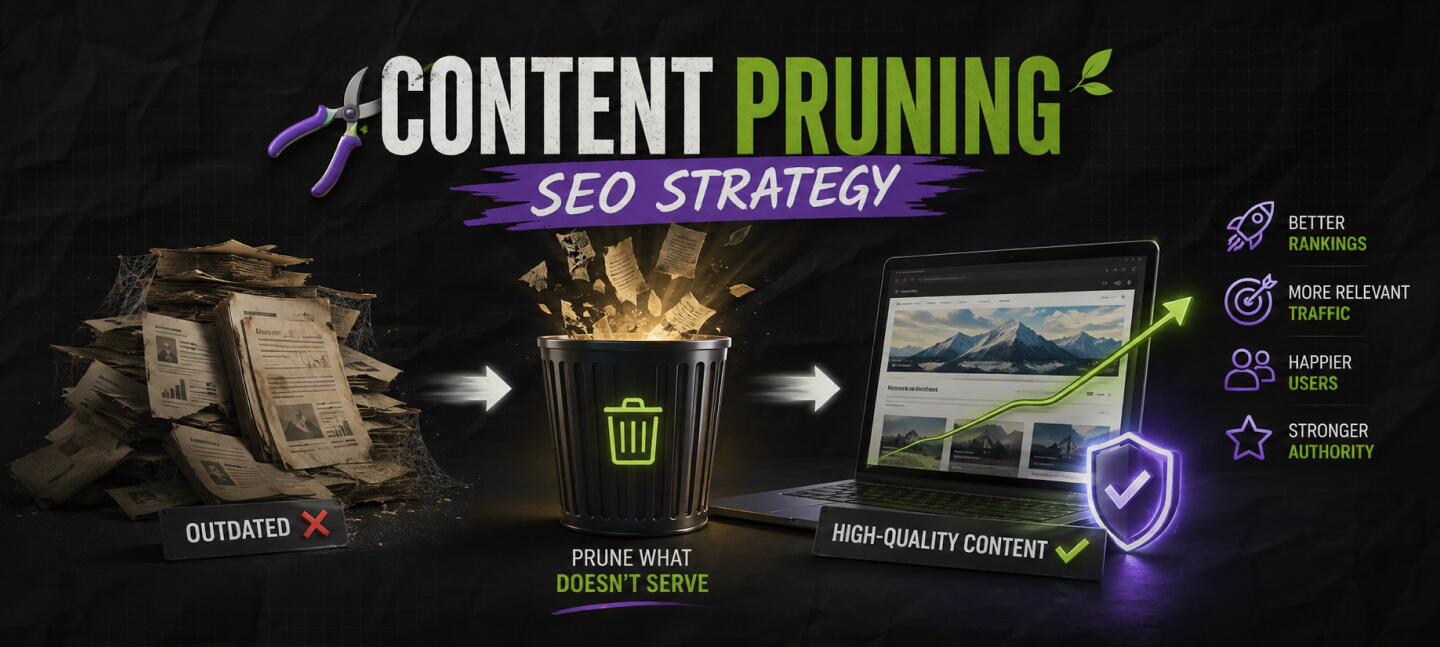

Following the brutal hit from the 2024 Google March Update, my organic traffic went into a tailspin. Like thousands of other creators, I watched my rankings plummet overnight as Google shifted its algorithmic weight toward rewarding lean, hyper-relevant websites.
As a digital marketing writer with over 8 years of experience in this market, I found navigating that volatile landscape an incredible learning experience. It forced me to strip away old assumptions and implement an aggressive, highly effective content pruning SEO strategy.
The pivot truly yielded results.
Within months, my traffic stabilized, and organic impressions began climbing back up.
Unlike what most amateur blogs might think, SEO content pruning is not simply about going on a frantic deleting spree. Moving blindly will destroy your hard-earned link equity. Instead, every single action must be intentional. Strategic. Almost surgical.
Technically, content pruning is a highly structured process of evaluating, updating, consolidating, or deleting outdated and underperforming pages from your website.
Think of it as a tactical triage for your digital archives. It removes the dead weight that triggers sitewide quality penalties, allowing your best assets to finally breathe.
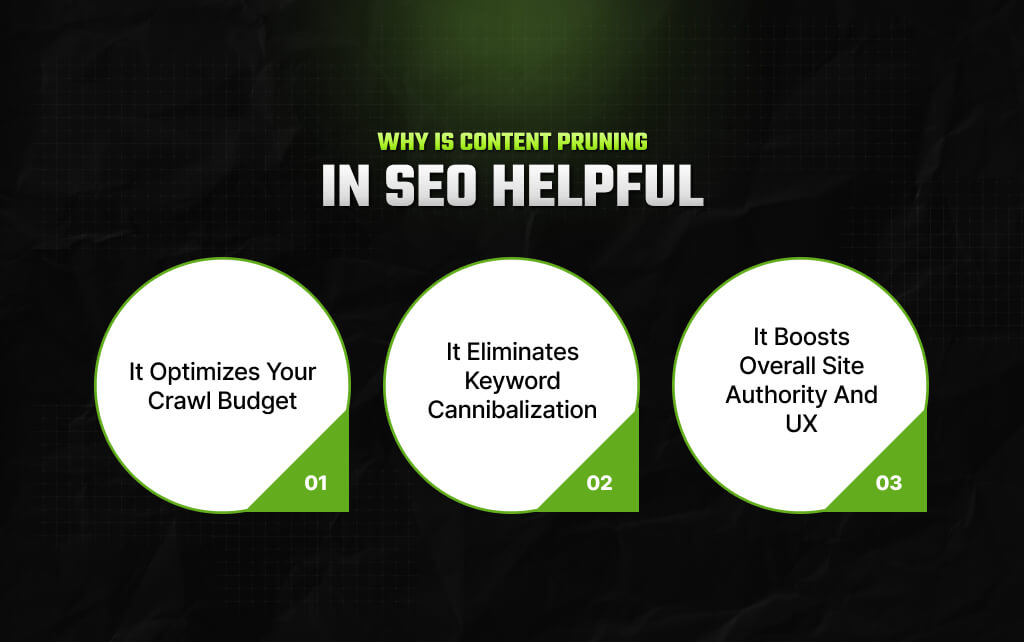
So, technically, it is not solely dependent on simply deleting old pages. It is much more than that. And when done properly, this systematic cleanup optimizes your crawl budget, eliminates keyword cannibalization, and helps your website grow immensely.
If you are ready to stop feeding Google thin content and want to build an effective content pruning SEO strategy that actually survives the algorithm, stay tuned.

It is the technical process of auditing your underperforming, thin, or outdated URLs to ensure every single page earns its keep. According to Yoast, it is “a form of content maintenance.” And the target of this strategy? Underperforming content or pages.
Google rewards lean, high-quality sites. But you don’t just hack away blindly. You triage your archive into three distinct, high-impact actions:
So basically, by systematically cleaning up your digital footprint, you eliminate internal keyword cannibalization and optimize your crawl budget. It works.
And trust me – speaking from experience – when done properly, this is exactly how you make your best content flourish and help your website grow immensely.

The short answer is yes. And guess what? The data proves it.
We know that only 1.94% of all web pages capture monthly search traffic from Google. The remaining 98%? It is dead weight that dilutes your site’s authority and drains your crawl budget.
According to SEO Statistics for 2026, when you prune, you concentrate your internal link equity, sending stronger quality signals straight to search engine bots. [Source: Ahrefs]
The industry proof is undeniable:
The math is simple. Stop feeding Google thin content. Clean your archives, protect your URLs with clean 301 redirects, and let your best assets finally rank.
Frankly speaking, Google doesn’t want your fluff. It wants your absolute best. And that is exactly what a content pruning SEO strategy helps you with.
Because, TBH (and as I have already told you before), pruning isn’t just about deleting pages. It is about restructuring your entire digital footprint for maximum performance.
Here are the major benefits of SEO content pruning:
Googlebot doesn’t have infinite time for your website. Every domain has a crawl budget – the number of pages a bot will index during a single visit.
If search bots are wasting precious time crawling outdated event announcements or thin, low-value blog posts, they miss your money pages.
So – if I have to put it simply – pruning forces bots to crawl only your highest-converting, revenue-generating content.
Stop competing against yourself. When you have multiple, overlapping articles targeting the identical search intent, you confuse the algorithm. Besides, Google cannot determine which URL to rank.
So it suppresses both.
Therefore, consolidating these duplicate pages into a single, authoritative powerhouse resource immediately concentrates your ranking power and clears up your search signals.
Finally, pruning old and underperforming content genuinely helps you improve your overall website authority. Let me explain why.
As we already know, Google evaluates your site on a sitewide quality threshold. So, obviously a handful of high-performing pages cannot really save a domain weighed down by hundreds of dead-weight URLs.
Instead, removing the rot instantly elevates your average content score. When I did this for my site, I saw results almost instantly.
Your visitors stay longer, navigate more easily, and find accurate information. This creates a high-converting user experience that search engine algorithms love to reward.
Trust me when I say this – initially, I was nervous about this entire content pruning SEO strategy myself. I was not sure whether Google would see this as a positive signal or not. Which is why I did my share of research.
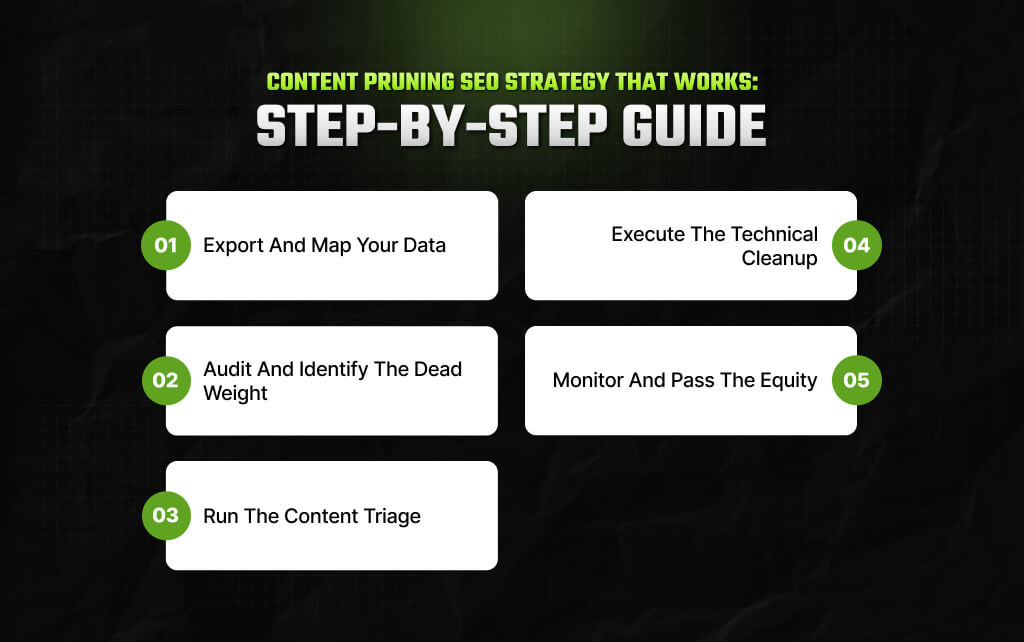
Eventually, I came up with this strategy that really worked for me. Here are the steps:
First and foremost, never prune blindly. Ever.
Your first step is to pull a comprehensive inventory of your website to see exactly how your assets are performing. You will want to run a crawl using a technical tool like Screaming Frog to grab every live URL on your domain.
Once you have that list, pull data from Google Search Console and Google Analytics, looking at a full 12-month window. Overlay these datasets into a single spreadsheet so you can analyze organic impressions, clicks, keyword rankings, and conversions side by side.
| Metric To Collect | Primary Tool Source | Strategic SEO Purpose |
|---|---|---|
| Total Organic Clicks and Impressions | Google Search Console | Identifies if Googlebot even surfaces the page to users. |
| Conversions and Bounce Rate | Google Analytics 4 | Determines if the page holds real business and transactional value. |
| Word Count and Index Status | Screaming Frog SEO Crawler | Spots thin content and hidden structural indexing issues. |
Secondly, once you have mapped out your data, it is time to hunt for the warning signs of algorithmic decay.
You are specifically looking for pages that drag down your sitewide quality score and dilute your search authority.
Target URLs that have pulled in zero clicks or impressions over the last six months, duplicate topics that confuse search engines, and thin posts under 500 words.
However, you must avoid the amateur trap of deleting critical backend assets. Keep privacy policies, terms of service, and direct-traffic paid landing pages safe from your pruning list.
This is where the surgical work happens. You must evaluate every underperforming URL on your spreadsheet and assign it to one of three distinct action buckets based on its remaining potential.
As I have already mentioned above, to determine the right path for your underperforming URLs, follow this decision matrix:
| Content Condition | Action | Strategy |
|---|---|---|
| Ranking pages 2 – 3 | Improve | Update data/visuals; add internal links. |
| Duplicate / thin / old | Remove | Merge insights; delete URL; 301 redirect. |
| Paid / seasonal landing | Hide | Keep live; apply noindex, follow. |
Execution is where most writers mess up. A sloppy cleanup will trigger a massive wave of broken links that ruin your user experience and panic Googlebot.
When you improve a page, keep the original URL exactly the same to preserve historical ranking signals. When you remove a page, never leave it as a broken dead end.
I would genuinely recommend that you immediately implement a 1:1 permanent 301 redirect to the closest relevant article on your site.
Also, for hidden pages, open up your SEO plugin and add a strict noindex, follow tag. In this way, you let users access it via direct links while signaling search engines to stay away.
Your job isn’t finished just because the site cleanup is complete. You need to proactively force Google to recognize your new, leaner architecture.
Head into Google Search Console and resubmit your updated XML sitemap to trigger a fresh crawl of your domain.
To accelerate your recovery, build fresh internal links from your top-performing, high-authority pages directly to your newly improved pieces.
Monitor your indexation status and crawl efficiency over the next 30 to 60 days to watch your traffic climb.
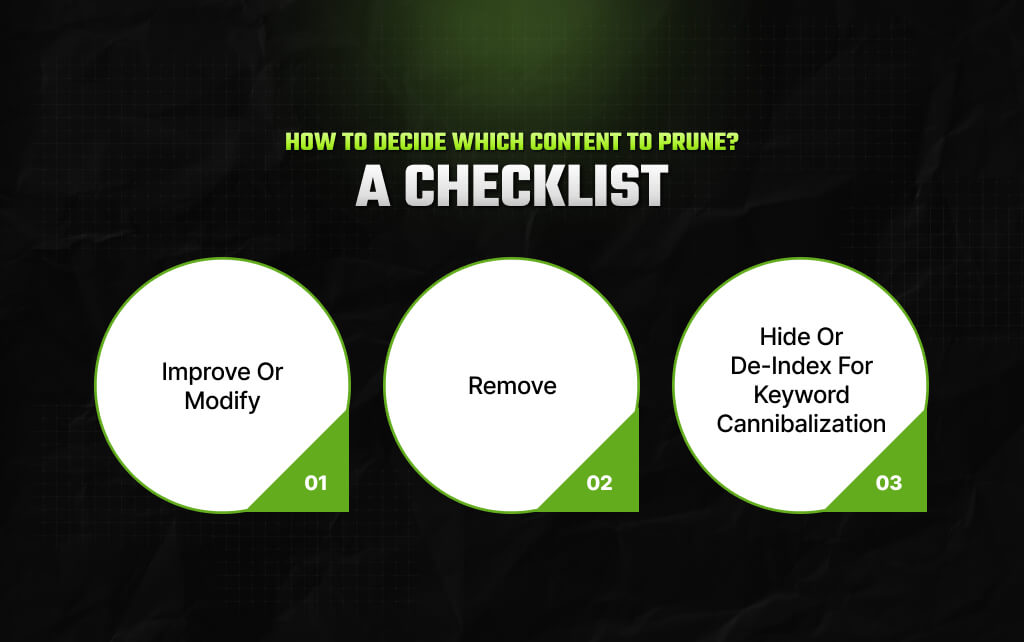
Before touching your content, look at the page’s primary goal. From my experience in this field, I have understood a golden rule in SEO: Every URL must earn its keep.
When you are carrying out a content audit, you have three strategic paths:
Here’s the checklist that will make your task easier:
This is for high-quality, older content currently languishing on page two of Google. It has the foundation to rank; it just needs an algorithmic push.
Here’s what you need to do:
Build strategic internal links from top-performing pages to pass link equity. Once refreshed, push it out to your newsletter and social channels.
Outdated event announcements or duplicate, thin content on topics you’ve covered better elsewhere are actively dragging down your crawl budget.
This is what I did for my site that really worked:
And yes, always implement a 301 redirect from the deleted URL to its new equivalent. Never leave your audience, or Googlebot, stranded on a frustrating 404 error page.
Sometimes, great content hurts your SEO. Hyper-targeted PPC landing pages or seasonal sales posts often compete with your core informational content for the same keywords.
One of the most important things that you can do in this regard is to keep the page live for direct traffic, but apply a noindex tag.
This is something that instructs search engine bots to ignore the URL, preventing internal keyword cannibalization and keeping your search signals crystal clear.
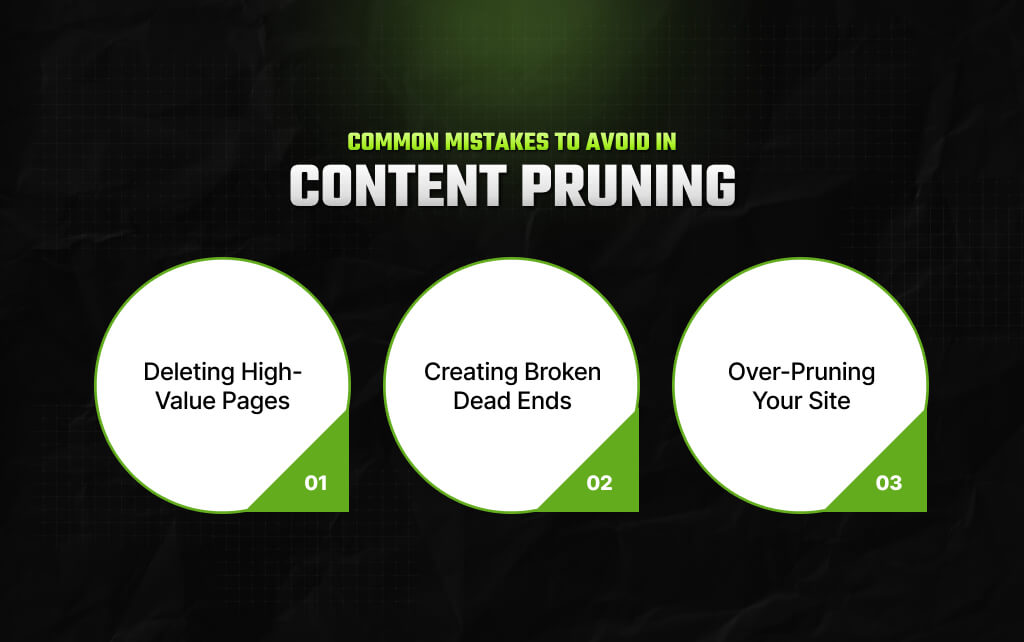
All the years that I have spent in this market have shown me that writers consistently fall into the same three technical traps:
Avoid these careless slipups to protect your link equity and keep your optimization strategy running smoothly.
TBH, it depends entirely on your publishing volume, but consistency is non-negotiable. Treat it as a routine technical health check, not a one-time panic reaction.
According to data and recommendations from top optimization platforms, your schedule should match your site’s velocity:
The Core Update Exception: Regardless of your calendar, you must immediately trigger a surgical prune whenever a major Google algorithm update impacts your visibility. Waiting for a fixed schedule when thin content is actively hurting your rankings is a mistake your traffic cannot afford.
Barsha is a seasoned digital marketing writer with a focus on SEO, content marketing, and conversion-driven copy. With 8+ years of experience in crafting high-performing content for startups, agencies, and established brands, Barsha brings strategic insight and storytelling together to drive online growth. When not writing, Barsha spends time obsessing over conspiracy theories, the latest Google algorithm changes, and content trends.
View all Posts

The Traffic-to-Revenue Gap: Why More Website ...
Sep 17, 2026
The Volatility Trap: What Crypto Position Siz...
Sep 17, 2026
Schema Markup: How To Use It Without Turning ...
Sep 17, 2026
Turn A Search Question Into A Watchable Expla...
Sep 16, 2026
Agency Guide To YouTube Growth: Wholesale Pri...
Sep 15, 2026