KeywordStat Review: Keyword Research, Clustering & SEO Data Compared
Oct 03, 2026


My relationship with Google updates started with the Panda update – of course, I had no clue what was happening.
TBH, my website wasn’t impacted. But what I did face was a heavy penalty from Google in March, 2024 – the similarities between the two updates were striking.
What Google launched with the Panda update was iconic, but people didn’t really suffer, at least not at the scale they did after the March update of 2024.
9 months – it took me 9 long months to get my website to 1k organic traffic from 0. And after two years, I’ve finally managed to take my website to its former position with 35K stable traffic.
Based on my personal experince and industry insights, here’s my take on the Google Panda update.
Stay tuned.
Initial Release Date: February 23, 2011.
In February 2011, Google launched the Panda update, and the rest was history.
This update was launched with a specific purpose in mind – to boost Google’s attempt to eliminate webspam and any black hat search engine optimization tactics.
During this time, users were already frustrated with content farms and their rapidly growing influence.
And then, the Google Panda Update was launched with a killer algorithm for making a quality ranking factor for web content.
The quality classification was being used internally and created on the basis of actual human ratings.
In 2026, it’s finally becoming easier to understand the relevance of this update – improved user experience and quality of content.
Here’s all that you need to find out about the update – more information that led to its launch, its algorithm, and its entire timeline.
2010 was a truly dark year for Google, with decreasing quality of search results and growing popularity of those content farms. Google’s business model was thus suffering greatly.
The then Senior Vice President of Google, Amit Singhal, in fact, later told Wired (at TED) how the 2009 Caffeine update had increased Google’s indexing speed but, in the process, had ended up introducing some content that lacked quality.
The then head of Webspam, Matt Cutts, even said that this new issue related to content was not really a spam issue.
After this, ReadWriteWeb pointed out something quite interesting!
They said that by the time 2009 came to an end, two content farms, Answers.com and Demand Media, had already made it to the list of top 20 sites in the US, according to ComScore.
Now, these farms were creating nearly 7ooo content pieces every day – the epitome of such farms!
For instance, Demand Media’s policy was simple. Pick any niche, create some random content, target search engines, use social software to make those content pieces viral, and make plenty of money through advertisements.
Then Business Insider published a headline that said, “Google’s Search Algorithm Has Been Ruined, Time to Move Back to Curation” in the month of January 2011.
Fortunately, all these media coverages started influencing Google significantly. Google’s response? The Google Panda Update!
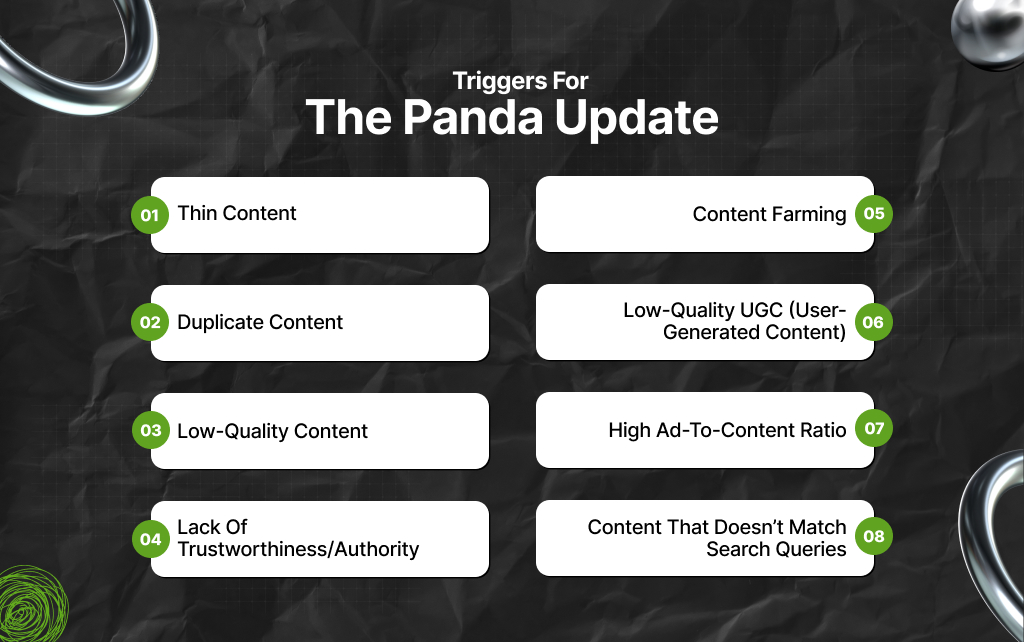
The Panda update was able to address several issues related to the search engine giant’s SERPs. This included:
Weak pages that have hardly any substantive or relevant resources and texts, such as pages featuring different health conditions, but with only a few sentences on every page.
Content that has been copied from existing content on the internet is known as duplicate content.
Also, it is possible if you have multiple web pages with the same content on your site with zero to little variation.
For instance, a washing machine company might create 15 pages with one page featuring a city where the washing machine is sold.
Now, if the content turns out to be almost similar to the city name, with the only difference being the city name, then it all gets flagged under duplicate content.
This one’s super important – and not just for the Panda update but all updates since then, be it the 2024 March update or the 2025 Spam updates.
Any page that fails to help users and offer hardly any value to its readers falls under low-quality content because such content pages lack information and depth.
Content produced by any source that isn’t verified or considered definitive points to a lack of authority and trust.
According to a Google representative (source: Moz), one way to mitigate the impact of the Panda update is to become an authority on the topics your site covers.
Content farming refers to several pages featuring low-quality content, usually aggregated from other sites.
For instance, content farms employ several writers at low costs for creating short content pieces on a variety of queries that have the potential to rank at the top of search results.
The problem? These content pieces lack value and authority for readers because the primary purpose is to obtain rankings on SERPs for every possible phrase.
An instance of low-quality user-generated content is a blog website that primarily publishes guest posts that are short, lack value, and have several grammatical errors.
Pages featuring a lot of paid advertisements instead of anything original can also trigger a penalty from Google.
This is because excessive advertisements can create a poor user experience by stealing the limelight from the content.
Plus, it fails to meet the search engine giant’s content policies as per the Panda update.
Any pages that promise to deliver helpful answers when clicked but fail to provide any value can trigger a penalty as well.
For instance, a page with the title ‘Discount Coupons For Essentials,’ sounds great to a user who is looking for a way to cut down living costs.
But on clicking, if the user doesn’t find any coupon, then it might be just a page for advertisements – naturally, this impacts the overall user experience.
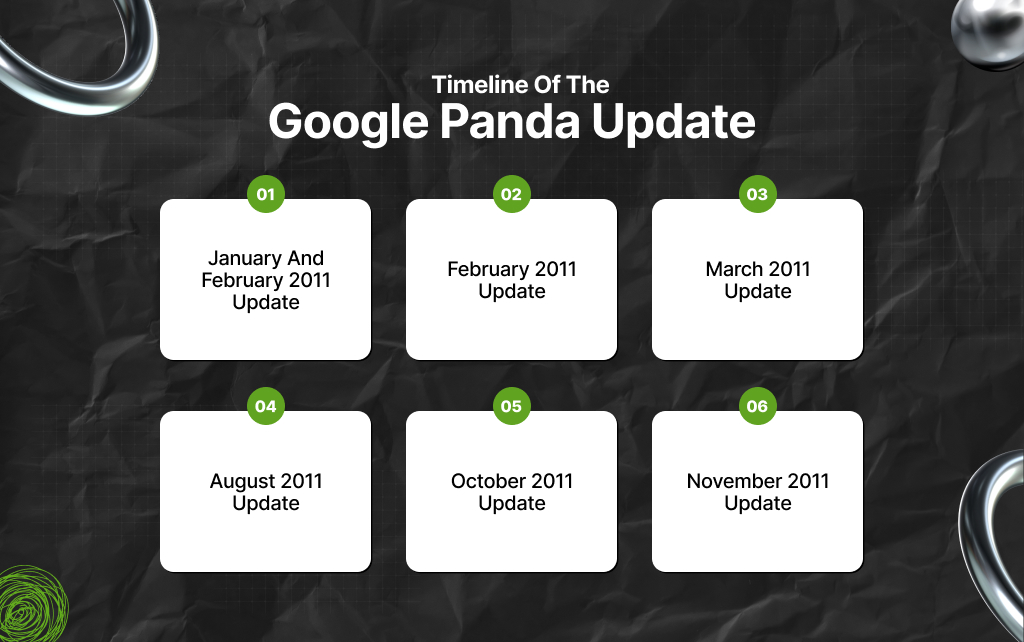
Now that you have a fair idea about what the Google Panda update is, let’s look at its exciting timeline!
Google punishes Overstock.com and JCPenney for doubtful link-building practices.
At the very beginning of 2011, both Overstock.com and JCPenney saw their rank fall on search engine result pages greatly.
It was soon discovered that Google punished these two sites for using shady link-building tactics to move traffic to their product pages from unimportant sites.
Thus, the quality of inbound links was now based on site authority and relevance according to Google’s algorithm.
The Google Panda Update next punished spammy, low-quality content published by content farms.
This update went after all content farms using poor-quality content and, depending primarily on quantity, littered with advertisements.
The update affected a solid 12% of the entire search result.
Google then came up with incorporating social sharing in its algorithm.
The result was Google’s development of the +1 button – an attempt at Google’s plan to gain access back to the world at large.
The Panda Google Update was tremendous, and in August, Google came up with Expanded Site Links.
This move helped users to find out exactly what they were searching for on any website, even after using a vague phrase for initiating the search in the first place.
For instance, if a user enters HubSpot in the search engine, the user will land on the HubSpot homepage with at least six links to other content by HubSpot that the user might read next.
What all the Google updates failed to do was encrypt search queries. So in October, Google even began doing that.
As a result, any logged-in user on Google can perform a search without losing search referral information to their destination websites.
Simply put, website owners will not be able to find out the keywords users use to land on their websites.
The Google Panda Update truly changed things forever.
The November update started rewarding fresh content – this move impacted a solid 35% of all search queries.
Thus, this was Google’s choice of rewarding quality over quantity. Today, content that’s qualitatively written has better chances of ranking on search engine result pages.
The Google Panda Update was a marketing boon in disguise, but marketers soon figured it out. Scroll down to find out the top 3 benefits of the Panda Update, especially for marketers.
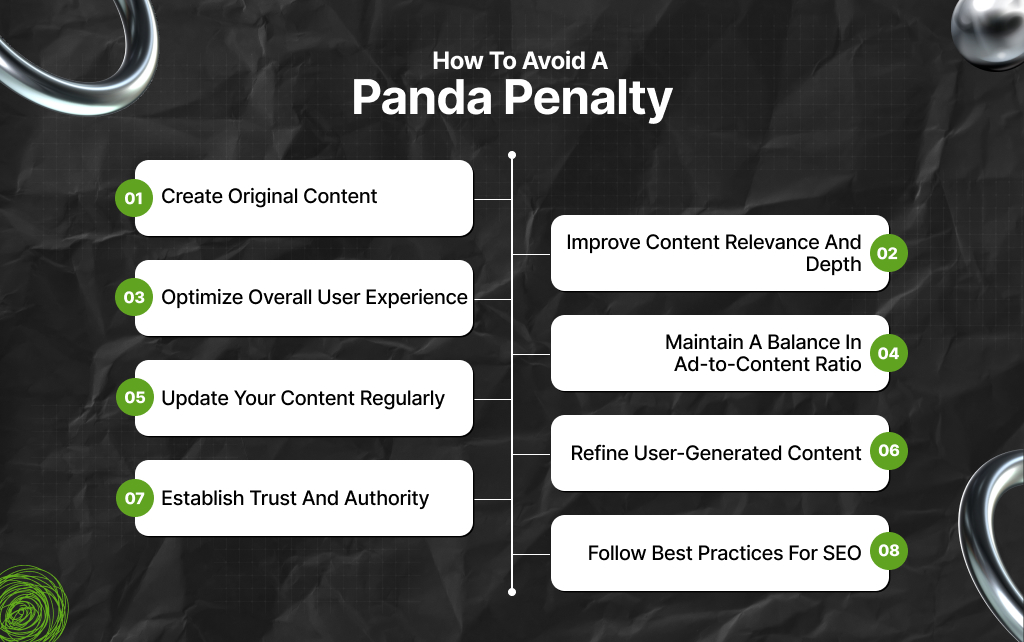
To avoid a penalty by the Panda update, it is crucial to prioritize creating valuable (and high-quality) content – the idea? To help your audience.
On that note, I have a list of best practices that can help you ensure your site aligns with the strict Google policies.
Ensure that you are creating content that is unique – it cannot be a duplicate of stuff already published elsewhere. This is because originality is super important for differentiating your website from low-quality, spammy content farms.
Offer insightful and comprehensive information that addresses search queries at length. Moreover, avoid creating thin and unhelpful content that lacks value and substance.
Design your site in a way that is user-friendly, complete with a clean layout and easy navigation. This includes optimization of page loading times and mobile compatibility.
Avoid stuffing your web pages with too many advertisements. Moreover, it is safer to focus on improving the site’s user experience by maintaining a relevant balance between your content and advertisements.
Ensure your content stays fresh, helpful, and relevant – you can only do it by updating it regularly. This will not only refine user engagement of your website but also send a signal to Google that your website is current and active.
Track and moderate user-generated content – that way, you can ensure that UGC on your website is meeting all quality standards. Moreover, accept contributions that actually add value and don’t have errors.
Built your website’s authority – source content from trustworthy professionals and link to authoritative resources online. This, in turn, will enhance your credibility for both search engines and users.
Implement effective SEO strategies that align well with Google’s standards, such as creating content with relevant keywords, optimizing all meta tags, and ensuring a healthy website structure.
Once you adhere to these practices, you will be able to protect your site from Google’s penalties and refine your rankings on search results.
Also, prioritize high-quality content and creating a good user experience to develop a credible online presence.
Barsha is a seasoned digital marketing writer with a focus on SEO, content marketing, and conversion-driven copy. With 8+ years of experience in crafting high-performing content for startups, agencies, and established brands, Barsha brings strategic insight and storytelling together to drive online growth. When not writing, Barsha spends time obsessing over conspiracy theories, the latest Google algorithm changes, and content trends.
View all Posts

KeywordStat Review: Keyword Research, Cluster...
Oct 03, 2026
How Corda Turns Authority Data Into Campaigns
Oct 01, 2026
How To Audit Your Search Visibility In 2026: ...
Sep 30, 2026
What Is Google Lighthouse? A Practical Guide ...
Sep 30, 2026
When Can You Save A Public Instagram Story?
Sep 30, 2026