
The Traffic-to-Revenue Gap: Why More Website Visitors Don’t Always Create More Customers
Sep 17, 2026

Alphabet’s total revenue surged past $402 billion, with Google advertising alone driving $82.3 billion in a single quarter. This massive scale of investment highlights the absolute dominance of Google Ads in the global digital landscape.
However, this success occurs in a highly complex ecosystem in which over 912 million internet users actively use ad-blocking or ad-filtering software.
Managing Google Ads today demands advanced machine learning optimization, structured first-party data strategies, and continuous campaign maintenance. Most businesses opt for specialized Pay-Per-Click (PPC) services to handle this complexity.
If you’re considering outsourcing your marketing spend, you must know how to choose google ads agency.
For a high-level strategic breakdown, this guide explores the critical operational, financial, and legal traits required of a top-tier Google Ads agency partner.
A good Google Ads agency does more than manage bids or write ad copy. But how to choose google ads agency?
The right partner should have proven experience in your industry, transparent reporting practices, direct access to your advertising accounts, and a clear focus on measurable business outcomes such as leads, sales, or return on ad spend (ROAS).
Before signing any contract, verify the agency’s Google Partner credentials, ask who owns the advertising account and campaign assets, review recent case studies, and understand exactly how performance will be measured.
An agency that communicates openly and bases its decisions on data is usually a stronger long-term investment than one that makes aggressive promises or guarantees results.
A basic Google search will give you a plethora of options to choose from.
However, scale efficiency lies in choosing the right partner and eliminating underperforming or deceptive agencies early. So you need to know how to choose google ads agency.
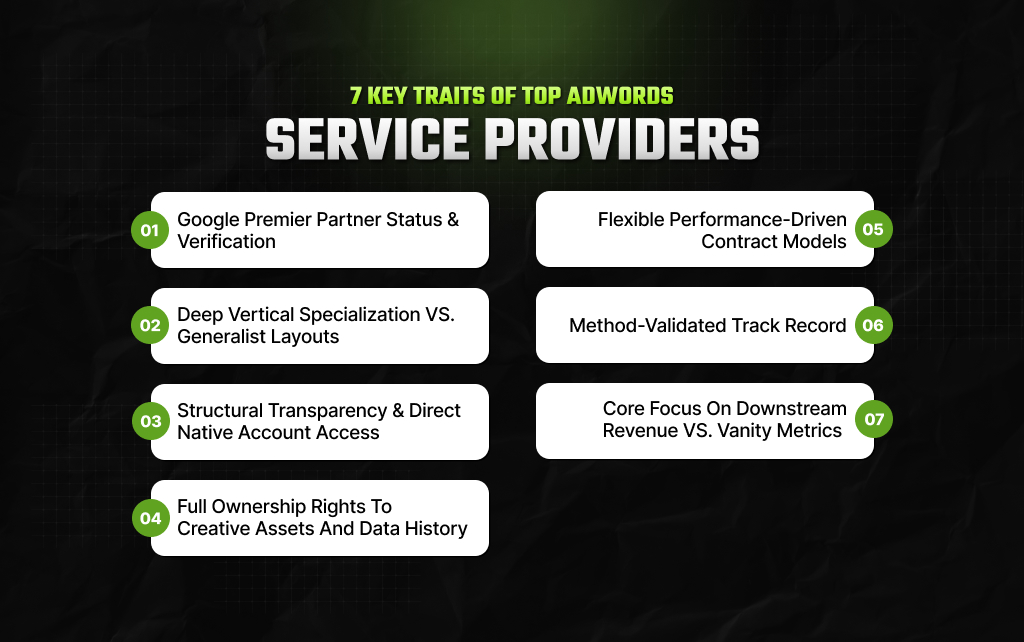
It might seem basic, but it doesn’t matter. Do not settle for a basic partner status; look specifically for Google Premier Partner designation, which represents the top 3% of participating companies in a given country.
This means they meet Google’s rigid modern criteria, including managed ad spend stability, structural optimization scores, and certified client growth metrics.
Google Partners receive direct technical escalation channels, access to beta products, and the official Partner badge. This badge on your agency’s site signals:
Top Google Ads agencies display their certificates openly on their websites. If the verification link is not readily accessible, request their formal Google Partners profile link to check their live certification status directly inside Google’s directory.
Specialized knowledge comes from working continuously in a particular field.
For this reason, it is best to work with an agency that has mastered Google Ads for years, rather than a generalist digital agency that splits its focus between web design and organic social media.
Inquire about their industry expertise. While a broad portfolio is useful, an agency holding deep vertical specialization in your exact niche (e.g., B2B SaaS, High-Ticket Lead Gen, or Enterprise E-commerce) possesses historical cost-per-click (CPC) baselines and proven negative keyword lists.
They bring valuable marketing knowledge and relevant case references. Crucially, establish a clear geographic or vertical exclusivity clause in your service agreement to ensure they do not simultaneously manage campaigns for your direct local competitors.
Google notes that most certified partners prioritize transparency. It’s a long-standing requirement that emphasizes the absolute importance of Google Partner status and individual practitioner certifications.
At any given second, you must possess full administrative visibility into your:
Avoid agencies that require you to run campaigns from their centralized master account. Non-certified or predatory agencies often lack transparency by bundling ad spend and management fees into a single confusing invoice.
You should have direct, uncompromised access to real-time performance reports and essential metrics, including impressions, CTR, quality scores, search term reports, and conversion paths.
If you have questions about your spending, your agency should provide clear answers. Don’t hesitate to inquire about the exact reporting dashboards available to clients before signing an agreement.
There are a ton of PPC agencies that use a predatory pay-per-lead model.
They direct traffic to a shared, white-labeled landing page, generating leads while completely hiding the underlying engine. Clients do not receive the creative work, custom code, or ad account data behind it.
This benefits short-term agency margins but limits long-term client independence. It works if you only want raw leads and plan to stick with the same agency forever.
However, if you seek long-term asset equity, first-party data loops, and future marketing scalability, insist on written contracts ensuring your company retains 100% ownership of the ad accounts, custom landing pages, tracking scripts, and visual creatives.
Some agencies opt for rigid, long-term contracts (e.g., 12-month lock-ins) because setting up a new client account demands upfront time and strategic resources.
Most AdWords agencies start profiling a clear profit loop after a few months into the campaign.
While a ramp-up period is natural, multi-quarter contractual locks rarely benefit the client, especially if the agency underperforms due to poor management.
Clients should have the freedom to choose based on performance milestones. A focus on strong execution and clear communication leads to a far more stable relationship.
Pro tip: Negotiate an initial 90-day structural optimization contract. Once this initial baseline is established and technical proficiency is verified, transition the agreement to a flexible month-to-month rolling contract that requires a standard 30-day notice period.
The promises an agency makes are reflected in its historical performance. The smart way to gauge their operational capability is to review their historical data portfolios.
Your agency must provide detailed case studies to demonstrate its technical expertise. You need hard data to assess their experience and track record without doubt. It’s vital to show consistent, long-term success across volatile market shifts, not just temporary, lucky traffic spikes.
├── Request anonymized, multi-quarter campaign reports.
├── Review before-and-after conversion rate optimization (CRO) metrics.
└── Verify historical data regarding average customer acquisition costs (CAC)
Your agency’s focus must be on increasing net revenue. Many lower-tier agencies prioritize surface-level vanity metrics like impressions or total clicks. Your chosen partner should concentrate heavily on converting those clicks into bottom-line revenue.
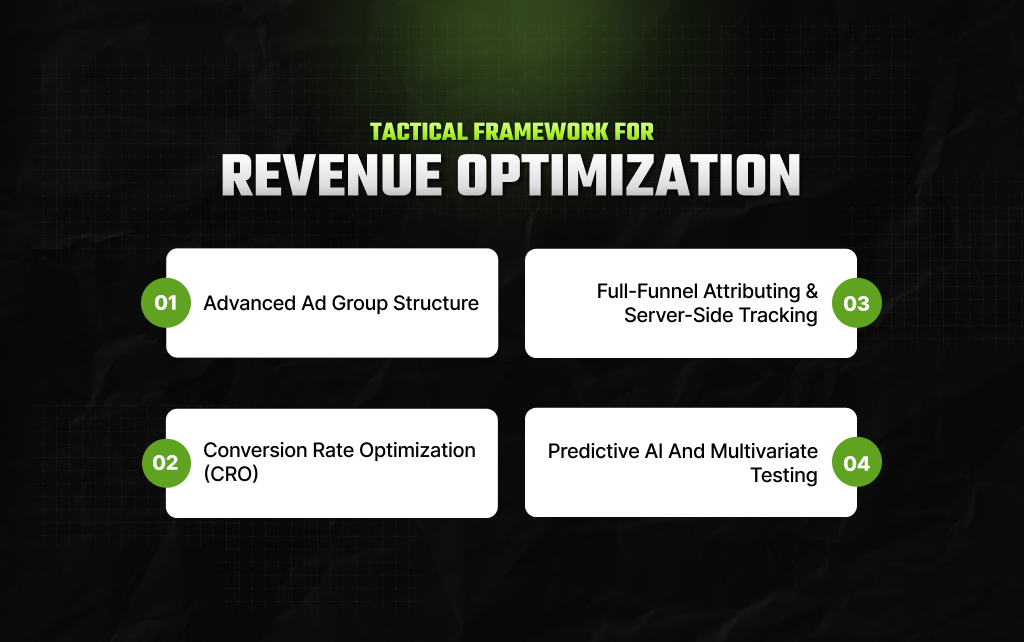
To maximize returns in a modern PPC environment, ensure your agency actively deploys the following conversion architecture:
1. Advanced Ad Group Structure: Prerequisite.
Optimize ad messaging, ad copy variation, granular geo-targeting, and precise device placement to lower baseline CPC.
2. Conversion Rate Optimization (CRO): Continuous.
Improve post-click performance with tailored landing pages, strong value propositions, and dynamic copy aligned with user intent.
3. Full-Funnel Attributing & Server-Side Tracking: Data Guardrails.
Deploy Google Analytics 4 (GA4) alongside Server-Side Google Tag Manager to bypass browser ad blockers and accurately track offline conversions.
4. Predictive AI and Multivariate Testing: Scale Phase.
Execute continuous A/B splits on creatives, bidding structures, and landing pages to safely scale Performance Max and Search campaigns.
The Direct Response Rule: Google Ads is a direct response engine. If an agency prioritizes brand awareness over direct conversion attribution and tangible pipeline revenue, they are not a viable fit for your growth objectives.
An agency relationship is a collaborative infrastructure. But you need to know how to choose google ads agency.
To secure exceptional results, your partner needs specific inputs and clear boundaries from your executive team. :
| Partner Responsibility | Client Operational Inputs |
|---|---|
| Campaign Strategy & Bidding | Set clear, measurable business KPIs (Target CPA / Target ROAS). |
| Ad Testing & Scaling | Maintain a stable product pricing model and communicate true margins. |
| Conversion Infrastructure | Keep web infrastructure reliable and fast to reduce bounce rates. |
| Data Loop Optimization | Feedback closed-won CRM sales data to train the bidding algorithms. |
Establish explicit communication channels. Appoint a single internal point of contact to prevent conflicting directives, and define your reporting cadence (e.g., automated bi-weekly data dashboards combined with an executive-level monthly performance review).
That’s all there is to it. Feel free to reach out if you have any more questions!
Read Also:
Barsha is a seasoned digital marketing writer with a focus on SEO, content marketing, and conversion-driven copy. With 8+ years of experience in crafting high-performing content for startups, agencies, and established brands, Barsha brings strategic insight and storytelling together to drive online growth. When not writing, Barsha spends time obsessing over conspiracy theories, the latest Google algorithm changes, and content trends.
View all Posts

The Traffic-to-Revenue Gap: Why More Website ...
Sep 17, 2026
The Volatility Trap: What Crypto Position Siz...
Sep 17, 2026
Schema Markup: How To Use It Without Turning ...
Sep 17, 2026
Turn A Search Question Into A Watchable Expla...
Sep 16, 2026
Agency Guide To YouTube Growth: Wholesale Pri...
Sep 15, 2026