KeywordStat Review: Keyword Research, Clustering & SEO Data Compared
Oct 03, 2026


Today’s topic: AI SEO.
Although the internet has become the quintessential element in our lives. Offering information from celebrity gossip to sink-fixing guides.
But what has really changed over the years is the way we search. For instance, five years back, users would get SERPs filled with valuable article links for any search query.
Now, search engines come with advanced algorithms to comprehend the context of the search query and respond to it, rather than simply ranking useful articles.
That is, it understands the question and directly answers it with the AI-generated responses from the chatbots.
So, ranking on Google SERPs is not enough to attract an audience. Rather, ranking on AI Overviews is the key – helping to find the right audience.
But traditional SEO is not enough. So, switching to a more dynamic SEO approach along with AI tools can keep the boat afloat in the changing digital market.
In this blog, I will be delving into the diverse nuances of AI SEO, highlighting:
Stay tuned!

A question that is filling the digital marketing world in 2025 is, “What is AI SEO?”
To explain in simple terms, it refers to the set of best practices and optimization methods that help businesses rank on AI Overviews easily.
That is, it clearly indicates the combination of natural language processing, large language models, and machine learning algorithms in SEO methods.
So, it remodels the traditional SEO practices to make them more focused on AI overview ranking. As the report from Search Engine Land shows—
“Traditional SEO relies on reactive strategies, where practitioners would study algorithms, implement changes, and wait to see results. AI for SEO changes this approach by using predictive analysis, real-time data processing, and continuous optimization that adapts to both search engine updates and user behavior shifts.”

Since the emergence of AI in the search landscape, there has been a significant shift in the search patterns among users.
That is, AI snippets and summaries of valuable content bring changes to SEO approaches. So, optimizing content with AI SEO can help improve content rankings.
Now, since AI and SEO can go hand-in-hand, some of their combined benefits include:
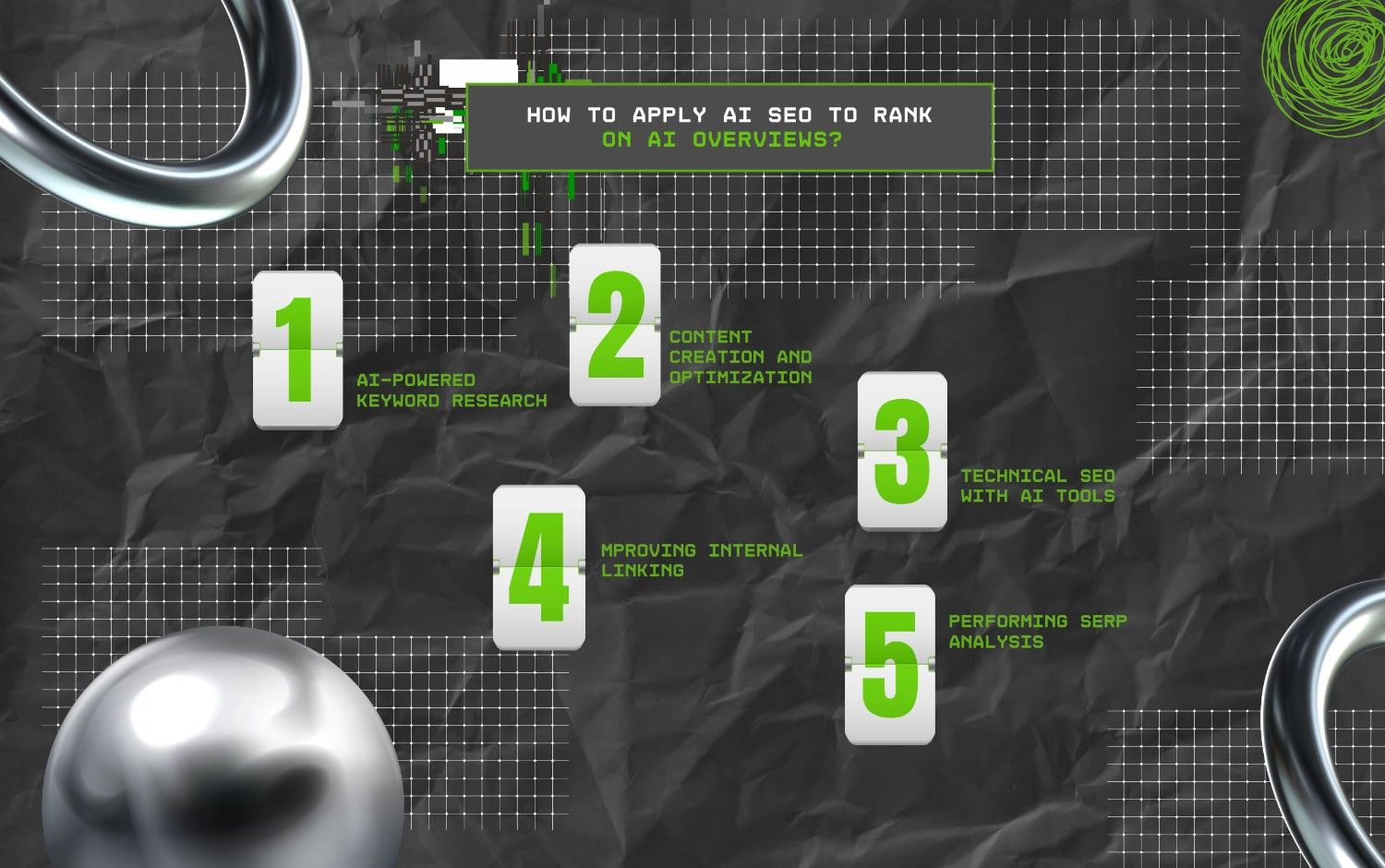
Now that you know how relevant AI is in the SEO field, here is a step-by-step guide on how to apply it to improve rankings.
Firstly, you can use the AI tools to brainstorm content ideas and conduct keyword research.
Since the AI tools utilize efficient machine learning and advanced algorithms, they provide long-tail keywords in a jiffy. According to SEMrush:
“AI tools can quickly generate a list of relevant keyword ideas that help point you in the right direction when you’re in the early stages of content planning.”
In addition to this, AI tools can help in creating SEO optimized content by assisting with topic clusters, drafting content outlines, and finding secondary keywords for the content.
That is, they can plan content around a topic – creating a pillar page and related clusters.
Also, they can help with drafting content based on the instructions. So, brands can create useful and valuable content that addresses the user queries.
Moreover, these tools also find secondary keywords. Allowing the content to target secondary keyword searches along with the primary one. So, expanding the audience base.
Since AI-powered search engine algorithms crawl through the content to understand the context, it is vital to optimize the technical structure.
So, using the AI tools for improving the technical SEO can help optimize the following:
That is, they can develop creative, engaging titles and meta descriptions for the content, attracting audience interaction. So, you can choose from the engaging list.
Given that internal linking is vital for site structure, AI tools can help find internal link opportunities and distribute link authority.
This way, businesses can link related webpages to create a topic cluster. And have a hierarchical structure for the page that allows the search engine to understand the site structure.
Finally, the AI tools help with analyzing the SERP to find the gaps and ranking opportunities for your content.
That is, they can analyze the top-ranking articles on the SERPs for a specific keyword and identify the ranking areas. Then, provide a content outline to create ranking content easily.
As the report from SEMrush points out –
“AI can speed up the process of analyzing the top-ranking pages for a keyword to see what concepts those pages cover and what they’re missing.”
Since the incorporation of AI in SEO changed the entire search paradigm, there are multiple strategies to employ it. That is, according to the blog of Neil Patel –
“AI SEO combines artificial intelligence with search engine optimization to improve keyword research, content creation, and technical optimization at scale.”
So, the AI SEO strategies combine machine learning with traditional SEO practices to provide personalized methods, automated technical audits, and predictive analysis.
Some of these key strategies include the following:

Even though AI SEO offers countless benefits in ranking articles on AI Overviews and generative chatbots, it comes with certain limitations and risks.
Some of these include:
So, simply relying on the tools is not right. Rather, combining AI tools, diverse SEO practices, and human supervision is the key to ranking on AI Overviews or SERPs.
Now, choose the right strategy to pull up your game and rank on the AI models – to attract more audience and drive organic traffic to your site.
Barsha is a seasoned digital marketing writer with a focus on SEO, content marketing, and conversion-driven copy. With 8+ years of experience in crafting high-performing content for startups, agencies, and established brands, Barsha brings strategic insight and storytelling together to drive online growth. When not writing, Barsha spends time obsessing over conspiracy theories, the latest Google algorithm changes, and content trends.
View all Posts

KeywordStat Review: Keyword Research, Cluster...
Oct 03, 2026
How Corda Turns Authority Data Into Campaigns
Oct 01, 2026
How To Audit Your Search Visibility In 2026: ...
Sep 30, 2026
What Is Google Lighthouse? A Practical Guide ...
Sep 30, 2026
When Can You Save A Public Instagram Story?
Sep 30, 2026