The Traffic-to-Revenue Gap: Why More Website Visitors Don’t Always Create More Customers
Sep 17, 2026
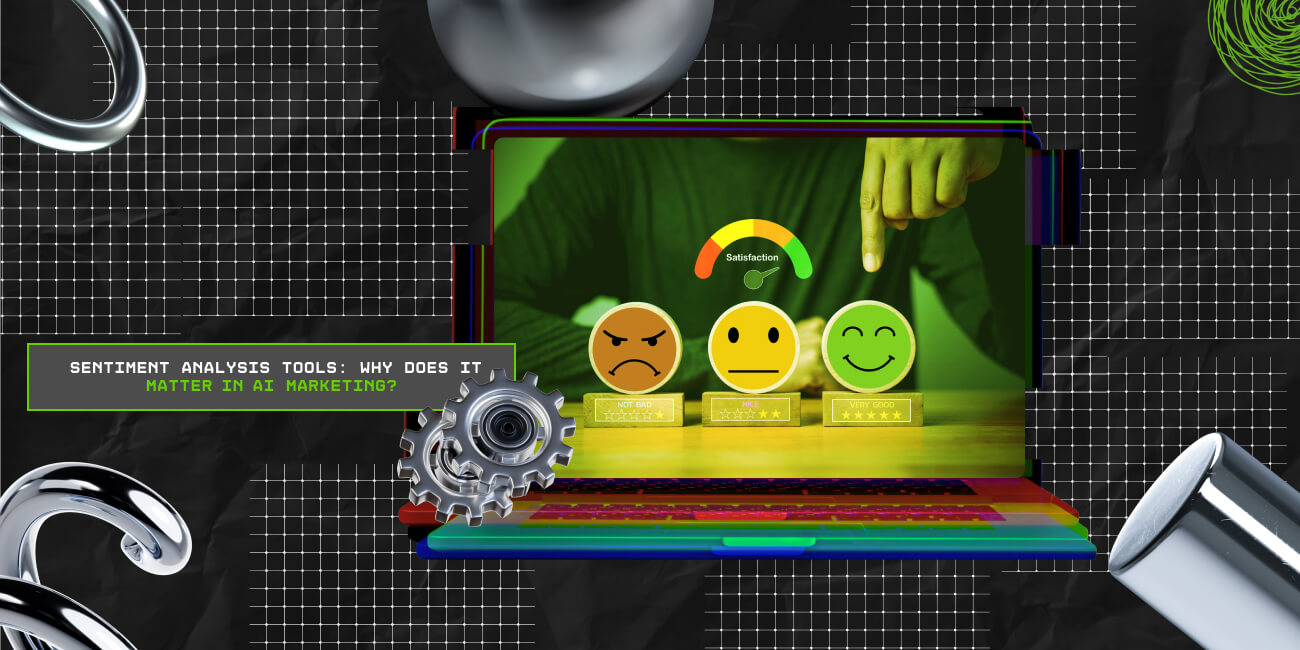

In marketing, knowing your customer in and out is the key. But understanding the sentiment of your customer in a digital space is next to impossible.
Since you cannot physically take the cues from their conversation or body language, it becomes difficult to read between the lines of their digital reviews.
That’s where a sentiment analysis tool comes into play.
It acts as a digital human and analyzes the sentiment from the diverse textual sources — customer reviews, feedback surveys, and social media posts — to classify them as positive, negative, or neutral.
Now, this decoding of emotions depicts a clear picture of the public reception of the brand’s products and services. Making it easier for brands to modify the items or marketing strategies.
But the real question is— “Why do sentiment analysis tools matter in AI marketing?” Well, no need to be confused. I have brought you the perfect guide.
Here, in this blog, I have delved into the diverse nuances of the AI-powered sentiment analysis tool by exploring—
Stay tuned!

To explain in simple terms, a sentiment analysis tool uses AI technology to identify and classify the emotions from the text sources.
That is, these tools employ the Natural Language Processing (NLP) algorithm to detect the hidden context, emotion, and tone from the texts.
But unlike human emotion detection, it executes the emotion identification process much faster. So, the sentimental context of the text is assessed in a jiffy.
Moreover, the Machine Learning (ML) algorithms and advanced technology categorize the text— positive, negative, or neutral —based on the tone. Providing a frequency rate for the intensity of the emotion.
Much of the popularity of sentiment analysis tools lies in their unique set of features and dynamic functionalities. So, some of these key features include—

By replicating the human emotion detection system, the sentiment analysis is designed to identify and classify the sentiments from texts.
That is, these tools use NLP and ML algorithms to train the models to break the text into smaller sections and interpret them.
So, there are essentially three types of methods that help sentiment analysis tools detect and classify emotions from texts.
Firstly, the rule-based sentiment detection method uses pre-determined classification for certain words to determine the sentiment.
That is, the model recalls its trained datasets to classify certain keywords and phrases as an indication of specific emotions.
So, it looks for these classifier terms to determine the sentimental context of the text.
According to the report from IBM Think—
“In the rule-based approach, software is trained to classify certain keywords in a block of text based on groups of words, or lexicons, that describe the author’s intent.”
Another method is to apply the ML algorithm to train the model to turn the text sources into measurable datasets.
So, the model can detect the keywords and the order in which they appear to identify the exact sentiment.
Unlike the rule-based method, the ML approach is more adaptable in determining the emotion and tone from a block of text. Some of the commonly used classification methods include—
Finally, in the hybrid approach, both the rule-based and ML methods are combined to optimize the accuracy and speed of the sentiment detection.
That is, it employs the technologies and high resources of training datasets for sentiment analysis. So, businesses can get a more accurate classification of public sentiment.
As the report from Amazon highlights—
“Hybrid sentiment analysis works by combining both ML and rule-based systems. It uses features from both methods to optimize speed and accuracy when deriving contextual intent in text. However, it takes time and technical efforts to bring the two different systems together.”
Since knowing the customer reception is important in marketing, sentiment analysis tools offer a lot of benefits in successfully running AI marketing strategies.
Some of these benefits include—
As AI-powered tools, sentiment analysis models provide a massive set of benefits and challenges. So, here is a clear breakdown of their pros and cons—
| Pros | Cons |
|---|---|
| 1. Provides a scalable and speedy tool to analyze the sentiments from diverse text sources. | 1. Potential for contextual misinterpretation of complex emotions or tones. |
| 2. Allows real-time monitoring of sentiments to identify the trends. | 2. Limitations in the accuracy of the model results. |
| 3. Offers consistent and objective insights into the emotions and tone. | 3. Data security risks with third-party tools using unethical data processing. |
Although these tools work with top-notch technologies, they come with certain limitations and challenges. So, some of these limitations include—
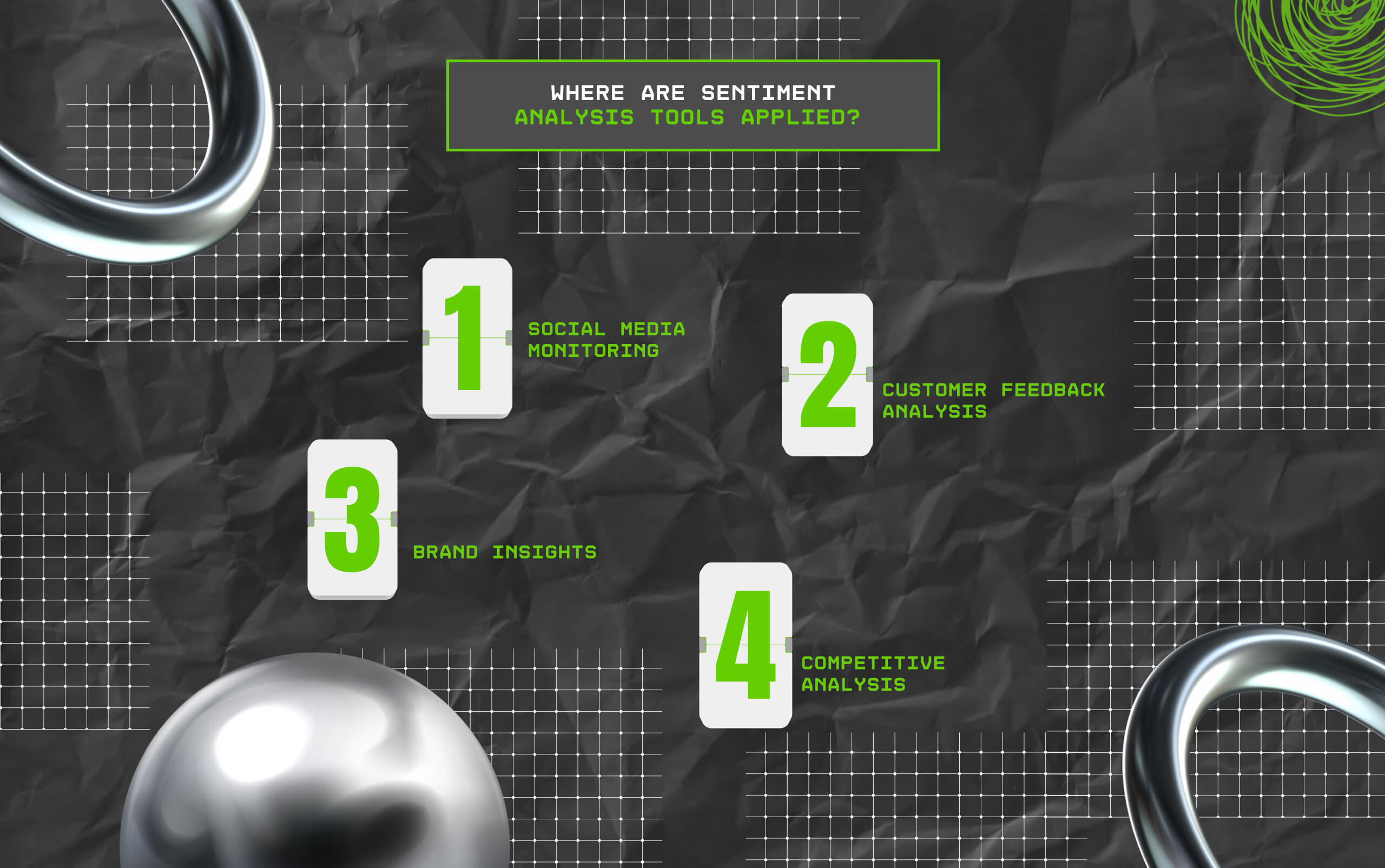
Sentiment analysis tools have massively transformed how brands understand and respond to customer feedback. So, here are some of the practical applications of these tools—
Now, here is a simple guide on how to integrate these sentiment analysis tools into the business metrics—
Since sentiment analysis tools require massive sets of diverse data to train the models, sometimes they can collect data unethically.
That is, without the consent of the customers, their data is collected for training and analyzing the sentiments. So, there is a growing concern about the ethical and privacy protocols of these tools.
In addition to this, there is a potential for misusing the data collected for manipulative tactics and unconsented surveillance.
So, before choosing the tools, learn about their data collection and processing methods to ensure they are ethical, transparent, and privacy-supported.
Given that the sentiment analysis tools come with certain limitations and ethical or privacy concerns, using them responsibly is the need of the hour. So, here are some tips—
Using a sentiment analysis tool is quite simple. You just need to ensure that its data processing is ethical and transparent, with a high accuracy rate.
And, bam! There you have the perfect tool to understand how the customers are perceiving the brand’s products and services.
But if you haven’t tried one yet, it’s high time to try your hand at one. So, implement the sentiment analysis to see how your customers react to your brand today!
Here, I have brought you some of the common questions on the sentiment analysis tools used for AI marketing.
Yes, absolutely. Since ChatGPT is an AI model that uses Natural Language Processing (NLP) to analyse textual context, it can identify and classify the emotions, tone, and sentiment from various content. So, it can conduct the sentiment analysis on a variety of content — customer reviews, feedback, surveys, and social media posts.
Unlike other AI-powered tools, sentiment analysis tools combine business intelligence and NLP technology to identify the tone and emotions. Making it easier to analyze and classify diverse tones, emotions, sentiments, and more. Moreover, these tools use AI technology to measure the intensity of the sentiments based on the text orientation.
As an AI-driven technology, NLP breaks down the text into specific words and phrases. Then, it runs the model to identify the emotion behind each of these words or phrases, delving deep into the context and tone. So, it becomes easier to classify the texts under various sentiments — humorous, sarcastic, and others.
Generally, the accuracy rate of these AI-powered sentiment analysis tools ranges from 70% to 90%. But the top-notch AI models often provide result accuracy over 90%. Moreover, the accuracy of these results completely depends on the industry, context, and diverse language complexities. So, based on these factors, the accuracy rate can differ for various models.
Although there are countless AI-driven sentiment analysis tools, some of the most popular ones include—
• InMoment — Analyzes customer reviews from multiple sources to identify the sentiment of the audience towards a certain product or business service.
• Medallia — Offers massive listening features that can identify the sentiment from the text, speech, and video content.
• Qualtrics — Provides the Text iQ feature to analyze huge sets of unstructured data from multiple sources — social media posts, surveys, and customer interactions.
• Chattermill — Analyzes the feedback from multiple sources of textual data to identify the sentiment of the public on products and services.
• Meltwater — Provides interactive dashboards to visually check the trend in public opinion on specific products from the brands.
Chandrima is a seasoned digital marketing professional who works with multiple brands and agencies to create compelling web content for boosting digital presence. With 3 years of experience in SEO, content marketing, and ROI-driven content, she brings effective strategies to life. Outside blogging, you can find her scrolling Instagram, obsessing over Google's algorithm changes, and keeping up with current content trends.
View all Posts

The Traffic-to-Revenue Gap: Why More Website ...
Sep 17, 2026
The Volatility Trap: What Crypto Position Siz...
Sep 17, 2026
Schema Markup: How To Use It Without Turning ...
Sep 17, 2026
Turn A Search Question Into A Watchable Expla...
Sep 16, 2026
Agency Guide To YouTube Growth: Wholesale Pri...
Sep 15, 2026