
What Is Content Intelligence, And How Can It Help Your Site Grow In 2026? Best Practices Explained
Aug 08, 2026


With 8 years in this industry, if I have learned something, it is the fact that SEO is evolving every day. Every second.
We are completely past the era of keyword stuffing. Buying sketchy backlinks does not work anymore. Neither does cranking out generic content calendars.
In 2026, search engine results pages are not just lists of static links. They are dynamic, live ecosystems. Google uses real-time AI Overviews. Complex semantic engines rule the web.
If your marketing strategy relies on guesswork, you are invisible. Modern search engines do not just read your text. They:
To beat the massive brands, you need a new weapon. You need a strategy backed by data science. You need content intelligence. Let me break down exactly what it is and how it works.
Stay tuned.

Content intelligence is an AI-powered system for your content strategy. It uses artificial intelligence, machine learning, and natural language processing.
It tracks huge amounts of search data. Then, it turns that data into an exact blueprint for your writing. It completely removes subjective opinions from your content creation.
You no longer have to guess what your audience wants to read. Instead, this technology actively monitors search patterns. It predicts your traffic before you write. It tells you exactly which topics to cover before you hit publish.
For a moment, I want you to think of it as a bridge. So, basically, it connects hard data science with your creative writing. It ensures that every single article you publish actually drives business growth.
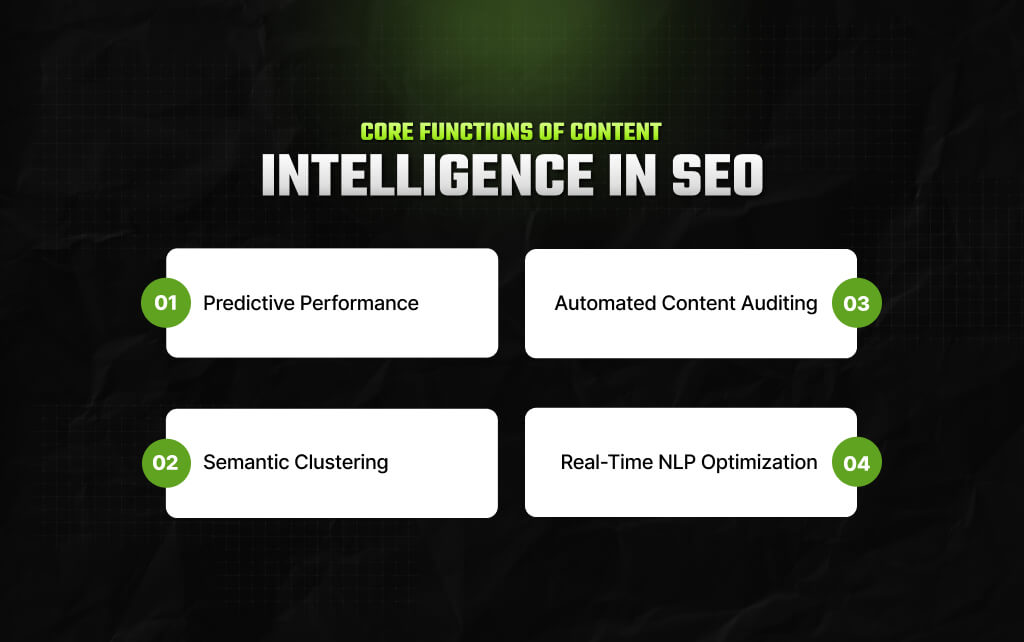
To understand why I rely on this method in 2026, we have to look under the hood. Specifically, content intelligence stops looking at lonely keywords. Instead, it analyzes the entire digital landscape.
Content intelligence tools run on a continuous four-stage feedback loop. I love this loop because it mimics how Google’s modern helpful content systems evaluate your site.
| Stage | Process Name | How It Operates |
|---|---|---|
| Stage 1 | Data Ingestion | The software crawls active search results, competitor sites, and industry trends to see what works right now. |
| Stage 2 | NLP Analysis | Linguistic AI analyzes the text. It extracts core nouns, flags the reading level, and identifies user intent. |
| Stage 3 | Prescriptive Modeling | The tool compares your competitors to your website. It highlights your weak spots and builds an exact writing brief. |
| Stage 4 | Performance Feedback | The platform tracks your live rankings and clicks. It pumps this data back into Stage 1 to make your next brief even better. |
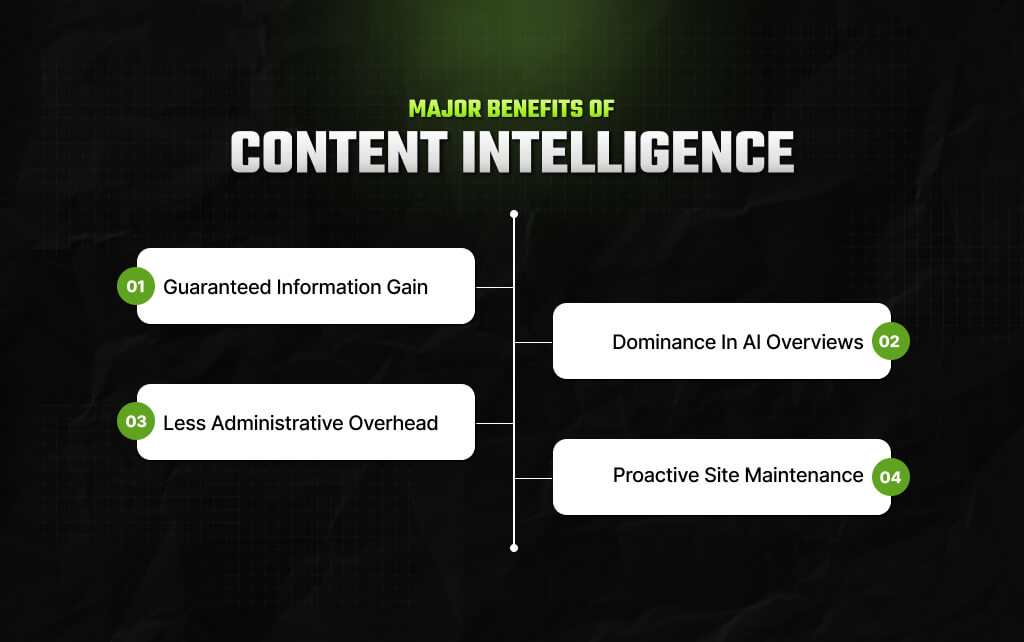
Using a data-driven workflow gives you a massive competitive advantage. This is especially true if you are a nimble team fighting giant corporate publishers.
To begin with, the software shows you exactly what your top competitors missed. Consequently, you can easily add fresh insights to satisfy Google’s quality algorithms.
Secondly, it helps you structure your text around clear entities. Therefore, AI models can easily extract your data for zero-click summary boxes.
Thirdly, it completely automates manual keyword research. As a result, your editorial team can stop building spreadsheets and start writing.
Finally, you do not have to wait for your traffic to crash to notice a drop. Instead, the tools warn you the exact moment your content starts losing relevance.
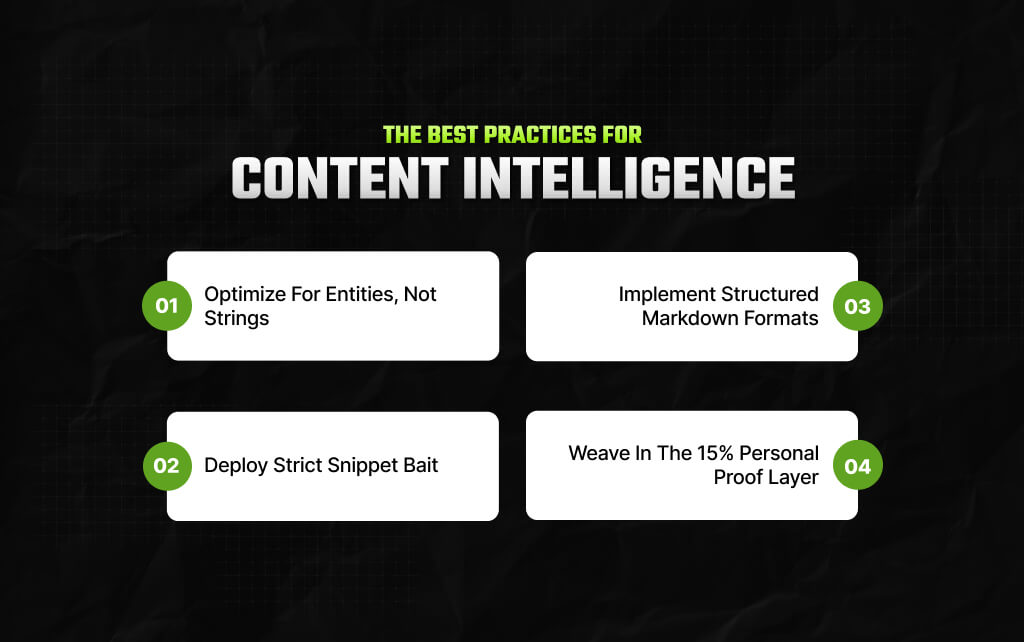
Simply buying an expensive tool will not fix your traffic. You must build a strict, repeatable framework around the data. Here are my personal rules for success.
First and foremost, stop worrying about old-school keyword density. Instead, remember that search bots understand relationships between concepts.
For instance, if I am writing about technical SEO, I must naturally include related nouns. Specifically, I need to talk about things like:
Fortunately, the intelligence tool gives you a map of these concepts. Therefore, you should use them to build deep context rather than just repeating a single phrase over and over.
In addition, you need to structure your text for machine extraction to win Featured Snippets. To achieve this, I always place a clear question inside an H2 or H3 tag.
Then, directly below that heading, I write a crisp, 40-to-60-word answer. Make sure to start the sentence with a direct noun or an active verb phrase.
Furthermore, HubSpot suggests that we should cut out all the filler words. For example, do not write: “In this paragraph, I will explain why…” Instead, just answer the question immediately.
Finally, search engines process clean code much faster than massive paragraphs. Consequently, I use markdown tables for product comparisons.
Simultaneously, I use numbered lists for step-by-step optimization tutorials. Additionally, I use bullet points to group clean features.
Above all, keep your lists parallel. To do this, start every single bullet point with an active, imperative verb, using words like:
Above all, never treat an automated outline as a perfect, final script. This is because tools only analyze what already exists on the web. Consequently, if you copy them exactly, you will produce boring, unoriginal content.
For instance, here’s what I did for my site that gave me positive results and helped with recovering from the 2024 Google March Update.
First, I take the AI brief and intentionally inject my 15% Information Gain Multiplier. Next, I add my own case studies. Simultaneously, I share metrics from my client portfolio. Finally, I talk about times my real-world testing proved the software wrong.
The Result? Well, this injects human authority that no AI writer can copy.
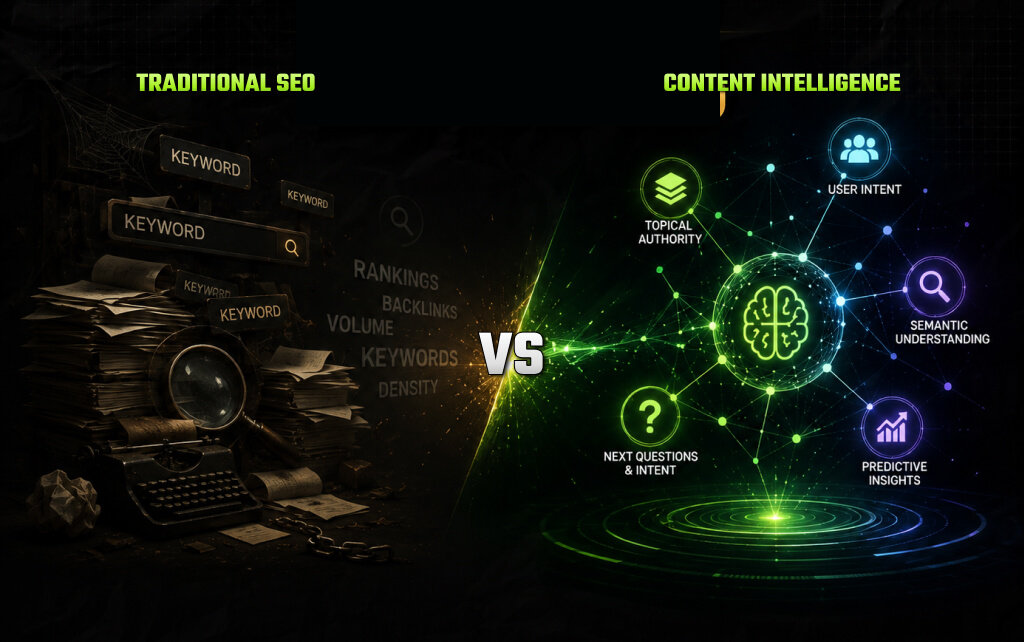
Shifting to an intelligence model changes how you value and execute digital content.
| Strategy Area | Traditional SEO | Content Intelligence (2026) |
|---|---|---|
| Main Metric | Keyword search volume and raw word count. | Topical breadth and entity relationships. |
| Workflow | Manual research using lagging third-party indexes. | Real-time predictive modeling of active search intent. |
| Editorial Goal | Writing long pages to match competitor lengths. | Delivering fast answers and unique data points. |
| Tracking | Checking keyword rankings after a traffic drop occurs. | Receiving automated alerts before your content decays. |
| Engine Target | Traditional spiders looking for text string matches. | Generative search models and semantic neural networks. |
The foundation of organic search has completely cracked.
For a long time, our playbook was simple. Frankly, I am sure that, like me, most of you have found a high-volume keyword with low competition. You wrote a long article. You built a few links, and then watched the traffic roll in.
In 2026, that playbook fails. Traditional search volume metrics are fractured. Users do not just type queries into a standard box anymore. They talk to conversational AI assistants. They use voice search. And they scroll through personalized feeds.
Search engines have evolved. Currently, they are no longer simple link directories. They are answer-delivery engines. They do not care how many times you mention a keyword phrase. Rather, they prioritize domains that own absolute topical authority.
Content intelligence bridges this gap.
Here’s what it does:
This lets you build a helpful site ecosystem that satisfies modern search algorithms.
If you want to build a modern marketing stack, start with these four core tools.
This is my top choice for deep semantic gap analysis. It scores your website against the entire web. It shows you exactly where your topical authority is weak.
I love this tool for real-time writing. The clean grading system updates as you type. It ensures you include all necessary entities before you hit publish.
I recommend this for fast, agile agencies. It excels at quick competitor research and layout mapping, keyword clustering, and automated internal link suggestions.
This is a fantastic option if you want to mix research with AI assistance. It scans the live results to build cohesive outlines and uncovers great user questions from forums.
I need to warn you about the dangers of using these platforms blindly. Relying too heavily on automated scores can actually hurt your rankings.
Content intelligence software builds recommendations by looking at pages that already rank on page one. If you only follow the tool, you will write the exact same thing as everyone else.
You create an echo chamber. If your article contains zero new information, Google’s systems will notice. They may flag your content as low-value duplication, no matter how high your tool score is.
I see writers fall into this trap all the time. They obsess over hitting a perfect “100” optimization grade in their software.
This leads to forced phrasing. The text sounds robotic. The writer ruins the user experience just to satisfy an algorithm.
Remember, the software score is a guide, not a law. If a tool tells you to insert a weird phrase five times, ignore it. Always protect your reader’s experience over a software grade.
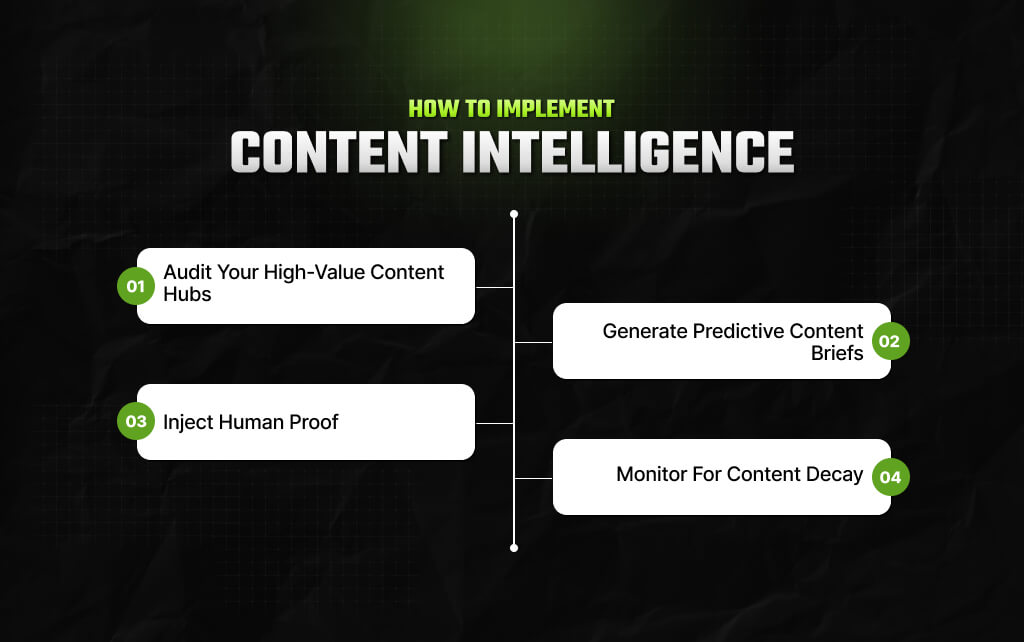
Ready to upgrade your workflow? To start, follow this simple, step-by-step rollout plan that I use for my own digital projects.
First, run your top 20 traffic-producing URLs through an intelligence audit. Specifically, look for missing entities or old sections that have decayed over the past year. Consequently, patching these structural gaps can trigger a quick ranking recovery.
Next, never assign a new topic to a writer without a data-backed brief. Instead, lock down the required headings, target entities, and intent formats up front. Ultimately, this proactive step saves you hours of developmental editing later.
Once the brief is ready, hand that technical blueprint to an expert writer. Then, tell them to follow the layout and include the semantic terms, but simultaneously demand real stories.
For example, as part of your content strategy, have them include original data, unique experiments, and personal insights to satisfy human audience needs. [Source: Backlinko]
Finally, set up automatic tracking alerts for your most profitable pages. Therefore, the exact moment a tool shows that your topical score is falling below the current market average, you can schedule a quick update before losing your search position.
Understanding who should use content intelligence as a part of your strategy to grow your site is extremely important. And that’s especially true if you operate in a rather hyper-competitive space where generic content goes to die.
Consequently, content intelligence works best for:
Now, coming to the latter part – and probably the one that most of us are genuinely interested in knowing: How long does it take to see organic results?
TBH, the timeline depends on whether you are refreshing old data or building from scratch. For instance, if you optimize existing content, you can typically see ranking improvements within 2 to 4 weeks.
On the other hand, new articles written from predictive briefs usually take 3 to 6 months to establish real authority.
Barsha is a seasoned digital marketing writer with a focus on SEO, content marketing, and conversion-driven copy. With 8+ years of experience in crafting high-performing content for startups, agencies, and established brands, Barsha brings strategic insight and storytelling together to drive online growth. When not writing, Barsha spends time obsessing over conspiracy theories, the latest Google algorithm changes, and content trends.
View all Posts