The Ultimate Guide To Competitor Backlink Analysis: An Actionable SEO Blueprint To Steal Your Rivals’ Traffic
Oct 23, 2026
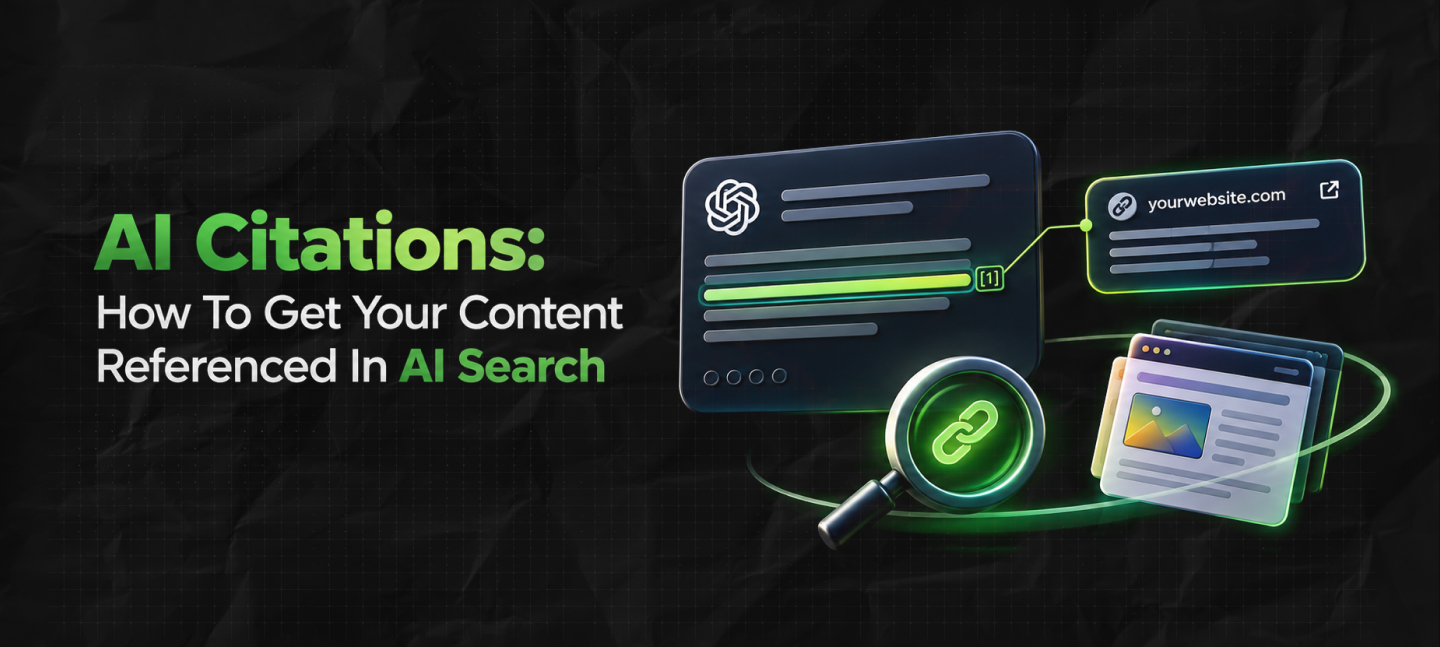

Getting mentioned by an AI system is not the same as getting cited by one.
A brand might appear in an AI-generated answer because the model already knows about it. Another brand might appear with a link to its website or a third-party source supporting the claim.
That second outcome is an AI citation.
And as search moves from lists of links toward generated answers, citations are becoming an important part of search visibility.
But there is a common misunderstanding around them.
You cannot simply “optimize a page for citations” in the same way you optimize a title tag for a keyword.
AI citations depend on several things happening together. The system must find your information, understand it, consider it useful, and decide that your source supports the answer.
That makes AI citations less about chasing a ranking position and more about becoming a source worth referencing.
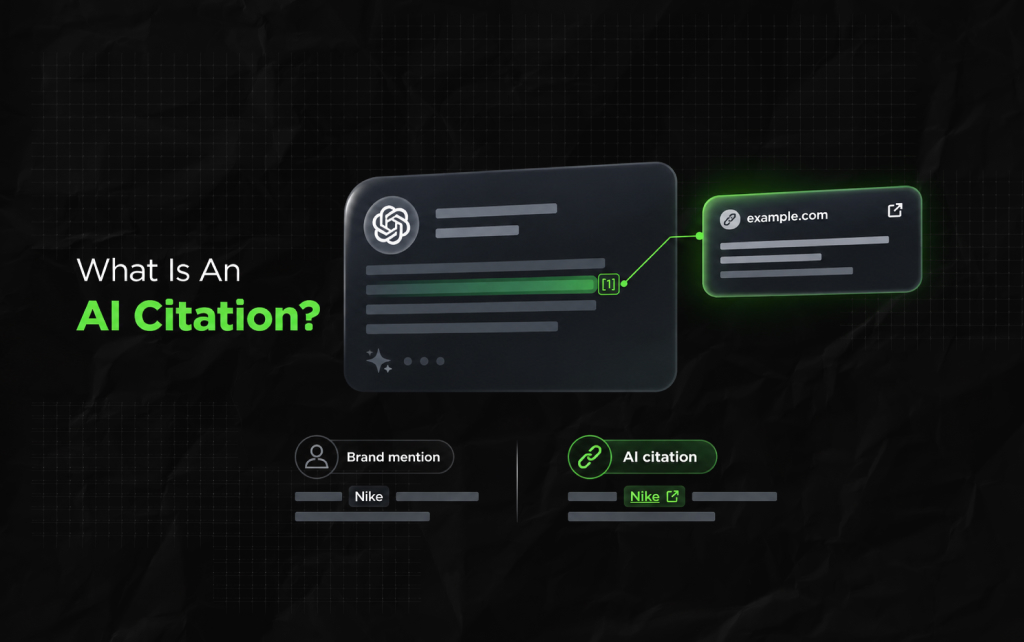
An AI citation is a reference to a source used to support information in an AI-generated answer.
Depending on the platform, the citation may appear as:
The exact format varies by AI search product. The underlying idea is the same: The AI system is telling the user, “This information came from here.”
That creates an important distinction between a brand mention and a citation.
So, suppose someone asks an AI assistant, “What are some good link-building platforms for agencies?”
The assistant might answer, “Blogger Outreach is a platform that helps agencies find publisher placements.”
That is a brand mention.
As a result, if the answer links to a Blogger Outreach page supporting that description, it becomes a citation.
The second is generally more valuable because the user can inspect the underlying source. Also, it tells you something about how the AI system understands your website.
Traditional search gives you a relatively visible measurement.
You rank at position three. You rank in the featured snippet. Also, you appear in the local pack. But AI search is different.
A user may ask a question and receive a complete answer without seeing a traditional ranking page.
Similarly, your website could contribute to that answer even if the user never sees your homepage in a conventional SERP.
A citation gives you another form of visibility.
It can:
But citations are not automatically valuable.
A citation from a weak or irrelevant page may not do much for your brand. And tbh, the context of the citation matters.
This is where AI citations differ from traditional link building.
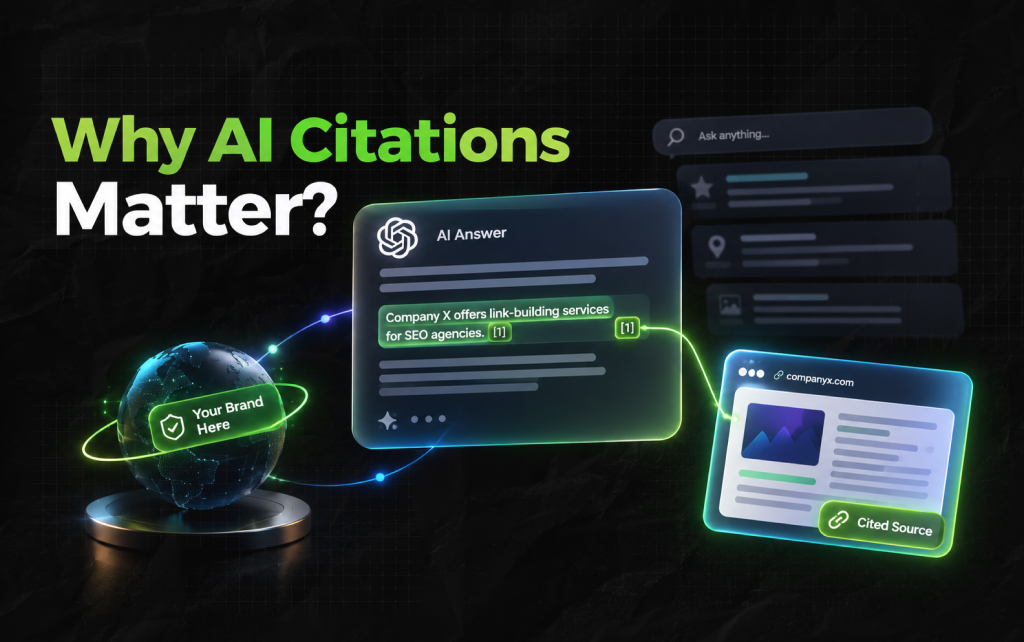
A backlink generally points from one URL to another. An AI citation has a relationship with a specific statement.
So, imagine an AI answer says, “Company X offers link-building services for SEO agencies.” The cited page should ideally support that exact claim.
Now imagine the citation points to an unrelated company blog post about SEO trends.
The link exists, but the relationship is weak.
This is why marketers should stop thinking about citations as simply “getting links into AI answers.”
The better question is: Which claims about my brand can reliable sources support? That changes the entire strategy.
There is no universal AI citation score.
Different systems retrieve and evaluate information differently. So avoid anyone promising a guaranteed formula such as, “add these five keywords and AI will cite your page.”
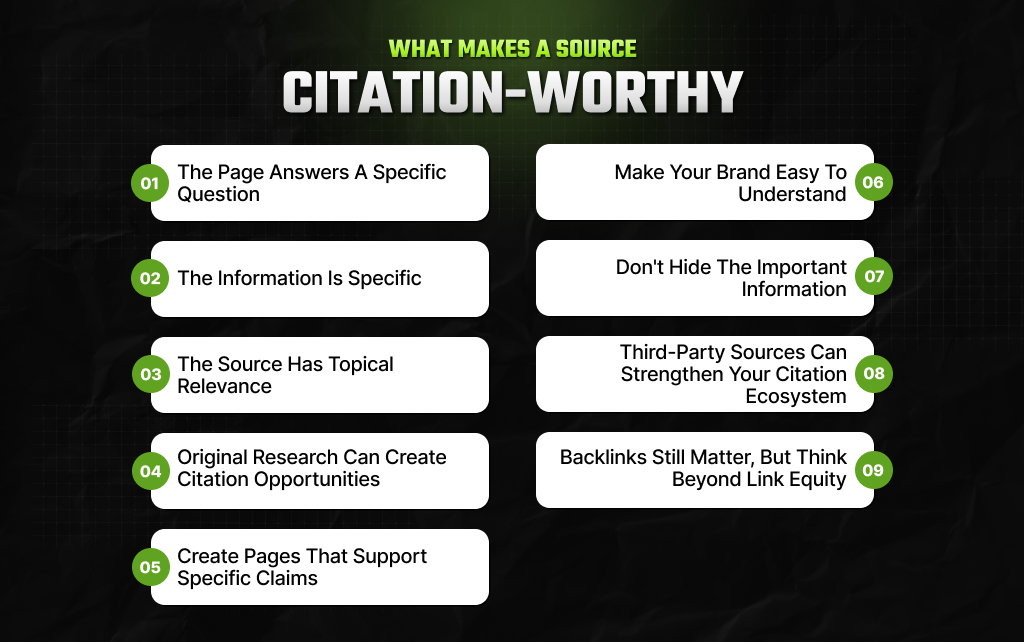
There is no reliable shortcut like that. However, some characteristics consistently make content more useful as a source.
AI systems need information they can use.
A page that directly explains how something works is easier to use than a page filled with vague marketing language.
So, compare “We deliver innovative digital solutions that transform online growth,” with “Our platform lets agencies purchase editorial placements from a network of publisher websites.”
The second statement contains concrete information. It actually gives an AI system something it can use for real.
Generic claims are difficult to distinguish from thousands of similar pages. Specific information is different.
For example:
These provide useful evidence rather than recycled explanations.
A page about financial regulations is more useful for a financial question than a generic lifestyle blog.
A developer’s documentation is more useful for a technical implementation question than an unrelated marketing article.
Relevance matters.
Also, getting cited by a page that has nothing to do with your subject is not a strong authority signal simply because the domain happens to be popular.
One of the strongest ways to earn citations is to publish information other websites do not already have.
So, think about what journalists, marketers, researchers, and other content creators need.
They often need:
If you publish those first, other sources have a reason to reference you. That creates a wider ecosystem around your information.
For example, instead of publishing “What Is Link Building?”, a link-building company could publish “We Analyzed 10,000 Outreach Placements. Here Are the Patterns We Found.”
The second piece creates an original source.
Other articles can reference the findings. But AI systems can potentially retrieve those findings when answering related questions.
That is a much stronger citation strategy than publishing another generic definition.
A common mistake is trying to make one giant article answer everything. That can make information difficult to locate.
Instead, create focused pages around important subjects. For example, a software company might have separate pages for:
Now each page has a clear informational purpose.
As a result, if an AI system needs information about pricing, the pricing page is an obvious source.
However, if it needs technical information, the documentation is more relevant. Clear information architecture makes your knowledge easier to retrieve.
AI systems need to establish what entities are connected to one another. Your website should therefore make basic relationships obvious.
For a company, explain: Who you are → what you sell → who you serve → what you specialize in → how you differ.
Don’t make users or machines piece this together from scattered marketing copy.
Also, your About page, homepage, product pages, documentation, and external profiles should tell a broadly consistent story.
This becomes particularly important when your company has a name that could be confused with another entity.
AI systems cannot reliably cite information they cannot access or identify. As a result, you need to put important facts in actual page content.
Do not bury everything inside images. Do not rely entirely on interactive widgets. Also, do not make basic product information impossible to find without multiple clicks.
If your company has a unique statistic, explain it in text. Similarly, if you have a specific certification, name it.
The information should be accessible before you worry about optimizing it.
Your own website is not the only place that matters. AI systems can encounter information about your brand across the wider web.
That includes:
This creates an important distinction.
You are not only trying to make your website authoritative. Instead, you are trying to make your brand’s information ecosystem credible.
As a result, if five independent sources describe your company consistently, that can provide much more context than your homepage repeating the same claim five times.
AI citations do not make backlinks irrelevant.
Links can still help search engines discover pages and understand relationships between websites.
Also, they can expose your brand to other information ecosystems.
But don’t reduce the strategy to getting more backlinks so that AI cites you. That is too simplistic.
A better approach is to earn references from sources that are relevant to your subject. For instance, a technical company should want technically relevant references.
Similarly, a financial brand should want credible financial sources.
And a marketing company should build relationships with respected marketing publications and practitioners.
The point? Relevance gives a link context.
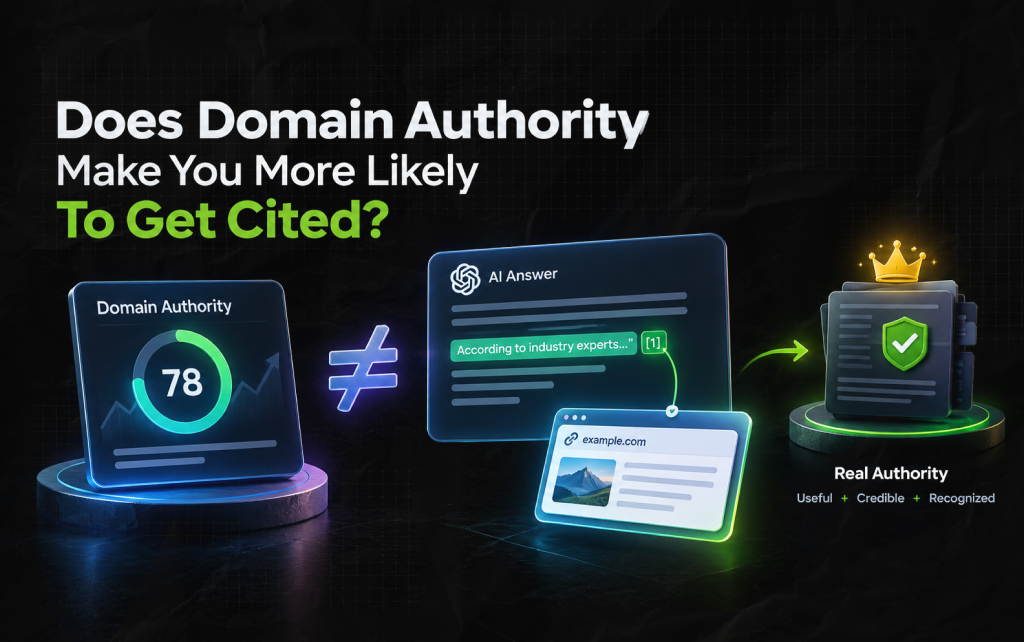
Not in any simple, universal way.
There is no publicly established “AI citation score” that works like Domain Authority. AI systems can use many signals when retrieving and evaluating information.
Those systems also differ from one another.
So chasing a third-party authority metric purely to increase AI citations misses the point. Instead, build sources that deserve to be referenced.
Authority should be an outcome of useful information and credible recognition, not the entire content strategy.
This is one of the most useful reasons to monitor AI citations.
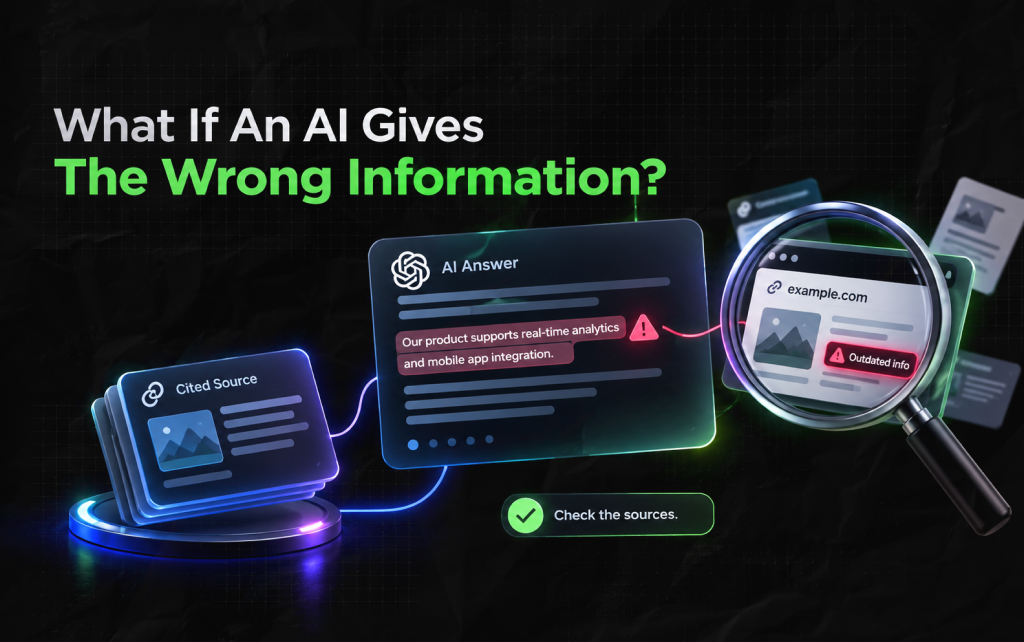
So, suppose an AI system says your product supports a feature that you do not offer. Or it claims that your company serves a market you have never targeted.
Or it attributes someone else’s research to your company.
In that case, look at the cited sources first.
You can then address the actual source of confusion.
Simply publishing another promotional article saying “we are experts” will not fix an information problem.
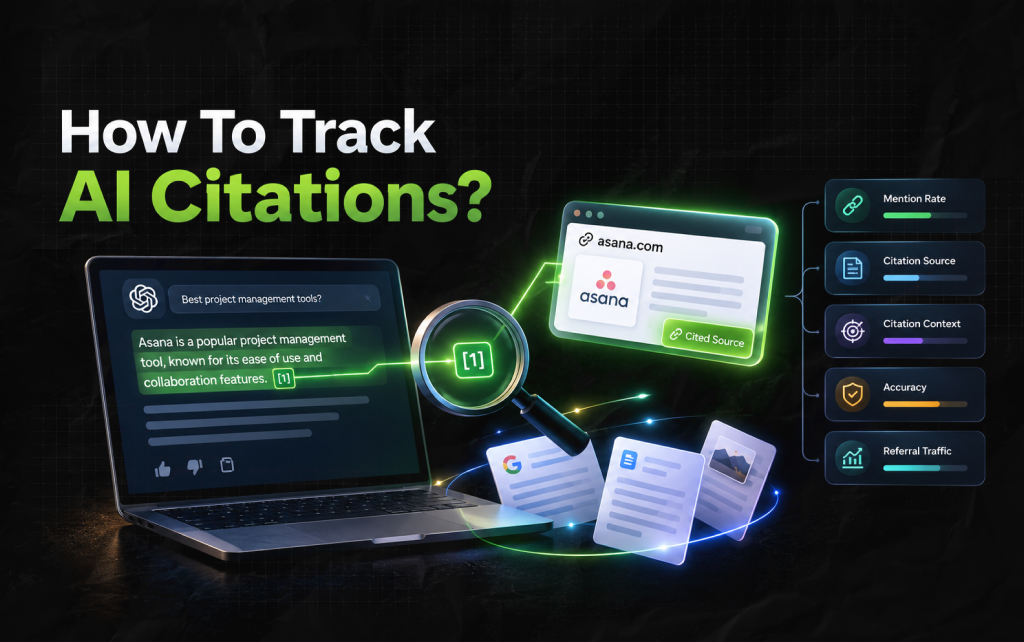
You need a measurement process. So, start by creating a list of realistic prompts. Then, divide them into categories.
Once you have created these prompts, record:
| Metric | What to track |
|---|---|
| Mention rate | How often your brand appears |
| Citation rate | How often your site is cited |
| Citation source | Which page gets cited |
| Citation context | What claim the page supports |
| Accuracy | Whether the description is correct |
| Competitor visibility | Which competitors appear |
| Referral traffic | Visits originating from AI platforms |
This gives you a much better picture than simply checking whether your company was mentioned.
Ten weak citations are not necessarily better than two strong ones. For instance, imagine your company receives citations for:
Those citations may have little commercial value.
Now imagine it receives citations for:
Those sources may support much more meaningful questions.
So add another metric: What kind of information is the AI using from us? That tells you whether your content strategy is working at the level that matters.
So, while the two are connected, they serve different purposes.
| Traditional backlink | AI citation |
|---|---|
| Links one website to another | Supports information in an AI answer |
| Often evaluated as part of a link graph | Appears in a specific answer context |
| Can pass referral traffic | Can generate referral traffic from AI interfaces |
| Helps discovery and authority signals | Helps establish the source behind an answer |
| Usually tied to a webpage relationship | Tied to a claim or piece of information |
The important takeaway is not that one replaces the other. Instead, it is that SEO now has another layer of source visibility to think about.
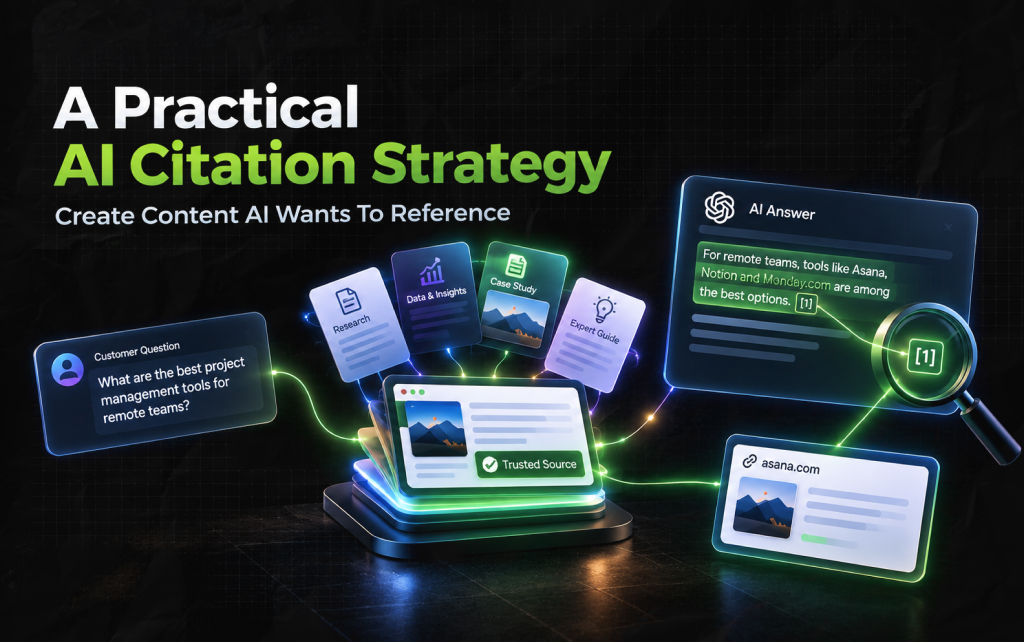
If you want to improve your chances of being cited, start with the fundamentals.
Step 1: Identify the questions that matter – find the questions your customers ask before buying. Don’t start with keywords. Instead, start with decisions.
Step 2: Find the information gaps. What does the current search landscape fail to explain well? And those gaps are opportunities.
Step 3: Publish original information. Also, add data, research, examples, experience, or analysis that other pages lack.
Step 4: Build focused source pages. While doing so, give important topics a clear home. And don’t scatter critical information across dozens of weak articles.
Step 5: Strengthen your external presence. So, earn relevant mentions and references from credible third-party sources.
Step 6: Keep facts current. How? Review pages whenever important business information changes.
Step 7: Test real AI prompts. For this, you need to use the questions your customers actually ask.
Step 8: Study the citations and look at which pages AI systems reference. Then create more content with the qualities those successful pages share.
That last step is where AI citation tracking becomes genuinely useful.
You are not trying to trick an AI system. Instead, you are learning what kind of information it finds useful enough to surface.
It is tempting to treat an AI citation as the new version of a Google ranking. But that misses the larger change.
Search engines traditionally answered, ‘Which pages should I show?’ But AI systems increasingly need to answer ‘Which information should I use to construct this answer?’
That makes source quality more important.
A page needs to do more than rank for a keyword. It needs to contain information worth using.
That is why original research, first-hand experience, clear explanations, credible references, and strong topical expertise matter so much in AI search.
The citation is simply the visible result.
Moreover, AI citations are not a new version of link building. Instead, they represent a shift in how visibility works.
Your content can now become part of an answer rather than simply appearing as a result beneath it.
Frankly, the future of AI search will not belong to the websites that publish the most content. It will belong to the sources that provide information worth citing.
Barsha is a seasoned digital marketing writer with a focus on SEO, content marketing, and conversion-driven copy. With 8+ years of experience in crafting high-performing content for startups, agencies, and established brands, Barsha brings strategic insight and storytelling together to drive online growth. When not writing, Barsha spends time obsessing over conspiracy theories, the latest Google algorithm changes, and content trends.
View all Posts

The Ultimate Guide To Competitor Backlink Ana...
Oct 23, 2026
How To Land High-Authority Editorial Backlink...
Oct 23, 2026
Why Your Website Traffic Dropped Suddenly And...
Oct 23, 2026
How Do The Physical Google Review Tools Redef...
Oct 23, 2026
How To Get Your Brand Cited In AI Search Resu...
Oct 22, 2026