SEO Dashboard: What To Track, What To Ignore, And How To Make It Useful
Sep 25, 2026
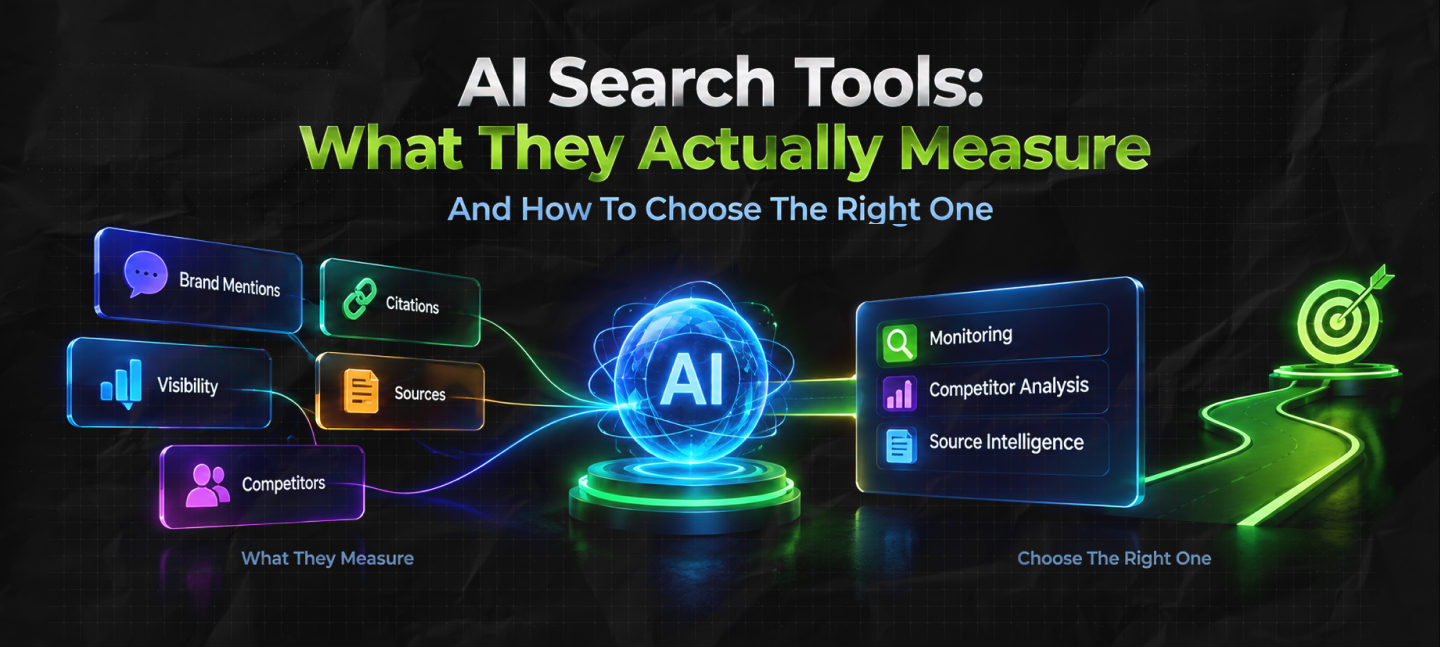

AI search has created a new measurement problem for marketers.
Traditional SEO gives you familiar numbers. As a result, you can easily track rankings, impressions, clicks, organic traffic, and backlinks. If your page moves from position 14 to position 6, you can see the change.
But AI search is different.
So, a user may ask a question and receive a generated answer instead of a conventional list of ten blue links.
Your brand might be mentioned, cited, recommended, compared with competitors, or ignored entirely.
That creates a new set of questions:
This is where AI search tools come in. But the category is still developing, and not every tool measures the same thing.
The important question is therefore not simply which AI search tool has the longest feature list.
Instead, it is: What are you trying to understand about your visibility in AI search? On that note, today, I’ll break down AI search tools and their relevance in the present search landscape.
More importantly, I’ll highlight what these tools actually measure and how you can choose the right one.
Stay tuned.
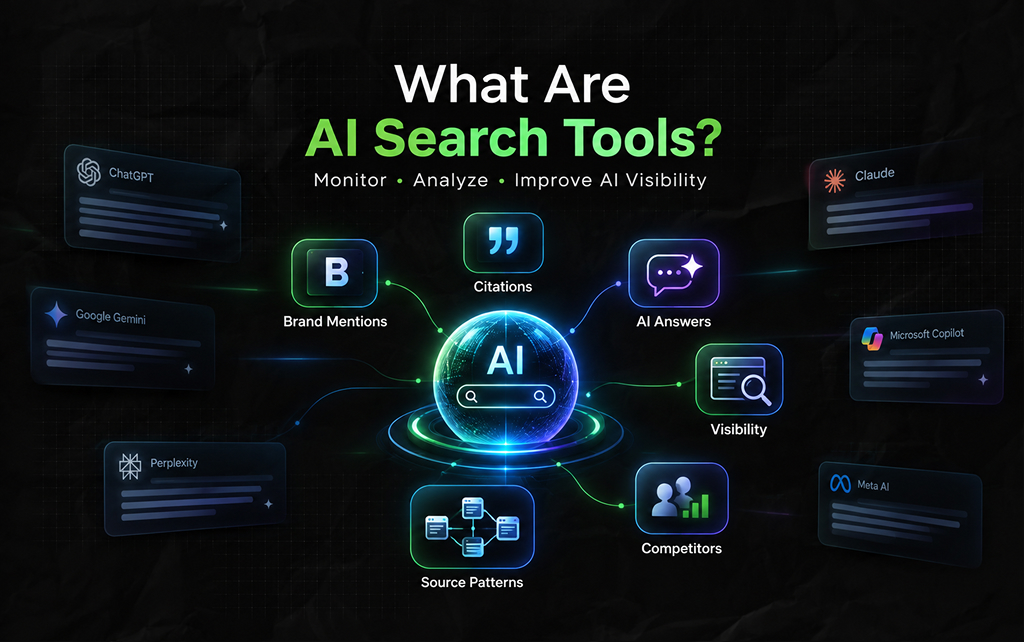
AI search tools help marketers monitor, analyze, or improve how brands and content appear in AI-powered search experiences.
Depending on the platform, they may track things such as:
Some tools focus mainly on monitoring. Others help with research and optimization. And some combine AI-search tracking with traditional SEO data.
These differences matter because there is no single standard measurement for AI visibility yet.
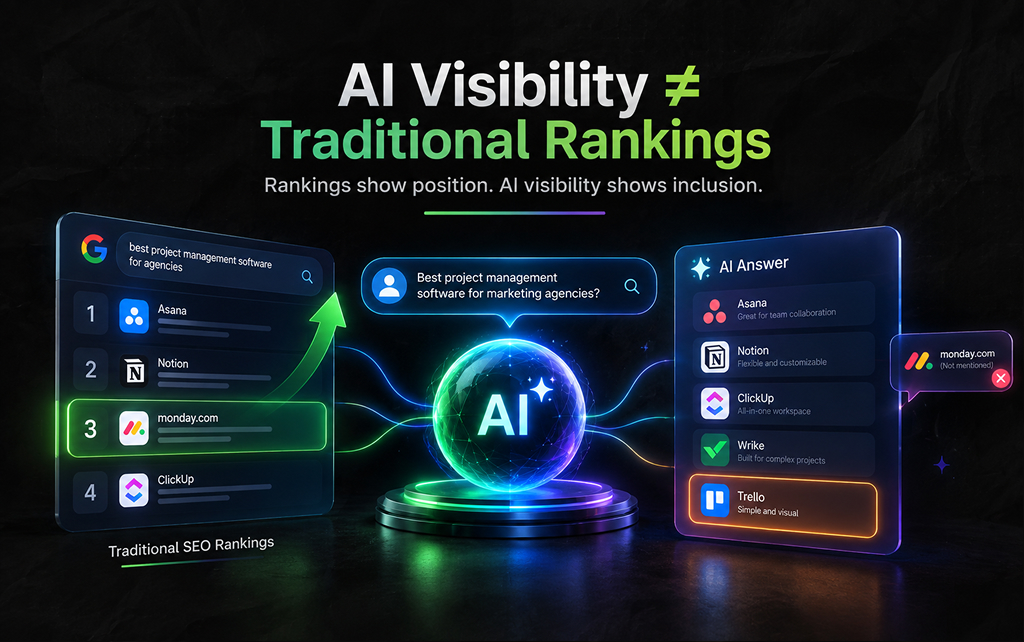
This is the first concept to understand.
Traditional SEO asks: Where does my page rank for this keyword? But AI search can require a different question: Does my brand become part of the answer when someone asks about this topic?
Now, imagine a company ranking #3 for ‘best project management software for agencies.’ A user asks an AI search engine: What project management software works well for marketing agencies?
The generated answer may mention five products. However, the company ranking #3 in Google might not appear.
Another company ranking lower in traditional search might be included because the AI system found stronger evidence connecting it with the specific question.
The two forms of visibility can overlap. They do not have to. And that is why AI search tools should not simply be treated as new rank trackers.
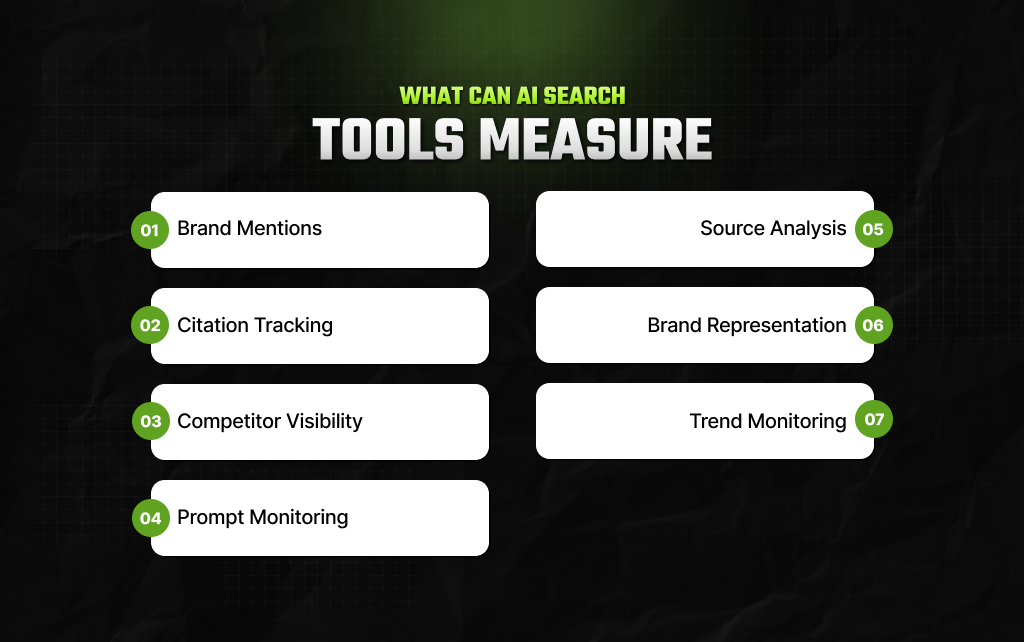
So, to be honest, the exact capabilities vary, but most tools fall into a few broad categories.
Does the AI system mention your company when users ask relevant questions? This is the most basic measurement.
Which websites or pages are cited or referenced when your brand appears? This can help reveal the information sources surrounding an AI-generated answer.
How often do competitors appear in the same prompt set? This gives you a comparative view of AI visibility.
Which questions are you tracking? This is important because AI visibility depends heavily on the query.
Which publications, websites, research papers, and other sources appear repeatedly in answers? This can reveal patterns that traditional backlink analysis may miss.
How does the AI system describe your company? A brand may be mentioned but described incorrectly, incompletely, or without its most important differentiators.
Does your visibility change over time? Repeated measurements can help identify movement rather than relying on one-off AI answers.
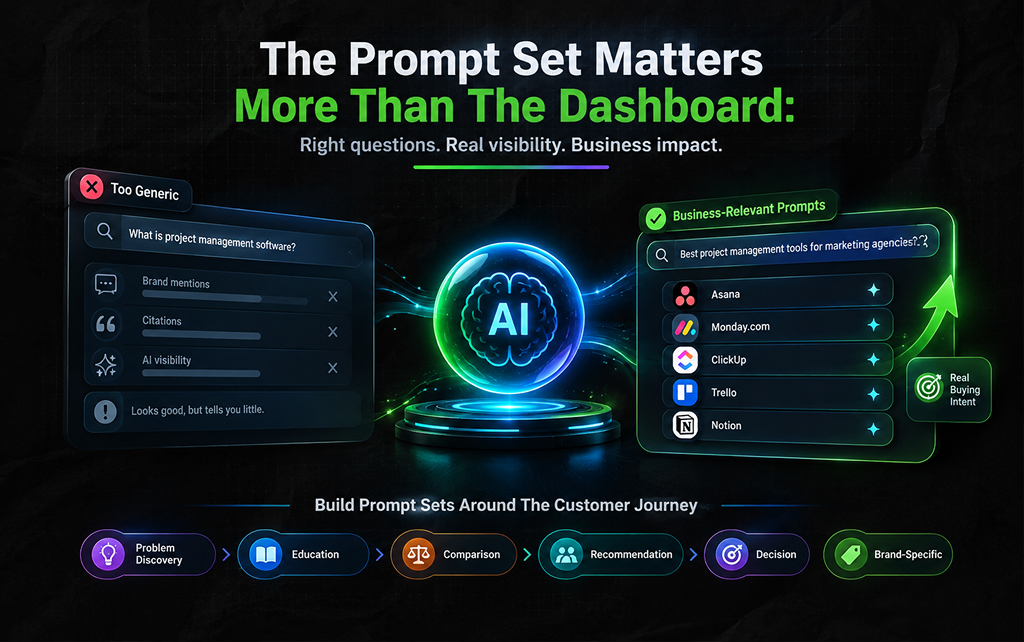
An AI visibility report can look impressive while measuring the wrong questions. So, suppose a company tracks: What is project management software?
Its brand may never appear. And that tells you very little. Now compare it with commercially relevant prompts:
These questions are closer to real buying decisions.
Also, your AI search strategy should therefore begin with the questions that matter to the business. The tool comes second.
A useful prompt library should not contain only product-related questions. So, think about the different stages of discovery.
This gives you a more realistic view of how AI systems represent your brand across the buying journey.
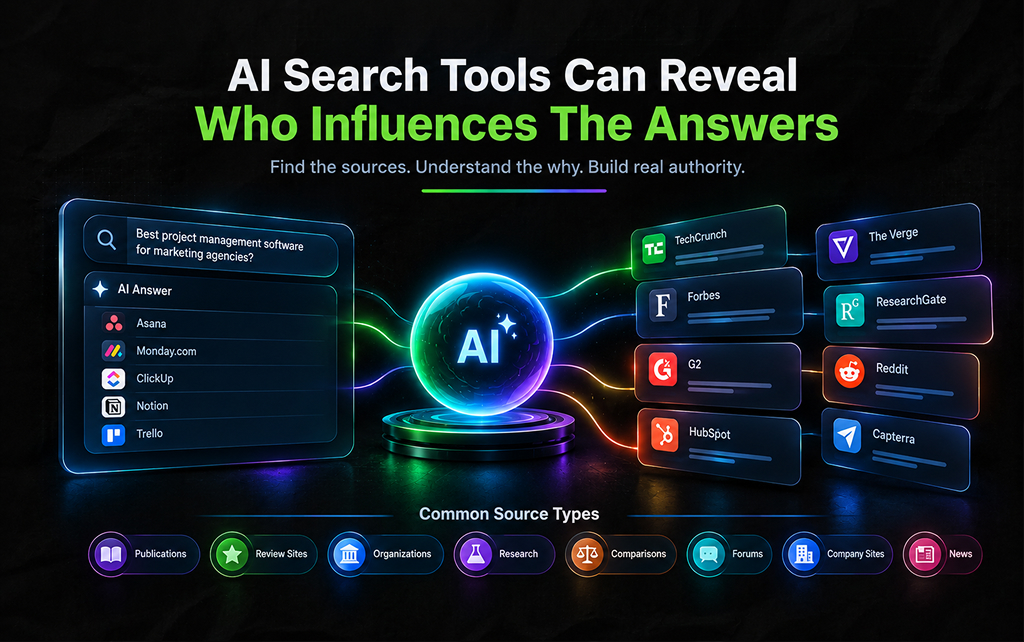
One of the most interesting uses of these tools is source analysis.
So, suppose you run 100 relevant prompts and discover that the same 15 websites repeatedly appear as cited sources.
That is useful information. Those websites may include:
Moreover, you can then investigate why those sources are being used.
Perhaps one publication has a comprehensive comparison article. Another publishes original research. Another has detailed product reviews.
This gives you a different way to think about digital authority. You are no longer asking only, “Who links to my competitors?”
Instead, you are asking, “which sources appear to shape the information around my category?”
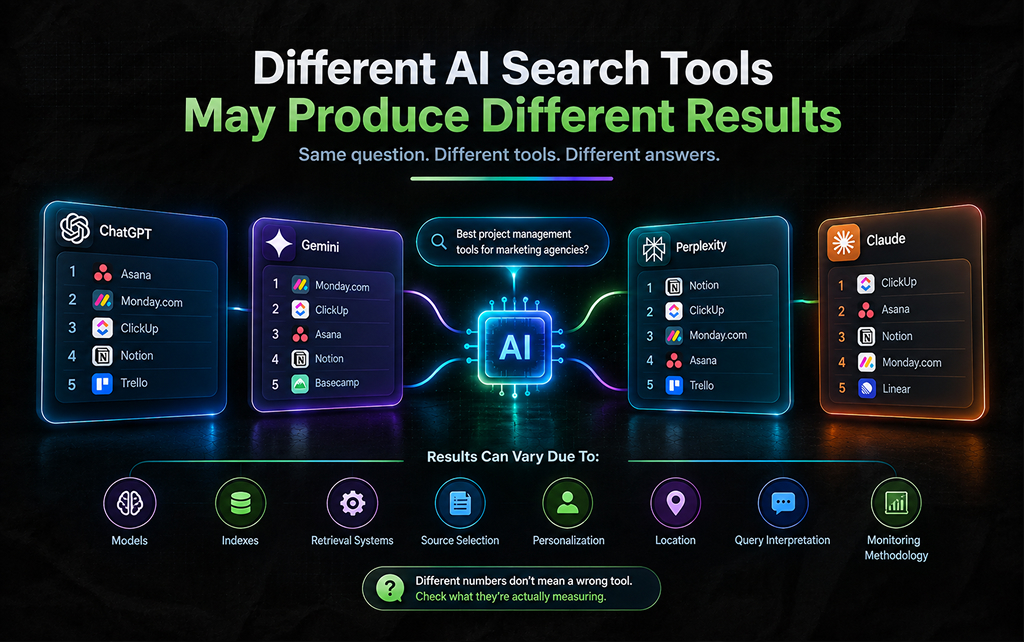
This is not necessarily a sign that one tool is broken. AI systems can generate different answers to the same question.
Moreover, they may use different models, search indexes, retrieval systems, source selections, personalization, locations, or query interpretations.
Also, a monitoring platform may also use its own methodology for running prompts and calculating visibility.
So if two tools report different numbers, do not immediately ask “Which one is correct?” First ask “Are they measuring the same thing?”
Also, consider checking the:
Remember, measurement methodology matters.
This distinction is easy to miss.
Some platforms mainly tell you what is happening. Others recommend what to do next. For starters, a monitoring tool might show “your brand appeared in 38 of 100 prompts.”
In contrast, an optimization-oriented platform might go further to show “Competitors are repeatedly cited from these publications, while your brand has limited representation across those sources.”
The second insight is more actionable. But it also depends more heavily on the quality of the analysis behind the recommendation.
The best tool depends on whether your immediate need is: measurement, diagnosis, research, or action.
Instead of comparing dozens of feature lists, classify tools by their primary job.
| Tool category | Main question |
|---|---|
| AI visibility monitoring | Where does my brand appear? |
| Citation tracking | Which sources support AI answers? |
| Competitor analysis | How does my visibility compare? |
| Prompt research | What questions produce relevant answers? |
| Source intelligence | Which websites influence my category? |
| Content optimization | What information is missing or weak? |
| Technical analysis | Can AI systems access and understand my content? |
Some platforms cover several categories. But identifying the primary job makes evaluation much easier.
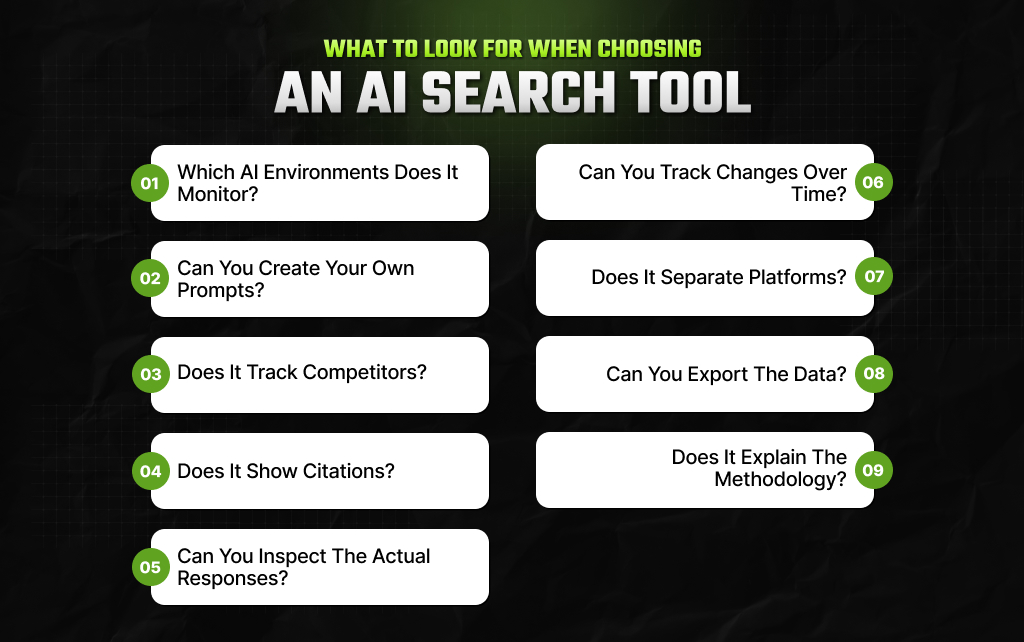
Do not start with the number of features. Instead, start with methodology.
1. Which AI environments does it monitor? A tool that tracks only one AI platform may give you a narrow picture.
2. Can you create your own prompts? Predefined queries are useful for benchmarking. Also, custom prompts are essential for understanding your actual market.
3. Does it track competitors? You need context. Moreover, a 20% visibility rate means little without knowing how competitors perform against the same prompt set.
4. Does it show citations? Knowing that your brand appeared is useful. Also, knowing which sources influenced the answer is often more actionable.
5. Can you inspect the actual responses? Aggregated scores can hide important context. As a result, you should be able to see what the AI system actually said.
6. Can you track changes over time? One snapshot is not a strategy.
7. Does it separate platforms? Your visibility on one AI system may differ substantially from another.
8. Can you export the data? Your AI-search data should ideally connect with the rest of your SEO and marketing analysis.
9. Does it explain the methodology? A transparent measurement process is more useful than an impressive-looking score you cannot interpret.
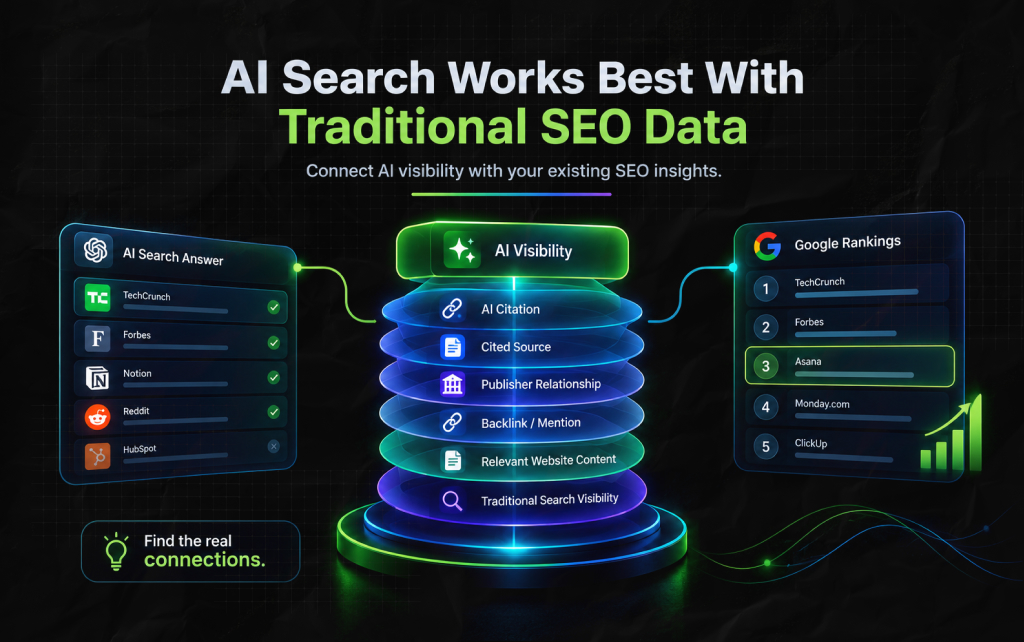
AI search should not become a separate marketing universe. The most useful analysis connects AI visibility with existing SEO data.
For example:
Prompt visibility
↓
AI citation
↓
Cited source
↓
Publisher relationship
↓
Backlink/mention
↓
Relevant website content
↓
Traditional search visibility
Now you can start seeing relationships between different forms of visibility.
Perhaps pages that attract strong backlinks also appear more frequently in AI citations. Perhaps certain publishers repeatedly influence AI answers.
And perhaps your competitors have strong traditional rankings but weak AI visibility. These are much more useful findings than isolated dashboards.
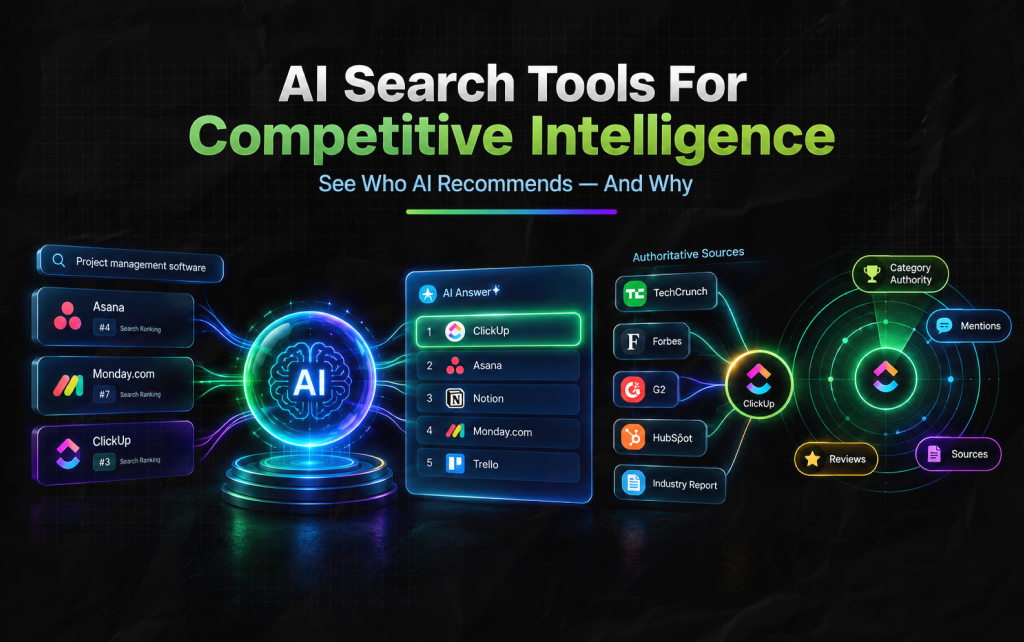
One of the strongest use cases is understanding competitors. So, it’s best to ask the same set of questions across your market.
Then compare:
You may discover something that traditional keyword research never showed.
For example, a competitor might have modest search rankings but strong visibility in AI-generated recommendations because many authoritative sources describe the company in a particular category.
That becomes a clue. You can investigate how that association was built.
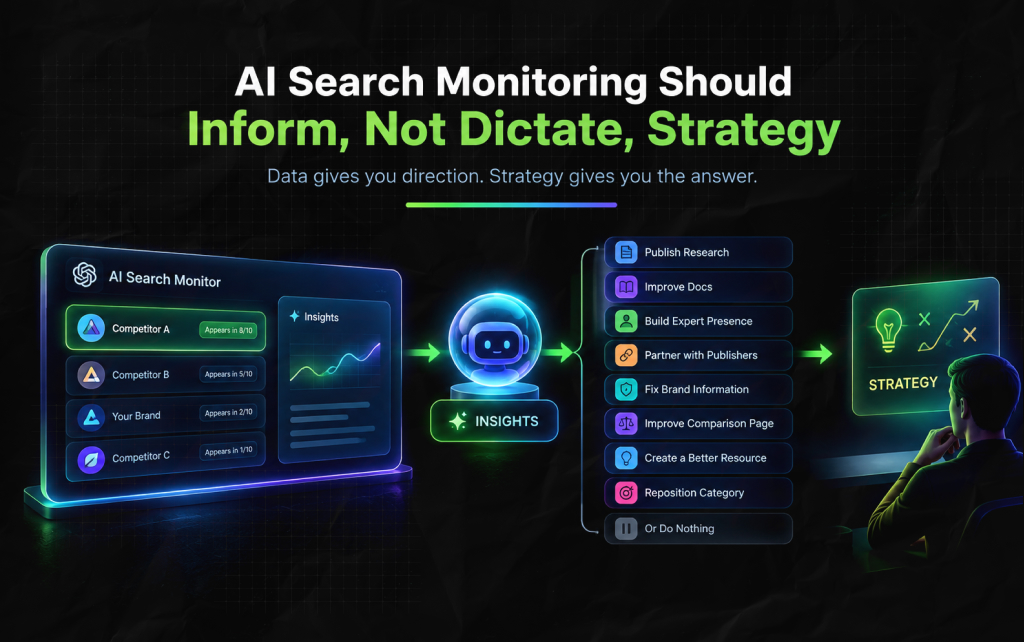
An AI search tool can tell you that a competitor appears in more answers. It cannot automatically tell you the correct response.
The answer might be:
Sometimes the right response may even be to do nothing. A dashboard is useful when it improves decisions. But it is not useful when every movement creates a new SEO task.
The AI-search software market is moving quickly.
New platforms will appear. Existing platforms will add features. And measurement methods will change. That makes feature-based buying difficult.
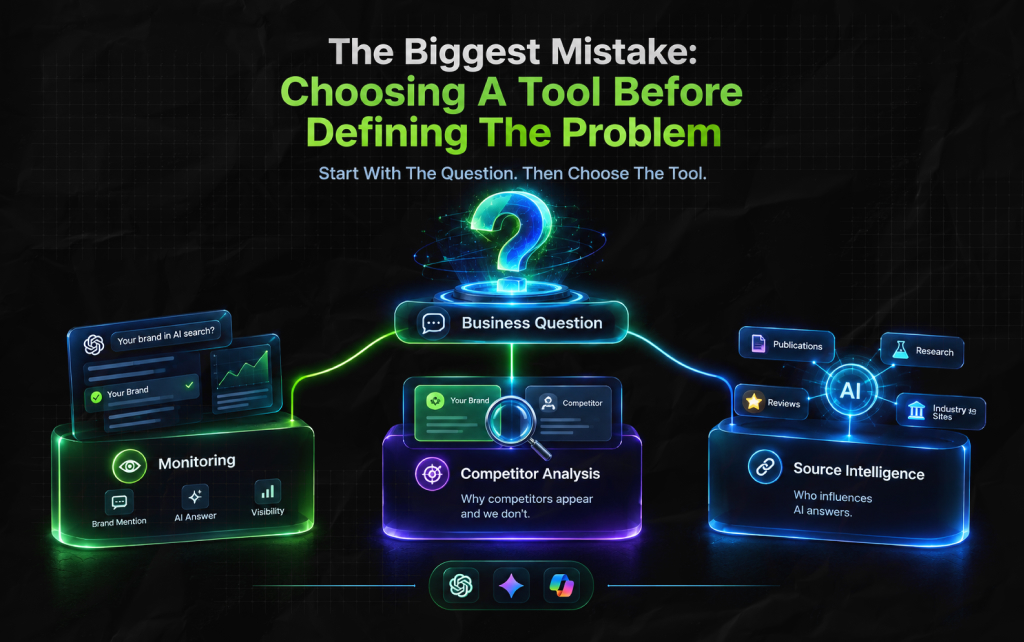
As a result, a better approach is to define the questions first.
So, if your question is “are customers seeing our brand in AI search?” you need monitoring.
But if your question is “why does our competitor appear but we don’t?” then you need competitor and citation analysis.
In contrast, if your question is “which publishers influence AI answers in our category?” you need source intelligence.
The tool should fit the question. Not the other way around.
AI search tools are becoming an important part of modern SEO because search visibility is no longer limited to traditional rankings.
But the category is still developing, and the tools measure different things.
Moreover, the useful ones are not necessarily the platforms with the biggest dashboards or the most impressive visibility scores.
They are the ones that help answer practical questions:
That makes AI search tools more than monitoring software.
As a result, when used properly, they become a source of intelligence about how your brand is represented across an increasingly complex search environment.
And that is the real shift in SEO for AI search: from tracking where a page ranks to understanding whether your brand is present in the answers that matter.
Barsha is a seasoned digital marketing writer with a focus on SEO, content marketing, and conversion-driven copy. With 8+ years of experience in crafting high-performing content for startups, agencies, and established brands, Barsha brings strategic insight and storytelling together to drive online growth. When not writing, Barsha spends time obsessing over conspiracy theories, the latest Google algorithm changes, and content trends.
View all Posts

SEO Dashboard: What To Track, What To Ignore,...
Sep 25, 2026
Analytics SEO: How To Turn Search Data Into B...
Sep 25, 2026
FAQ Schema: When It Still Makes Sense And Whe...
Sep 25, 2026
The Keyword With 10 Searches That Sent Ahrefs...
Sep 24, 2026
Paying Freelance Writers In Ten Countries: An...
Sep 24, 2026