The Traffic-to-Revenue Gap: Why More Website Visitors Don’t Always Create More Customers
Sep 17, 2026


The first organic search result on Google gets around 27.6% of the total clicks (source Backlinko).
So, if your page fails to appear at the top of the search results, then you won’t be able to steal any traffic. This is where rich snippets walk in to steal the show.
With the help of rich snippers, it is super easy to make your content visually stand out – you can feature the snipper with images, dates, prices, and stars, for example.
The point? To attract attention to your page, even if you fail to be on top of the search results.
Sounds fun, right? But what are these rich snippets – more importantly, how can you make the most of these snippets? Do rich snippets help SEO?
So here I am with my 8 years of experience in content marketing, SEO, and social media to help you out.
In my blog today, I will discuss rich snippets, with my primary focus on showing how you can implement them within your content for the best results.
Stay tuned.
Rich snippets are the standard fragments of any search engine – much like Google – that the search engine usually displays with its results:
Moreover, these snippets can go really overboard. How?
These search results primarily include structured information or additional visuals, such as dates, availability, prices, images, and star ratings.
So, it is interesting to see how these rich snippets can improve the relevance and presentation of your website to Google and other search engines.
Also, note that Google usually extracts all the supplementary information primarily via structured data added into HTML.
In addition, these snippets can help search results visually stand out in a crowd of normal results by making it so much more attractive to visitors.
Depending on your website’s content, there are different types of rich snippets that you can check out.
So, here are the most common types of snippets that you can implement:
Also, not all kinds of snippets will be relevant for all websites. The key here is to choose a snippet that fits the content for the same page.
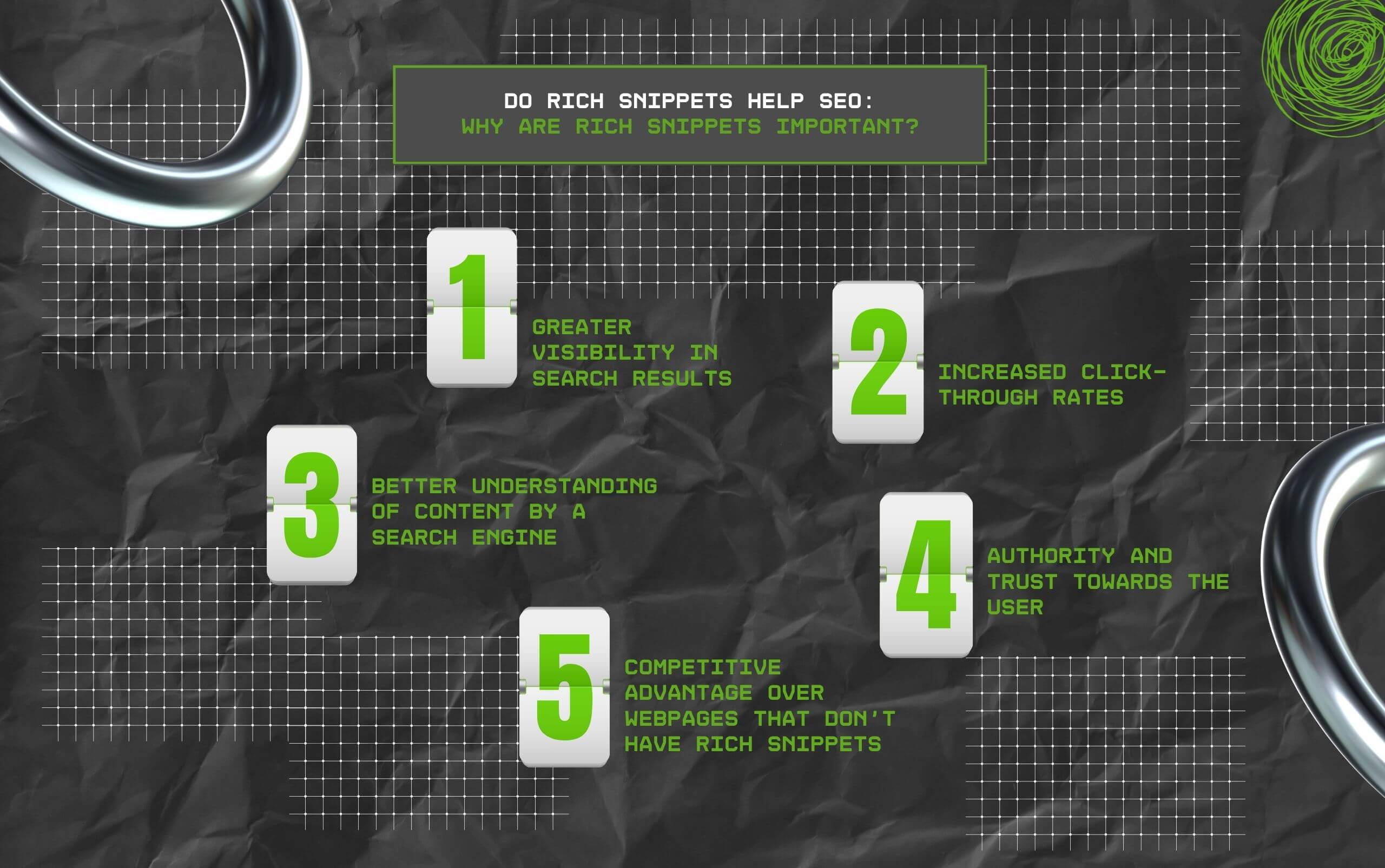
Incorporating rich snippets has its own set of advantages. So, I’ve done my best to dissect each one of them for you, especially in the context of SEO.
By adding contextual or visual elements such as images, prices, and stars, the result ends up becoming more appealing and eye-catching, compared to basic results.
When a search result stands out, its potential for receiving clicks increases.
As a result, adding rich snippets increases click-through rates, indicating to Google (or other search engines) that the web page is helpful and relevant.
This, in turn, can benefit the ranking of the page indirectly.
Structured data actually helps Google and other search engines to understand the content of a page so much better.
This, in turn, can help your content to appear in other valuable result formats.
Coming across specific information, including opening hours, prices, and ratings, right from the search results can increase trust and eliminate user uncertainty before visiting any page.
If your competitor is not using rich snippets and you are doing so, then your search results can easily stand out, attracting more visitors.
However, note that Google has issued a statement on how structured data isn’t a direct ranking parameter.
Rather, it is a sort of high-value but indirect ranking factor. Plus, it is much better than CTR, considering it offers excellent semantic interpretation.
So, you want Google to feature your rich snippets from your web pages? That’s great – and with my help, you will know how to implement rich snippets smoothly.
Of course, I can’t guarantee 100% success, but I can show you how to implement these snippets accurately – and that is your first requirement.
Structured data are annotations within your webpage that indicate what each element is all about – is it a product, a rating, or a recipe?
Google and even other search engines read the semantics to generate helpful results.
Moreover, the most common standard vocabulary that you can use for structured data is called Schema.org.
This defines the properties and classness that you can use, such as recipe, review, or product.
Google and other search engines can read that semantics and use it to generate rich results.

To add the structured data, there are different acceptable formats:
This format, often recommended by search engines including Google, separates the actual data from any visual HTML. Also, it is so much more flexible to incorporate.
You can insert this format into HTML directly, wrapping aspects with special attributes like itemscope, itemprop, etc.
This is a much more complex format that is less common in its basic implementation, which allows easy integration with different categories.
Additionally, in several cases, I recommend using JSON-LD since it decreases the risk of mistakes and technical errors. Why? Because it separates data from the content’s visual markup.
So if you want to optimize your chances of becoming successful after incorporating rich snippets, then I have some tips for you to check out.
Of course, rich snippets aren’t a ranking factor – at least directly. But do rich snippets help SEO? Yes! Their impact on your overall SEO strategy is undeniable.
Incorporating these snippets accurately can make a lot of difference between not getting enough attention and getting traffic from your target audience.
First, they boost the visibility of your page. A result with additional information like images, prices, or ratings stands out visually amidst a sea of blogs.
This, in turn, increases the potential for clicks, even when you are not sitting on top.
In addition, by accurately incorporating structured markup, users can actually help Google and other search engines better understand their content.
This, in turn, improves the users’ ranking on SERPs, helping them appear in other spaces within the search engine, such as carousels, featured snippets, or knowledge panels.
Also, rich snippets can reinforce the authority and credibility of your brand.
So, when you display verified information such as up-to-date prices and real reviews, it conveys credibility to users, increasing the chance of conversion once they visit your website.
Also, it contributed to an overall better UX since people can easily find information – more importantly, the information they have been looking for.
And Google only rewards websites that offer a structured, clear, and useful experience.
Barsha is a seasoned digital marketing writer with a focus on SEO, content marketing, and conversion-driven copy. With 8+ years of experience in crafting high-performing content for startups, agencies, and established brands, Barsha brings strategic insight and storytelling together to drive online growth. When not writing, Barsha spends time obsessing over conspiracy theories, the latest Google algorithm changes, and content trends.
View all Posts

The Traffic-to-Revenue Gap: Why More Website ...
Sep 17, 2026
The Volatility Trap: What Crypto Position Siz...
Sep 17, 2026
Schema Markup: How To Use It Without Turning ...
Sep 17, 2026
Turn A Search Question Into A Watchable Expla...
Sep 16, 2026
Agency Guide To YouTube Growth: Wholesale Pri...
Sep 15, 2026